
 PossieChem
Why bromine is picky and chlorine isn't
Radical chlorination gives a product salad, radical bromination picks the tertiary C–H almost every time. The Hammond postulate explains why, with the numbers to prove it.
- How a radical chain reaction works (initiation, propagation, termination)
- Bond dissociation energies
- Reading an energy diagram
Take one alkane. Shine light on it in the presence of chlorine, and you get a product salad: a bit of everything. Do exactly the same with bromine, and you get one product and some crumbs. Same alkane, same light, same kind of radicals. So why does one halogen behave like a toddler in a sweet shop and the other like a sommelier?
The answer is one idea, the Hammond postulate, plus three numbers you can look up in any table of bond energies.
The experiment
Our victim is 2-methylbutane. It has four kinds of hydrogen: six on the two equivalent CH₃ groups attached to C2, one tertiary H on C2 itself, two secondary H on C3 and three on the CH₃ at the far end (C4). Replace any of them by a halogen and you get four different products.
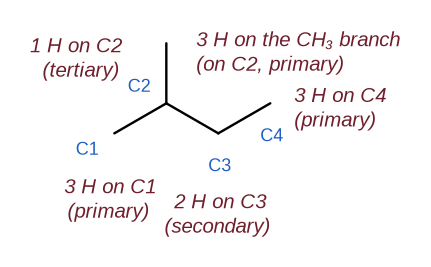
| Product (X = Cl or Br) | C–H that reacted | With Cl₂, hν | With Br₂, hν |
|---|---|---|---|
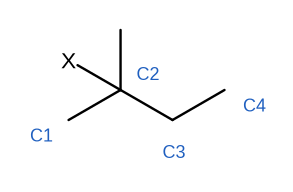 2-halo-2-methylbutane |
3° (1 H) | 22 % | 92.2 % |
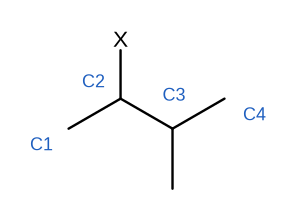 2-halo-3-methylbutane |
2° (2 H) | 33 % | 7.4 % |
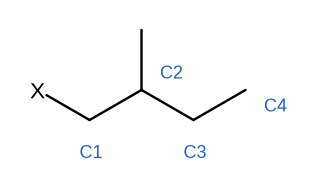 1-halo-2-methylbutane |
1° (6 H) | 30 % | 0.3 % |
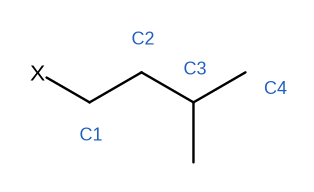 1-halo-3-methylbutane |
1° (3 H) | 15 % | 0.1 % |
Two questions. Why is there a product distribution at all? And why is it so wildly different for chlorine and bromine?
Statistics explains a little
For chlorine you can get some of the way with counting. The two CH₃ groups on C2 carry six hydrogens, the lonely CH₃ at the other end carries three, so the product from the first is twice as abundant as from the second: 30 % against 15 %. So far so good.
But counting falls apart at the tertiary hydrogen. It is 1 hydrogen out of 12, so statistics alone predicts about 8 %. We find 22 %. And for bromine, statistics is not even in the room: 92 % from a single hydrogen.
So divide each yield by the number of hydrogens that lead to it. Then divide everything by the value for the primary hydrogens (nine of them), so that a primary H counts as 1. For bromine: the primary products add up to 0.4 %, over 9 H, which is 0.044 % per H. The secondary H gives 7.4 % over 2 H, so 3.7 % per H, and the tertiary H gives 92.2 % over 1 H, so 92.2 % per H. Divide all three by 0.044 and you get the ratio below. For chlorine the primaries give 45 % over 9 H, so 5 % per H, against 16.5 % and 22 %, and dividing by 5 gives its ratio. That is the reactivity per hydrogen, relative to a primary H:
The bromine primaries are tiny and rounded (0.3 % and 0.1 %), so the last number is only good to about 10 %: read it as about 2000.
Chlorine is fast and sloppy, bromine is slow and picky. A tertiary C–H is about 4 times as reactive as a primary one towards Cl•, and about 2000 times towards Br•.
The mechanism, step by step
Every number in that table comes from the same radical chain. Here it is with bromine, on 2-methylbutane itself, for the tertiary C–H on C2. A fishhook arrow is one electron moving; a full arrow would be two.
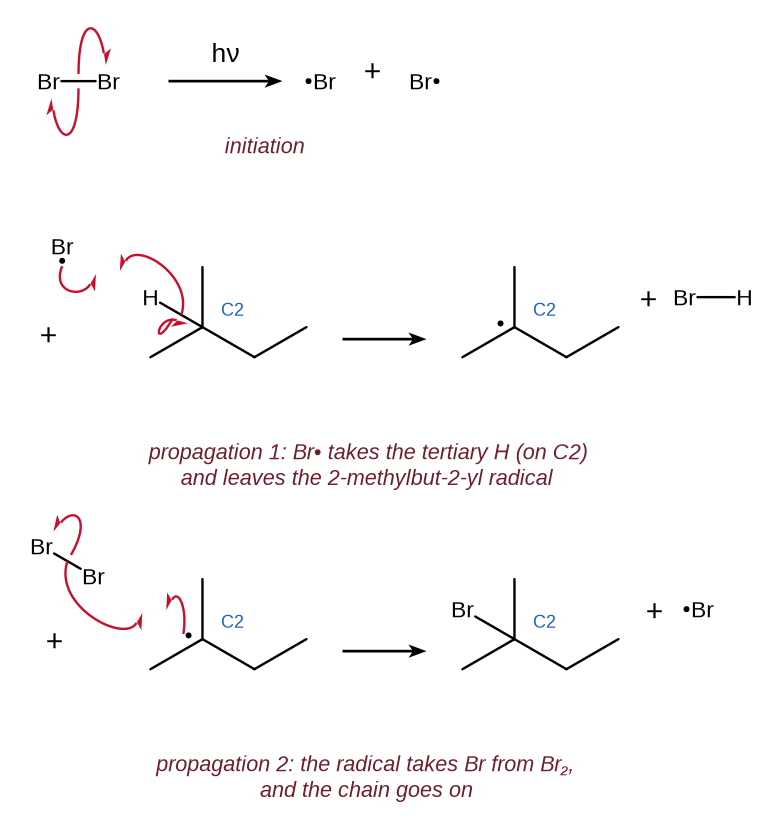
Step 1, the hydrogen abstraction, is the one that decides which product you get: whichever hydrogen leaves fixes where the radical sits, and step 2 only puts the halogen there. If Br• had taken a hydrogen from C3, C4 or the other methyl groups instead, the radical would have formed on that carbon and one of the other three products from the table would follow. Step 2 is the same in every case. Termination, two radicals meeting, ends a chain, but it is rare compared with the propagation steps, so it does not change the product ratios.
Which radical is the comfiest
Both halogens start step 1 the same way: the halogen atom rips off one hydrogen and leaves a carbon radical behind. Which radical forms depends on which hydrogen goes, and those radicals are not equally happy.
A carbon radical has an unpaired electron in a p orbital. Every neighbouring C–H or C–C bond that lines up with that p orbital can lean some electron density into it. That is hyperconjugation, and the more alkyl groups on the radical carbon, the more of it there is. So the order of stability is 3° > 2° > 1° > methyl.
You can read this straight from bond dissociation energies: the weaker the C–H bond, the more stable the radical it leaves behind.
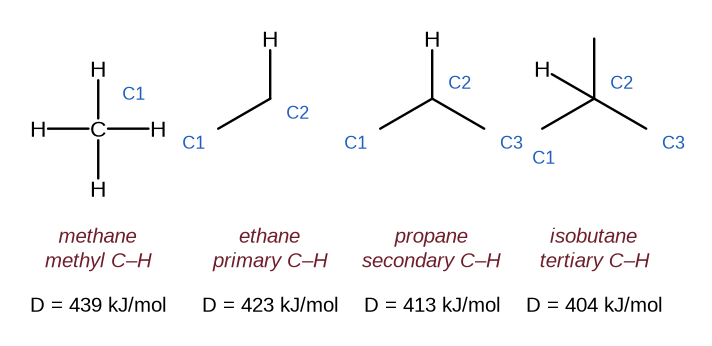
So far this predicts that both halogens should prefer the tertiary hydrogen. They do. The question is how much, and that is where Hammond comes in.
The Hammond postulate
The transition state of a reaction step looks most like whichever side it is closest to in energy:
- an endothermic step has a late transition state, which looks like the products;
- an exothermic step has an early transition state, which looks like the reactants.
That sounds like a technicality. It is the whole story.
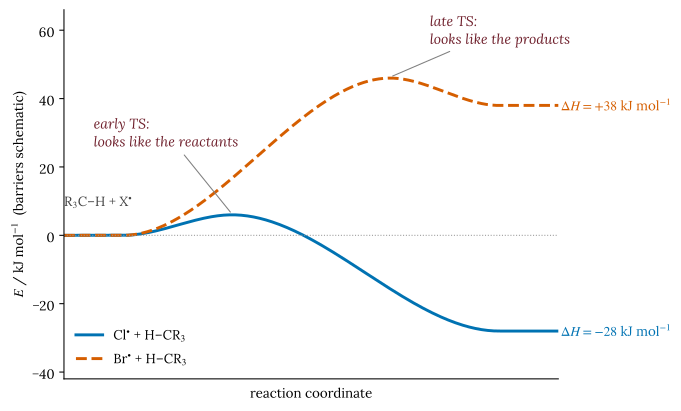
Bromine: uphill, so the radical matters
The first propagation step is the hydrogen abstraction:
You break a C–H bond and make an H–Br bond. For the tertiary C–H:
Uphill, and even more uphill for secondary and primary hydrogens. So the transition state is late. It looks like the products: the C–H bond is almost broken, the H–Br bond almost made, and most of the unpaired electron already sits on carbon.
Because the transition state already is mostly a carbon radical, everything that stabilises the radical also lowers the barrier. The tertiary radical is the most stable, so its transition state is the lowest by a wide margin, and bromine takes the tertiary hydrogen almost every time.
Watch out. An uphill first step does not make the bromination run uphill. The second propagation step, R₃C• + Br₂ → R₃C–Br + Br•, is downhill and pulls the chain along, and the overall reaction is exothermic. The first step only decides which radical forms, and therefore which product you get.
Chlorine: downhill, so it barely looks
Now the same step with chlorine:
Downhill. The transition state is early and looks like the reactants: the C–H bond is barely stretched and the unpaired electron is still mostly on chlorine. The carbon radical hardly exists yet, so its stability hardly affects the barrier. Chlorine grabs whichever hydrogen it bumps into first.
Hardly, not zero: the tertiary product still comes out at 22 % instead of the statistical 8 %. Radical stability still plays its part, it just plays it quietly.
And iodine?
Iodine does essentially nothing to an alkane. The H–I bond is only 298 kJ mol⁻¹, so abstracting even the weakest, tertiary hydrogen costs
and up to +141 kJ mol⁻¹ for methane (first structure in Figure 3). The step is so far uphill that the chain never gets going. Radical iodination of alkanes simply doesn't happen.
In one line
The more endothermic the hydrogen abstraction, the later its transition state, the more it looks like the carbon radical, and the more selective the halogen. Bromine: endothermic, late, picky. Chlorine: exothermic, early, sloppy. Iodine: too endothermic to react at all.