
 PossieChem
How do you assign R and S? The CIP rules step by step
Rank the four groups, put the lowest at the back, read 1, 2, 3. The CIP rules for R and S, worked out on three real molecules.
- What a stereocentre is (a carbon with four different groups)
- How wedge and hash bonds show a 3D molecule
- The atomic numbers of H, C, N, O, F, Cl and Br
Two molecules can have the same atoms and the same bonds in the same order and still be mirror images that never stack. They need two different names. "Left" and "right" will not do: you cannot pick up a molecule and look for its thumb.
So Cahn, Ingold and Prelog wrote a recipe, and it turns the 3D arrangement around a stereocentre into one letter: R or S. Picture a very strict talent show. Four groups walk onto the stage, the judges are atomic numbers, and the group with the lowest score is sent to the back of the stage where nobody can see it. The other three then walk past you in order of score, and you note whether they went clockwise or anticlockwise.
Three steps
- Rank the four groups on the stereocentre from 1 (highest) to 4 (lowest).
- Put group 4 at the back. Look at the centre from the side opposite to group 4, so that group 4 points away from you.
- Read 1 → 2 → 3. Clockwise is R (rectus, right). Anticlockwise is S (sinister, left).
Steps 2 and 3 are a matter of looking. All the work is in step 1.
The easy case: every neighbour is a different atom
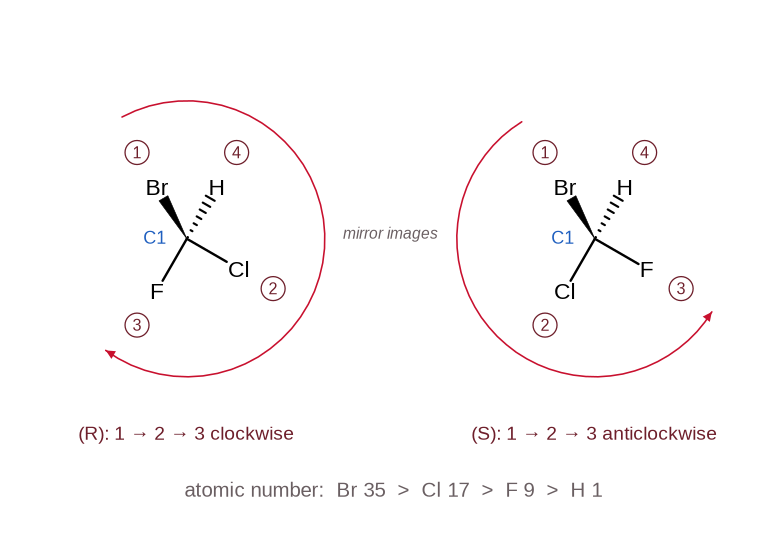
Bromochlorofluoromethane is the classic textbook stereocentre: one carbon, four different atoms. Rank them by atomic number, highest first: Br (35) is 1, Cl (17) is 2, F (9) is 3, H (1) is 4. The hydrogen is on the hash, so it already points away from you. Read 1 → 2 → 3 as drawn. On the left that goes clockwise: R. On the right the same four atoms sit in the mirror-image arrangement, and 1 → 2 → 3 goes anticlockwise: S.
The ranking is by atomic number, not by mass or by size. The common atoms, from high to low: I > Br > Cl > S > P > F > O > N > C > H.
A tie: go one step further out
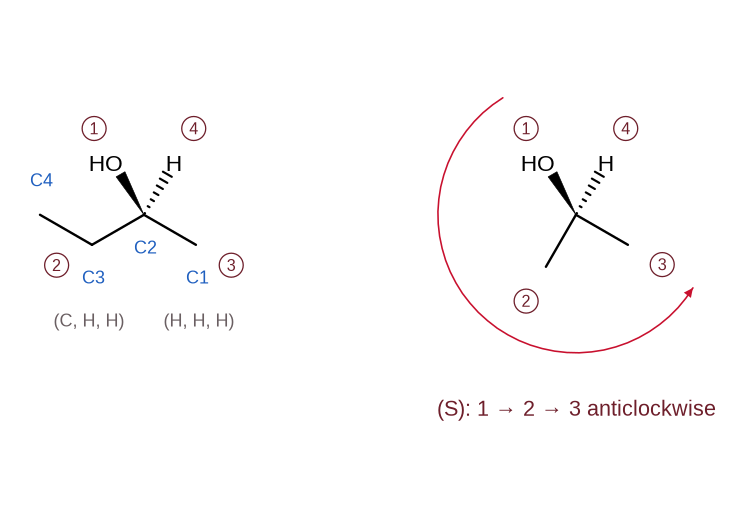
In butan-2-ol the stereocentre is C2. It carries an OH, a hydrogen, and two carbons: C1 (a methyl group) and C3 (the CH₂ of an ethyl group). Oxygen beats carbon, so the OH is 1, and the hydrogen is 4. But C1 and C3 are both carbon: a tie at the first atom.
When atoms tie, look at what each of them carries, apart from the way back to the stereocentre. C1 carries (H, H, H). C3 carries (C, H, H), because C4 hangs on it. Compare the two sets one atom at a time, highest first: C against H, and carbon wins immediately. So C3 is 2 and C1 is 3. The hydrogen is on the hash, so we read 1 → 2 → 3 as drawn, and it runs anticlockwise: (S)-butan-2-ol.
The CIP rules you need, in order.
- Compare the four atoms attached to the stereocentre. The higher atomic number wins.
- A tie? Compare what each of them carries, as a set of three atoms listed highest first, and compare the sets one atom at a time: (O, C, H) beats (C, C, C), because O beats C at the first position. The first difference decides, and the atoms are never added up. Still tied? Go one more step out and compare the branches' sets, best branch first.
- A double bond counts twice: each atom of the bond gets a copy of the atom at the other end. A triple bond counts three times. The copies carry nothing further.
- Only when the atoms and all their branches are equal does the heavier isotope win (D beats H). There are a few rules after that one, but you will rarely need them.
The hydrogen points at you: read it, then flip the answer
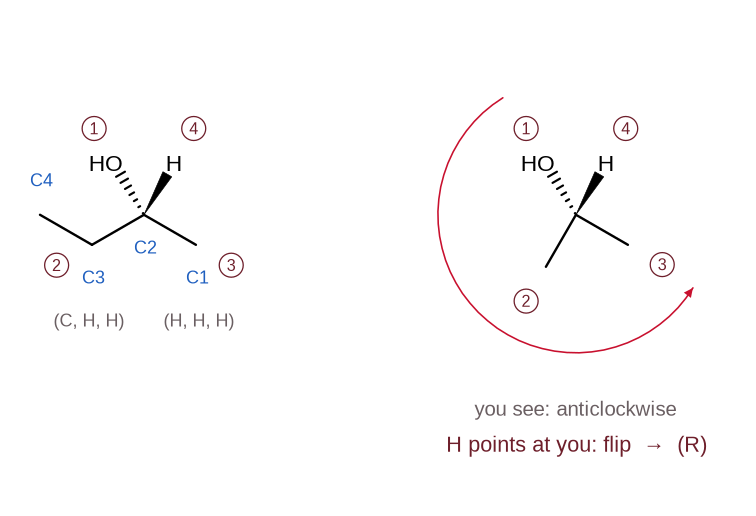
Figure 3 is Figure 2 with the wedge and the hash swapped: the OH is now on the hash and the hydrogen on the wedge. The hydrogen comes out of the page towards you, and you are looking at the centre from the wrong side. That reverses what you see. The sequence 1 → 2 → 3 still looks anticlockwise, but because the lowest priority points at you, the real answer is the opposite: (R).
That is the trick for a lowest-priority group on a wedge: read the direction you see, then flip it. And it is no accident that swapping the wedge and the hash turned S into R. Swapping any two groups on a stereocentre inverts it: that centre gets the opposite letter, and in a molecule with one stereocentre you get the mirror image.
If the hydrogen is not drawn and the centre has three drawn bonds, only one of them a wedge or a hash, the hydrogen sits opposite that bond. A wedge means the hydrogen points away. A hash means it points towards you.
A double bond counts twice
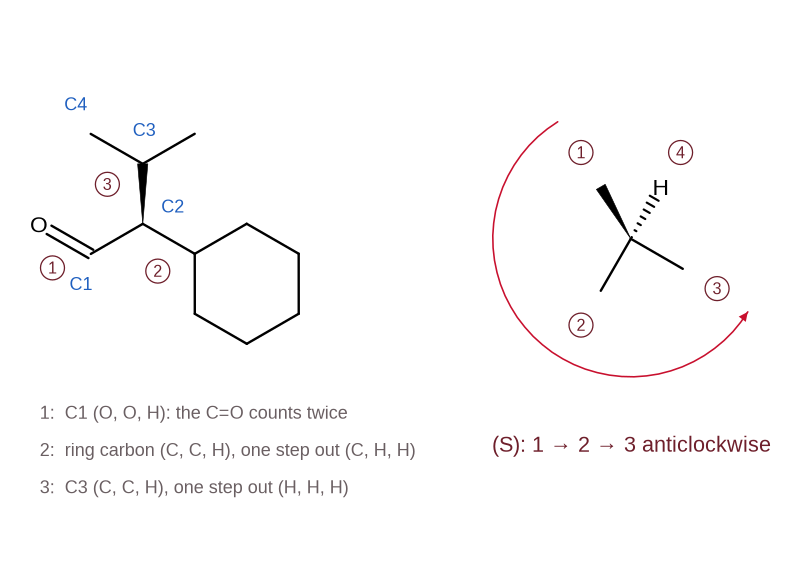
Now a stereocentre with no hydrogen drawn and a double bond in the neighbourhood: C2 of 2-cyclohexyl-3-methylbutanal. It carries C1 (the aldehyde carbon), the carbon of the cyclohexyl ring, C3 (the isopropyl carbon) and a hydrogen. The hydrogen is 4. It is not drawn, but the bond to C3 is on a wedge and the other two lie in the plane, so the hydrogen must point away. That is the viewpoint we need.
C1 carries the oxygen of the C=O, and the double bond counts twice, so C1 carries (O, O, H). Oxygen beats carbon at the first position of the set, so C1 is 1. The ring carbon carries (C, C, H) and so does C3: a tie. Go one step further out. The two ring carbons beside the attachment point each carry (C, H, H). The two methyl groups of the isopropyl each carry (H, H, H): the methyl C4 and the other methyl on C3. (C, H, H) beats (H, H, H), so the ring is 2 and the isopropyl is 3.
Read 1 → 2 → 3 with the hydrogen at the back: it runs anticlockwise, so the centre is S.
Watch out. R and S come from the priority rules, and from nothing else about how the molecule behaves. They say nothing about whether a compound rotates light to the right or the left: an R compound can be (+) or (−), and that has to be measured. Changing one group can also flip the letter without moving a single atom, because the label depends on the priorities as well as on the positions.
In one line
Rank by atomic number, go outward at a tie, count a double bond twice. Put the lowest group at the back and read 1 → 2 → 3: clockwise is R, anticlockwise is S. If the lowest group points at you, read it as you see it and flip the answer.
More from Structure
What makes a molecule chiral? Stereocentres and mirror images
Your hands are identical and still do not fit on top of each other. Molecules can do the same trick: four different groups on one carbon, and a mirror.
What is enantiomeric excess? Optical rotation and what the numbers mean
A bottle says 98 % ee, a polarimeter says −36.6 degrees. How the two are linked, how to get one from the other, and why the sign has nothing to do with R and S.
How do you read a Fischer projection? Turn it and get R or S
A cross with a rule: horizontal bonds come towards you, vertical ones go away. How to read a Fischer projection, which moves keep the molecule and which flip it, and why D and L are not R and S.
Can a molecule be chiral without a stereocentre? Allenes and axial chirality
No carbon with four different groups, and still a molecule that cannot be laid on its mirror image. How an allene does it, and how to give it an Ra or Sa label.