
 PossieChem
What is enantiomeric excess? Optical rotation and what the numbers mean
A bottle says 98 % ee, a polarimeter says −36.6 degrees. How the two are linked, how to get one from the other, and why the sign has nothing to do with R and S.
- Enantiomers, stereocentres and racemates
- R and S names (what they are, not how to assign them)
- A little arithmetic with percentages
Chemists do not say "mostly one enantiomer". They say 98 % ee, or a specific rotation of −61°, and the whole of asymmetric synthesis is judged on those two numbers. A reaction that makes a chiral medicine from flat starting materials is a success or a failure depending on how far its product is from a 50:50 mixture.
The two numbers are not independent. The rotation of a mixture of two enantiomers tracks its composition in a simple way, which means that one measurement on a machine the size of a toaster tells you how much of each hand is in the flask. Two lines of arithmetic, a minus sign you must not misread, and one very common confusion about R and S.
So what does "60 % ee" actually mean, and how do you get it from a polarimeter reading?
Racemate and enantiomeric excess
A 50:50 mixture of an enantiomer and its mirror image is a racemate. It is not a third kind of molecule, just a mixture with no net preference for either hand. When the two are not 50:50, the sample has an enantiomeric excess, ee, which says how far it is from a racemate:
Here and are the amounts (in mol, or just percentages) of the (R) and (S) enantiomer. A sample with 80 % (R) and 20 % (S) has an ee of 80 − 20 = 60 %.
There is a nice way to read that number. An ee of 60 % is the same as "60 % pure (R), plus 40 % racemate". The racemate contributes 20 % of each hand, so (R) = 60 + 20 = 80 % and (S) = 20 %. The racemate part is invisible to everything that cannot tell hands apart, which is why the ee, not the percentage of the major enantiomer, is the honest measure of what is left over.
To go from an ee back to the composition, split the sample in two: the fraction of the major enantiomer is (1 + ee)/2 and the fraction of the minor one is (1 − ee)/2, with ee written as a fraction (0.60 here).
Light, and why the sign is only a measurement
A chiral compound is optically active: it rotates the plane of polarised light, and its mirror image rotates it by exactly the same angle in the opposite direction. A rotation clockwise (seen looking into the beam) is written +, anticlockwise −. The sign cannot be predicted by looking at the structure; it has to be measured.
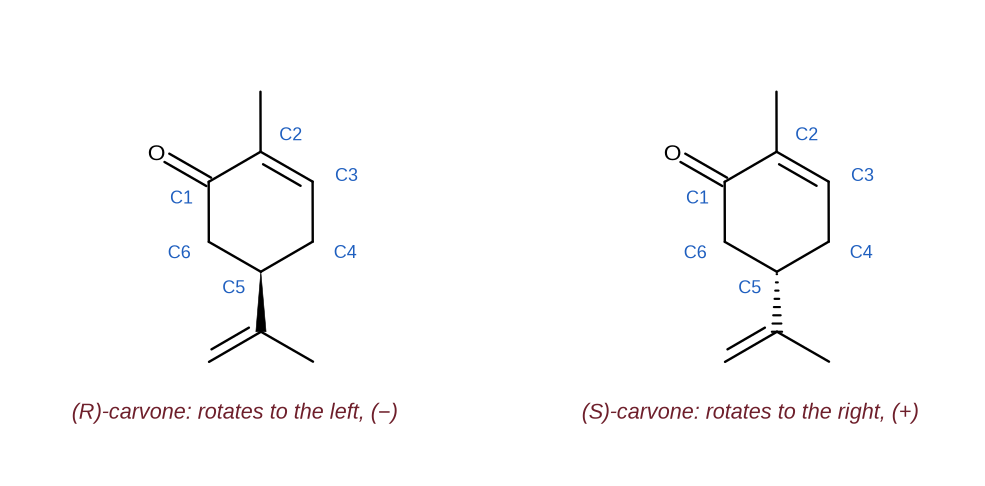
Figure 1 shows a pair of enantiomers with their measured signs. For carvone the (R) enantiomer rotates to the left and the (S) enantiomer to the right.
The measured rotation α depends on how much sample the light passes through, so chemists quote the specific rotation, which takes that out:
Here α is the measured rotation in degrees, c the concentration in g mL⁻¹ (for a pure liquid, its density), l the path length in dm, T the temperature and D the sodium D line (589 nm) the light comes from. The unit of [α] is usually left out; it is degrees mL g⁻¹ dm⁻¹.
A racemate does not rotate at all: for every molecule turning the light to the left there is a mirror image turning it equally to the right, and the two cancel. That is the origin of the term optically inactive for a racemate.
The sign has nothing to do with R and S
R and S are names produced by the CIP (Cahn–Ingold–Prelog) priority rules. The + and − are a physical measurement. They are two unrelated labels, and the same letter can come with either sign. Figure 2 shows the proof.
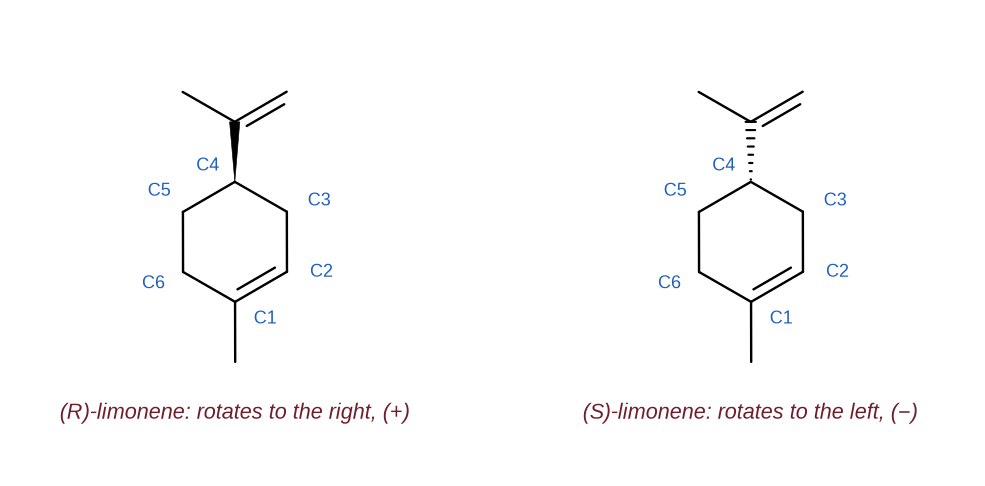
(R)-Carvone rotates the light to the left, (R)-limonene to the right: both are (R), with opposite signs. There is no rule that turns one into the other. When a name is written as (R)-(−)-carvone, the (R) is the structure and the (−) is the measurement.
Do not read the sign as a configuration. (+) does not mean R, (−) does not mean S. Only the measurement, or a comparison with a known sample of the same compound, tells you which hand has which sign.
From rotation to composition
The rotation of a mixture is proportional to its ee. At the same concentration, path length, temperature and wavelength:
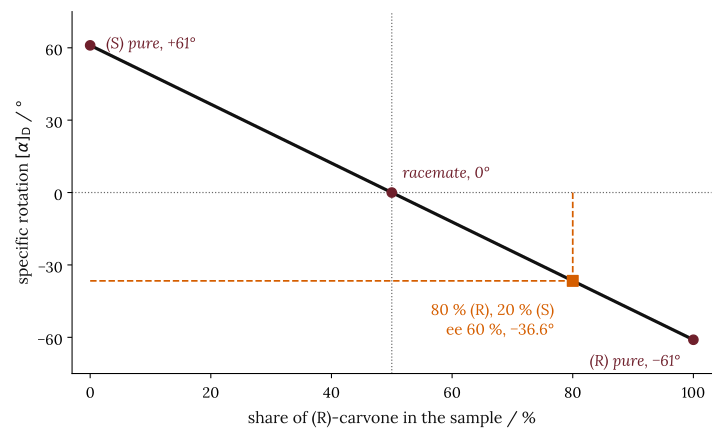
Figure 3 draws that line for carvone: it runs from +61° for pure (S) through zero at 50:50 to −61° for pure (R).
Example 1. A 1.00 dm tube filled with neat (R)-carvone (density about 0.96 g mL⁻¹) turns the light by −58.6°. What is the specific rotation?
Here c is the density, 0.96 g mL⁻¹, and l = 1.00 dm, so [α] = −58.6 / (0.96 × 1.00) = −61°. That is the number of the pure (R) enantiomer, and the reference for the next example.
Example 2. A bottle of carvone, measured under the same conditions, has [α] = −36.6°. What is its composition?
The ee is 36.6 / 61 = 0.60, so ee = 60 %, and the excess is (R) because the sign is the same as that of pure (R)-carvone. Then the fraction of (R) is (1 + 0.60)/2 = 80 % and of (S) (1 − 0.60)/2 = 20 %. Check: 80 + 20 = 100 %, and 80 − 20 = 60 %, the ee.
Example 3. What rotation do you expect for a mixture of 70 % (S)-carvone and 30 % (R)-carvone?
The ee is 70 − 30 = 40 %, with the excess in (S), the (+) hand. So [α] = +0.40 × 61 = +24.4°.
When the line is not straight
The proportionality is a good approximation, not a law. The specific rotation of some compounds depends on the concentration and on the solvent, and a few mixtures deviate noticeably from a straight line, so a polarimeter reading is only as reliable as the reference value it is compared with. That is one reason why modern work often measures ee by another route, such as chiral chromatography, where the two enantiomers simply come off the column at different times and the ratio of the two peak areas gives the ee directly. The rotation stays useful as a quick check, and it is the traditional way to say which hand a sample has.
More from Structure
What makes a molecule chiral? Stereocentres and mirror images
Your hands are identical and still do not fit on top of each other. Molecules can do the same trick: four different groups on one carbon, and a mirror.
How do you assign R and S? The CIP rules step by step
Rank the four groups, put the lowest at the back, read 1, 2, 3. The CIP rules for R and S, worked out on three real molecules.
How do you read a Fischer projection? Turn it and get R or S
A cross with a rule: horizontal bonds come towards you, vertical ones go away. How to read a Fischer projection, which moves keep the molecule and which flip it, and why D and L are not R and S.
Can a molecule be chiral without a stereocentre? Allenes and axial chirality
No carbon with four different groups, and still a molecule that cannot be laid on its mirror image. How an allene does it, and how to give it an Ra or Sa label.