
 PossieChem
Can a molecule be chiral without a stereocentre? Allenes and axial chirality
No carbon with four different groups, and still a molecule that cannot be laid on its mirror image. How an allene does it, and how to give it an Ra or Sa label.
- Enantiomers, stereocentres and the four-different-groups rule
- R and S: CIP priorities
- sp, sp2 and sp3 hybridisation (an sp carbon is linear)
The rule you meet first is that a chiral molecule has a carbon with four different groups. It is a good rule, and it is wrong in the sense that "all swans are white" is wrong: it covers nearly everything you meet, and then you meet a black one. What matters is not whether the molecule has a stereocentre. What matters is whether the molecule can be laid on top of its own mirror image, and some molecules fail that test without a single stereocentre in them.
The classic black swan is the allene, a chain with two double bonds that share a carbon, C=C=C. Nothing in it looks like a stereocentre: the middle carbon has only two neighbours, and each end carbon has only three, one of them through a double bond. Yet an allene can be a pair of mirror images, as handed as your own hands.
How can a straight line be handed, and how do you name the two forms?
The shape: a straight line with two perpendicular ends
The central carbon of an allene is sp-hybridised, so the three carbons of C2=C3=C4 lie on a straight line. Each of the two double bonds has its own π bond, and the two π bonds use p orbitals of the central carbon that are perpendicular to each other. The result is that the groups on one end carbon lie in one plane, and the groups on the other end carbon in the plane at right angles to it. Figure 1 shows penta-2,3-diene drawn this way.
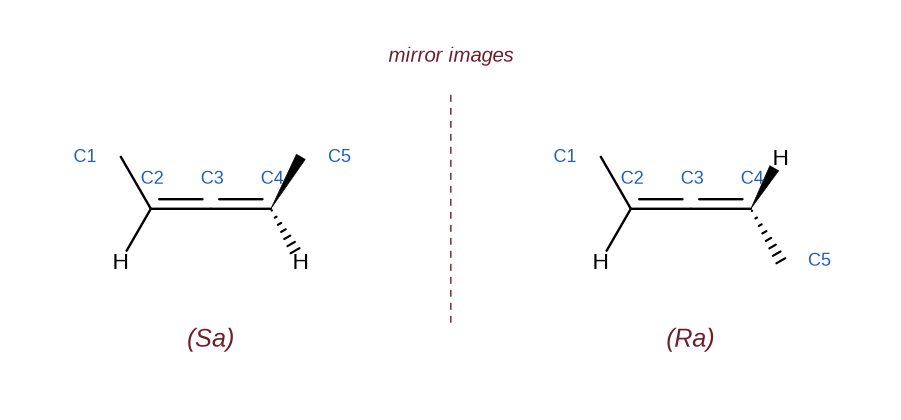
Look at C2: it carries the methyl group C1 and a hydrogen, in the plane of the page. Look at C4: it carries the methyl group C5 and a hydrogen, one in front of the page and one behind. Nothing you do to one end changes the other, because the double bonds do not allow the ends to turn relative to each other, and the right-hand molecule in Figure 1 is the reflection of the left-hand one in the dashed mirror. You can turn it as long as you like, it will never be the left-hand one.
When is an allene chiral?
Each end carbon needs two different groups. If either end carries two identical groups, the molecule has a mirror plane and there are no enantiomers. Figure 2 shows the simplest case, 3-methylbuta-1,2-diene.
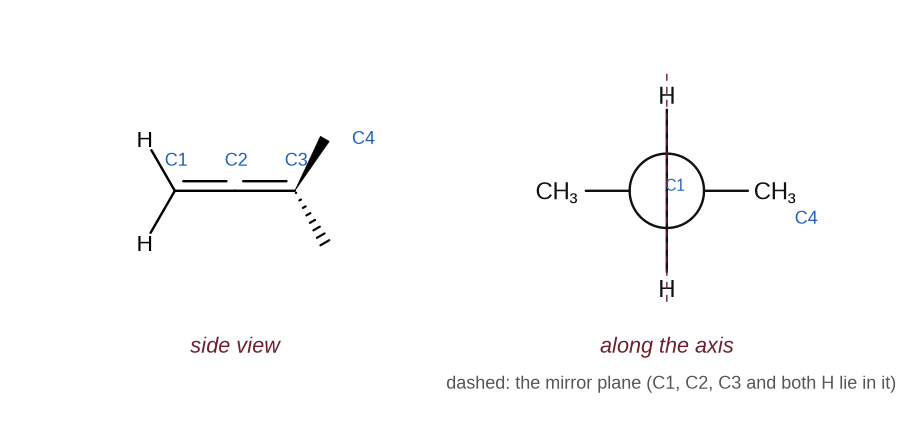
Seen along the axis, the two hydrogens sit above and below the middle and the two methyl groups to the left and right. A vertical mirror through the hydrogens swaps the two methyls and changes nothing. Compare Figure 1, where each end has two different groups and no mirror plane survives.
The rule for allenes is therefore the same shape as the stereocentre rule: the molecule is chiral if each end carries two different groups. One end with a repeated group is enough to kill it.
Naming it: Ra and Sa
The molecule has an axis of chirality, the C=C=C line, instead of a centre. The label is assigned by looking along the axis, from either end (the answer is the same). Figure 3 shows both molecules of Figure 1 seen like this.
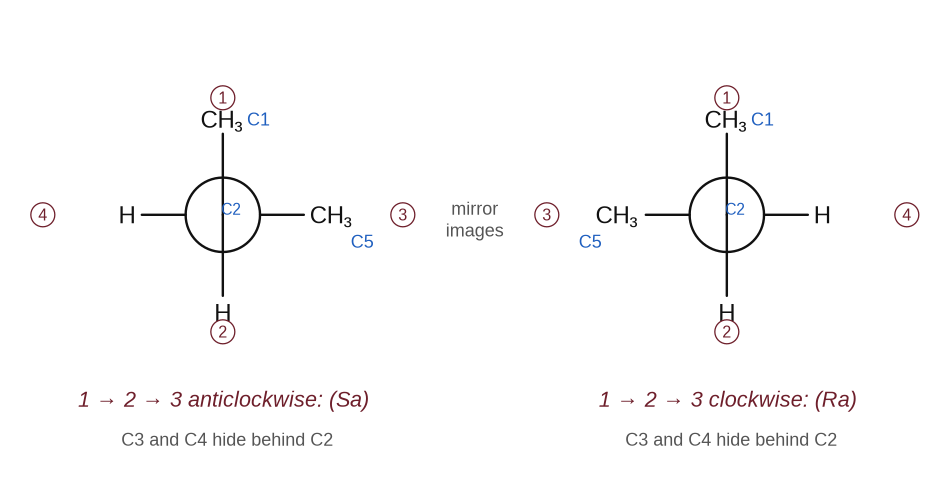
The recipe has three steps.
- Rank the two groups on the near carbon with the usual CIP (Cahn–Ingold–Prelog) rules, 1 and 2. Here the methyl group C1 beats the hydrogen.
- Rank the two groups on the far carbon, 3 and 4. Both groups on the near carbon outrank both groups on the far carbon, whatever they are.
- Follow 1 → 2 → 3. Clockwise is Ra, anticlockwise is Sa. The letter a says that the chirality is axial.
In the left-hand molecule of Figure 3 the methyl group C1 is at the top (1), the hydrogen on C2 at the bottom (2), and the far methyl group C5 on the right (3). Going 1 → 2 → 3 you see anticlockwise: Sa. The right-hand molecule has the far groups swapped, so the same path runs clockwise: Ra. They are mirror images and carry opposite labels, as they should.
The same idea in other shapes
An allene is one member of a family: molecules that are handed because of an axis or a plane, not a centre. A biaryl with bulky groups that stop the two rings from turning relative to each other has an axis of chirality along the bond between the rings, and a ring with a part held on one side of its flat face can have planar chirality. You will meet them far less often than stereocentres. The test is always the same: draw the mirror image and ask whether you can lay one on the other. If not, the molecule is chiral, whatever its atoms are doing.
More from Structure
What makes a molecule chiral? Stereocentres and mirror images
Your hands are identical and still do not fit on top of each other. Molecules can do the same trick: four different groups on one carbon, and a mirror.
How do you assign R and S? The CIP rules step by step
Rank the four groups, put the lowest at the back, read 1, 2, 3. The CIP rules for R and S, worked out on three real molecules.
What is enantiomeric excess? Optical rotation and what the numbers mean
A bottle says 98 % ee, a polarimeter says −36.6 degrees. How the two are linked, how to get one from the other, and why the sign has nothing to do with R and S.
How do you read a Fischer projection? Turn it and get R or S
A cross with a rule: horizontal bonds come towards you, vertical ones go away. How to read a Fischer projection, which moves keep the molecule and which flip it, and why D and L are not R and S.