
 PossieChem
What makes a molecule chiral? Stereocentres and mirror images
Your hands are identical and still do not fit on top of each other. Molecules can do the same trick: four different groups on one carbon, and a mirror.
- The tetrahedral carbon (four bonds, about 109.5 degrees)
- Wedges and hashes in a line drawing
- Naming a straight chain
Look at your hands. Same number of fingers, same bones, same length, same everything: a perfect pair. And yet nobody has ever managed to put a left glove on a right hand. Two things can be identical in every respect except one, and that one respect is enough to make them two different things.
Molecules do exactly this. Take two molecules with the same atoms, connected in the same order, and sometimes no amount of turning and tumbling will make one lie on top of the other. They are mirror images, like a pair of hands, and it matters: your nose can tell them apart, and so can your enzymes.
It almost always comes down to one particular carbon. Learn to spot it and you can look at most drawn molecules and say within seconds whether it has a mirror-image twin. So what does that carbon look like, and how do you test it?
The carbon with four different groups
Look at the top row of Figure 1. Carbon C2 carries four different things: a hydroxyl group, a nitrile (the carbon C1 with its triple-bonded nitrogen), an ethyl group (C3 and C4) and a hydrogen. Draw 2-hydroxybutanenitrile, draw its reflection in a mirror (the dashed line), and try to put one on top of the other. It cannot be done, however you turn them, so they are two different molecules. They are enantiomers, and a carbon like C2 is a stereocentre (also called a chiral centre or stereogenic centre): a centre where swapping two groups gives a different molecule. A molecule that cannot be laid on top of its own mirror image is chiral, from the Greek word for hand.
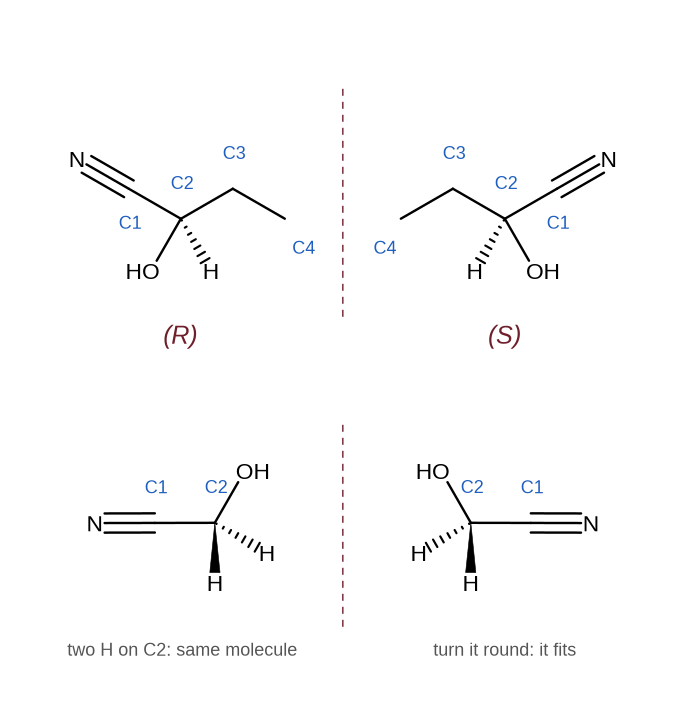
The bottom row shows what happens when the ethyl group goes away. In hydroxyacetonitrile, C2 carries two hydrogens, the mirror image is the same molecule, and there is nothing to tell apart.
A stereocentre needs four different groups. Three different groups and one repeated is not enough: the repeated pair can be swapped without changing anything.
The swap test
You do not have to draw the whole molecule's mirror image every time. Take one carbon, imagine swapping any two of its groups, and ask: did I get a different molecule? On C2 of 2-hydroxybutanenitrile, swapping OH and H gives the other enantiomer, so C2 is a stereocentre. On C2 of hydroxyacetonitrile, swapping the two hydrogens gives the same molecule, so it is not. Swapping two groups is the mirror image of the centre, which is why the test works.
What counts as "different"
Groups are compared as whole branches, not as single atoms. Two branches that start the same way are still different if they differ anywhere further out. Figure 2 shows the extreme case.
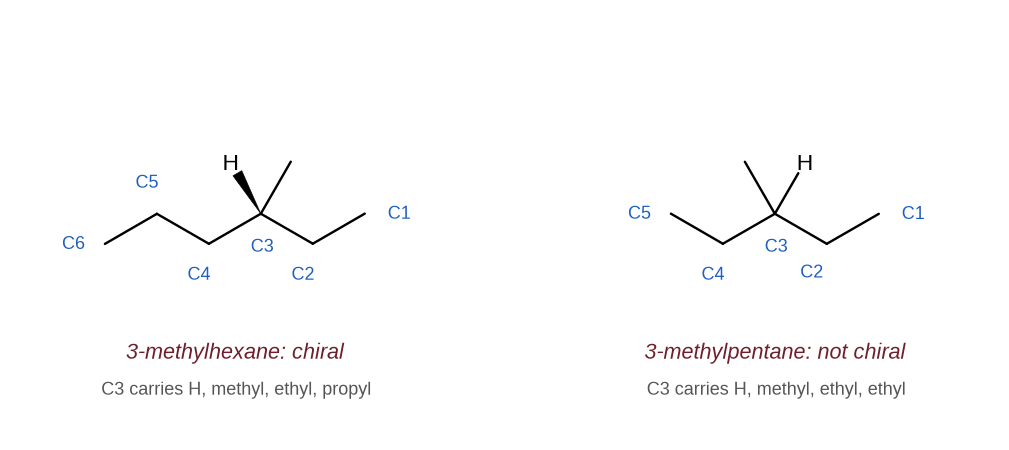
C3 of 3-methylhexane carries a hydrogen, a methyl group, an ethyl group and a propyl group. The ethyl and the propyl start the same way, with a CH₂, and differ only one carbon further out. That is enough: they are different groups, C3 is a stereocentre, and 3-methylhexane has an enantiomer. In 3-methylpentane the two arms are both ethyl. Same atoms, same shape, completely interchangeable, so C3 is not a stereocentre and the molecule is its own mirror image. One extra carbon decides the whole matter.
Rings work the same way, with the ring itself providing the two arms. A ring carbon with one substituent, one hydrogen and two ring paths that lead to different places is a stereocentre; if the two ways around the ring are identical, it is not.
Identical in everything, except for the nose
Two enantiomers have the same melting point, the same boiling point, the same solubility in an achiral solvent: the same everything, except how they treat polarised light and other handed things. What tells them apart is a chiral environment: something that is itself handed, such as another chiral molecule. Your body is full of those. Your proteins are built almost entirely from one of the two mirror-image forms of each chiral amino acid, so it treats the two enantiomers of a molecule as two different substances. That is why a medicine can work as one enantiomer while its mirror image does nothing, or something nasty.
Your nose works the same way. The two mirror images in Figure 3 differ in nothing but their handedness, and one smells of spearmint, the other of caraway.
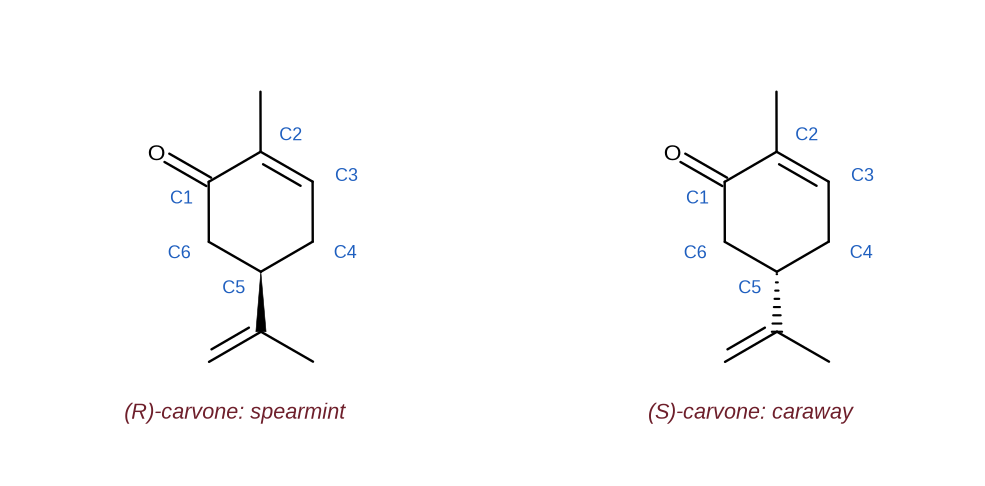
C5 is the stereocentre of carvone: it carries a hydrogen, the isopropenyl group and two ring arms, C4 and C6. Both ring arms start with a CH₂, but around the ring one leads to a C=C and the other to the C=O, so they are different groups.
A 50:50 mixture of an enantiomer and its mirror image is a racemate (a racemic mixture). It is not a third kind of molecule, only a mixture with no net preference for either hand.
Is it chiral? A three-question check
- Is there a carbon with four different groups? Compare the groups branch by branch, as far out as you need to.
- If there are several, does the molecule have an internal mirror plane anyway? Then it is its own mirror image despite its stereocentres: a meso compound.
- If there is no stereocentre at all, is there some other handed feature? A twisted allene is the classic case: chirality does not need a centre, it needs a molecule that cannot be laid on its mirror image.
One stereocentre always makes a molecule chiral. With several, symmetry can take it away again.
More from Structure
How do you assign R and S? The CIP rules step by step
Rank the four groups, put the lowest at the back, read 1, 2, 3. The CIP rules for R and S, worked out on three real molecules.
What is enantiomeric excess? Optical rotation and what the numbers mean
A bottle says 98 % ee, a polarimeter says −36.6 degrees. How the two are linked, how to get one from the other, and why the sign has nothing to do with R and S.
How do you read a Fischer projection? Turn it and get R or S
A cross with a rule: horizontal bonds come towards you, vertical ones go away. How to read a Fischer projection, which moves keep the molecule and which flip it, and why D and L are not R and S.
Can a molecule be chiral without a stereocentre? Allenes and axial chirality
No carbon with four different groups, and still a molecule that cannot be laid on its mirror image. How an allene does it, and how to give it an Ra or Sa label.