
 PossieChem
How does an acetal form? The full mechanism
An aldehyde, an alcohol and a drop of acid. Seven steps later two O–R groups sit on one carbon and the acid is untouched. Every arrow, every intermediate.
- Lone pairs and formal charges
- Curly arrows: one arrow moves one pair of electrons
- The C=O bond is polarised: the carbon is the electron-poor end
- What pKa means (a small pKa is a strong acid)
Put benzaldehyde in methanol and almost nothing happens. Add a drop of strong acid and, after a while, two methanol molecules are bolted onto the same carbon and a molecule of water has been thrown out. The acid is not in the product, and there is exactly as much of it at the end as at the start. So what did it do?
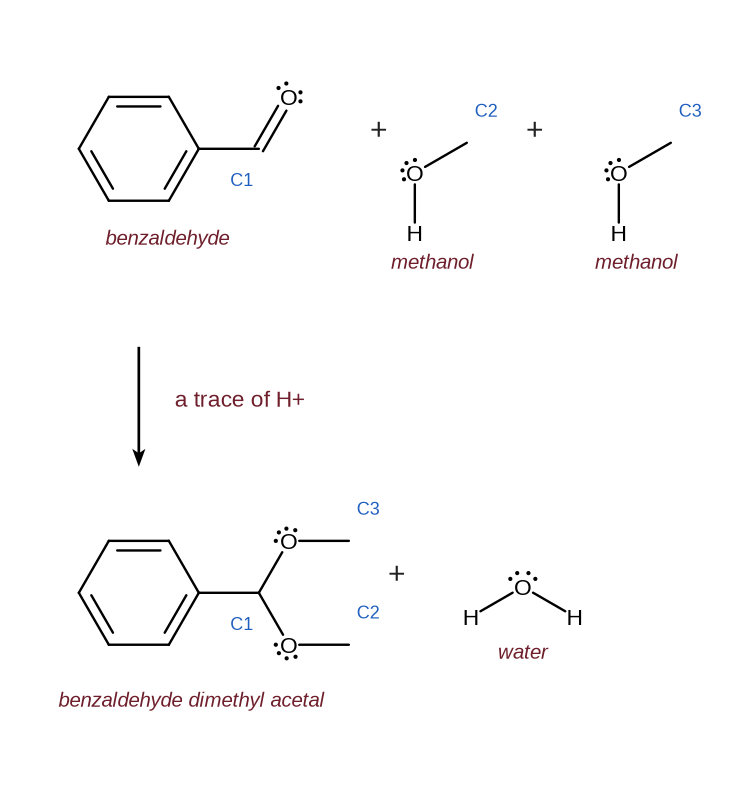
The product on the bottom row is an acetal: one carbon carrying two O–CH₃ groups. This page follows every one of the seven steps that get there, with every arrow, on exactly these molecules.
Acid does two jobs
Methanol is a polite guest. It has a lone pair, but it is a weak nucleophile, and the carbon of a C=O is only moderately hungry for electrons. Nobody walks through the door. Acid is the matchmaker who walks in first, makes the carbon far hungrier, and leaves again before the wedding. That is job one, and it happens in step 1.
Job two comes later. Somewhere in the middle an OH group has to leave, and an OH is a stubborn flatmate: it will not move out on its own. Acid gives it a better offer elsewhere (step 4) and then it goes happily, as water.
Everything else is a lone pair or a bond doing something, and a proton moving in or out.
Watch out. An arrow that protonates a carbonyl starts at the lone pair on oxygen, not at the C=O double bond. The lone pair is the electron pair that is free to go, and the C=O π bond is still needed afterwards. The double bond first becomes the start of an arrow in step 2, once the oxygen already carries the proton.
Steps 1 to 3: from the aldehyde to the hemiacetal
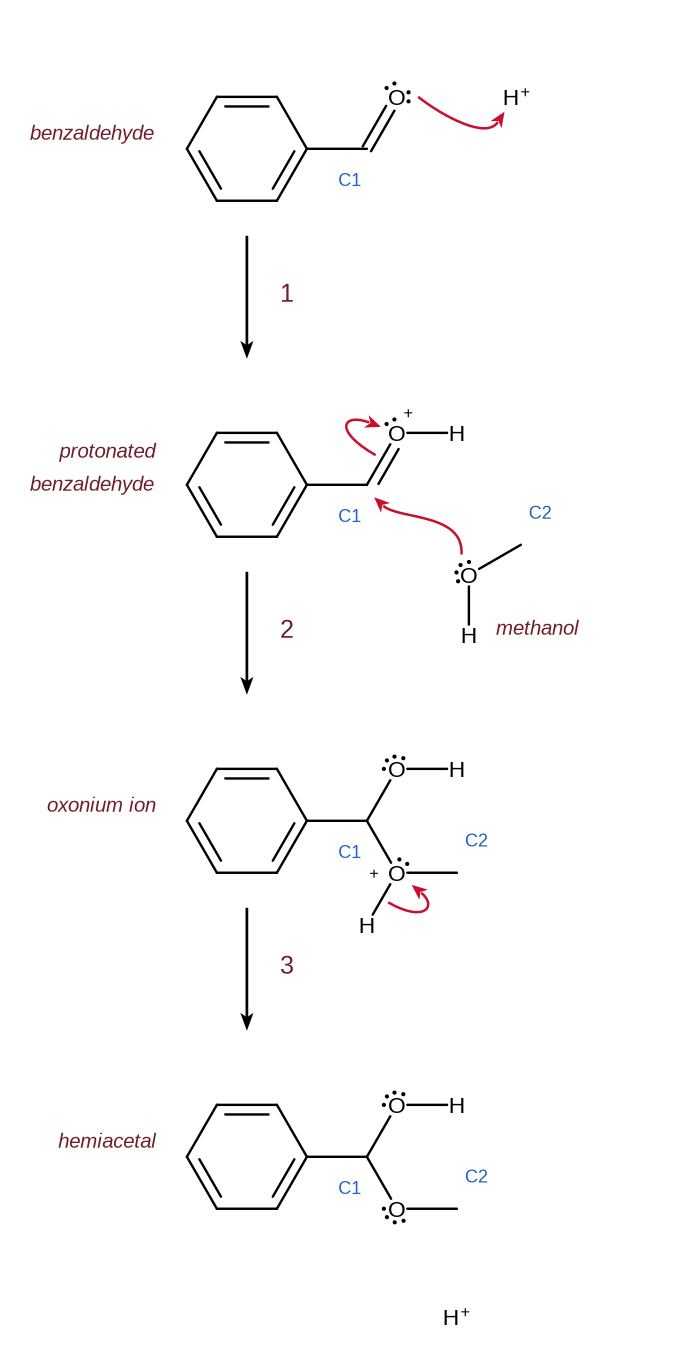
Step 1: protonation of the carbonyl oxygen. A lone pair of the carbonyl oxygen takes up H⁺. The oxygen now has three bonds and a positive charge, and the charge does not stay put on oxygen: the carbon next to it shares it. That is what matters, because C1 is now a very good electrophile. (The free proton is in reality always attached to a solvent molecule. We draw it bare to keep the arrows readable.)
Step 2: the methanol attacks. A lone pair on the methanol oxygen forms a new bond to C1, and at the same moment the C=O π electrons move onto the carbonyl oxygen, which ends up as a neutral OH. That is two arrows. The oxygen that just arrived has three bonds and a positive charge: it is an oxonium ion. C1 has gone from flat (sp², three neighbours) to tetrahedral (sp³, four). (C1 also carries one H. Like the H atoms of the CH₃ groups, it is left out of the drawing, as is usual in skeletal formulas.)
Step 3: loss of a proton. The O⁺–H bond breaks and its electrons stay on oxygen. The proton goes to the solvent, a methanol molecule or a trace of water. What is left is neutral: C1 carries an OH and an OCH₃. That is a hemiacetal. It took one proton out of the solution in step 1 and gave one back in step 3, which is why the acid is a catalyst and not a reagent.
Steps 4 and 5: the OH leaves as water
A hemiacetal is mostly a way station. It sits in equilibrium with the aldehyde and the alcohol, and to get to the acetal the OH on C1 has to be swapped for an OCH₃. That means the OH has to leave, and it does not want to.
A leaving group is good when it is comfortable on its own, and you can read that from the pKa of the acid it would come from: the smaller the pKa, the happier the leaving group. If the OH left as it is, it would take the bonding pair with it and become an anion, and the acid that anion comes from is water, with a pKa of 15.7. If it leaves as a neutral water molecule, the acid that molecule comes from has a pKa of −1.7. The OH is the flatmate who stays on the couch for a year; water is a flatmate who has already packed.
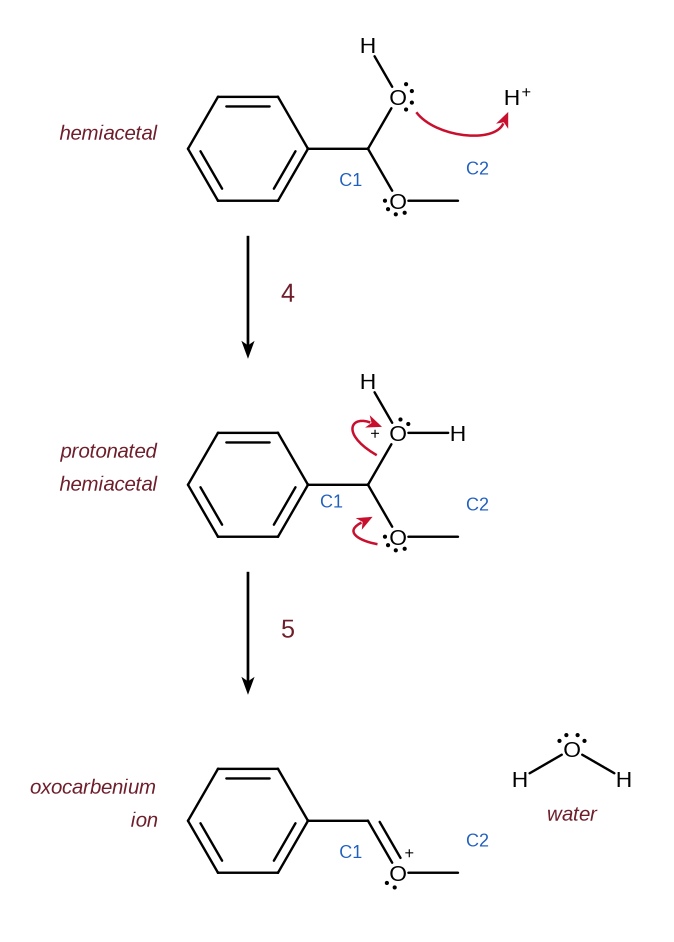
Step 4: protonation of the OH. A lone pair on the OH oxygen takes up H⁺. This is the protonated hemiacetal: the oxygen has three bonds and a positive charge, and what is about to leave is no longer a bare OH but a neutral water molecule.
Step 5: water leaves. Two arrows. The C1–O bond breaks and its two electrons go onto the oxygen: that is the water leaving. At the same time a lone pair on the other oxygen, the one carrying C2, swings in between that oxygen and C1 and becomes a C1=O⁺ double bond. Without that second arrow, C1 would be left with only six electrons. With it, every atom keeps its octet, and the positive charge sits on the oxygen, which now has three bonds.
The result is an oxocarbenium ion. C1 is flat again, and the positive charge is shared between C1 and the oxygen. This is the heart of the whole reaction: the lone pair of the neighbouring OCH₃ pays for the departure of water. A simple alcohol has no neighbouring lone pair to pay, which is why the OCH₃ on C1 matters so much.
Steps 6 and 7: the second methanol and the acetal
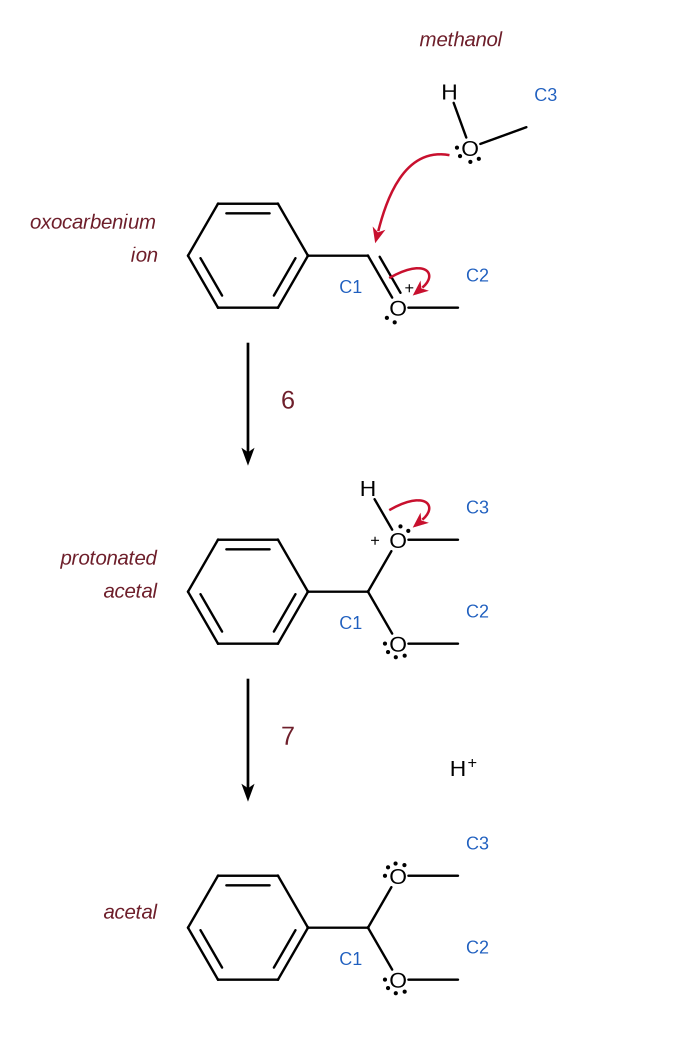
Step 6: the second methanol attacks. A second methanol uses a lone pair to bond to C1, and the C1=O⁺ π electrons go back onto the oxygen, which is neutral again. C1 is flat in the oxocarbenium ion, so the methanol can arrive from either face. The new oxygen carries a positive charge and an H: it is the protonated acetal.
Step 7: loss of a proton. Same move as step 3: the O⁺–H bond breaks and its electrons stay on oxygen. The product is the acetal, with two OCH₃ groups (C2 and C3) on C1, and H⁺ is back in solution. Count it: benzaldehyde plus two methanol gives the acetal plus water. Two protons went in (steps 1 and 4) and two came out (steps 3 and 7), so nothing of the acid is used up.
Why acid, and how to push it to the acetal
All seven steps are reversible, and that explains the two things you need to know when using acetals.
Forming one. The equilibrium is not far over on the acetal side, so you push it. Remove the water as it forms (a drying agent, molecular sieves, or distilling it off), or use the alcohol as the solvent so that there is a huge excess of it. A hemiacetal on its own is usually not worth isolating, because it tends to fall apart again as soon as you try.
Why acid and not base. Base can make the first addition faster, because an alcohol that has lost its proton is a much stronger attacker. But nothing in a basic solution is acidic enough to protonate the OH of the hemiacetal to any useful extent, so nothing makes it leave, and the reaction stops there. A fairly strong acid is the usual choice, because a carbonyl oxygen is a very weak base: a protonated carbonyl like the one in step 1 has a pKa around −7, so at any moment only a tiny fraction of the benzaldehyde is protonated. That fraction is enormously reactive, and the proton is handed back straight away.
Taking it apart again. Play the film backwards. Stir the acetal in water with a little acid and the seven steps run in reverse: protonate an OCH₃ oxygen, lose methanol to give the oxocarbenium ion, water attacks, a proton leaves (that is the hemiacetal), then the other OCH₃ is protonated and leaves as methanol, and a last proton goes to give the aldehyde back. That is why an acetal is a favourite protecting group for a carbonyl. It survives bases, nucleophiles and organometallic reagents, and a drop of aqueous acid releases the carbonyl again.
With a ketone instead of an aldehyde the same seven steps give a ketal (and a hemiketal on the way). The mechanism is the same, but the equilibrium sits further to the left for a ketone, so getting the water out matters even more.
Acid does two jobs. It makes the carbonyl carbon electrophilic (step 1) and it makes OH leave as water (step 4). In between, a neighbouring oxygen lone pair pays for the loss of water (step 5), and a proton leaves every oxonium ion (steps 3 and 7). Aldehyde + two alcohols ⇌ acetal + water: remove the water to form the acetal, add water and acid to take it back.
More from Structure
Hemiacetal or acetal? How to tell them apart
One carbon, two oxygens, and one hydrogen of difference. What a hemiacetal is, what an acetal is, why only one of them fits in a bottle, and how a sugar ring is a hemiacetal.
Why does acetal formation need acid and not base?
Base makes methanol a stronger attacker, so why does the acetal only form in acid? Two jobs, and the second one is the one base can never do.
How does acetal hydrolysis work? How an acetal protects a ketone
Hide a ketone behind an acetal, reduce the ester next to it, then take the acetal off with water and a drop of acid. The full hydrolysis mechanism, arrow by arrow, on a real molecule.
What does a pKa tell you? Acid strength from one number
One small number says how hard an acid pushes its proton away, and with it you can tell which hydrogen in a molecule leaves first. Here is how to read it.