
 PossieChem
How does acetal hydrolysis work? How an acetal protects a ketone
Hide a ketone behind an acetal, reduce the ester next to it, then take the acetal off with water and a drop of acid. The full hydrolysis mechanism, arrow by arrow, on a real molecule.
- Lone pairs and formal charges
- Curly arrows: one arrow moves one pair of electrons
- Hemiacetals and acetals
- What a leaving group is
Here is a molecule with a problem. It carries a ketone and an ester in the same molecule, and you want to reduce the ester to an alcohol and leave the ketone exactly as it is. The reagent that reduces esters is strong enough to reduce ketones first. If you just add it, the ketone goes.
The standard answer is to hide the ketone. Treat it with ethane-1,2-diol and a little acid (removing the water as it forms) and the ketone becomes an acetal, in the form of a ring called a dioxolane. Strictly it is a ketal, since it came from a ketone, but chemists call both acetals. The reducing agent ignores it. Reduce the ester, and then add water and a drop of acid: the ketone comes back. Figure 1 shows the three moves on ethyl 4-oxopentanoate.
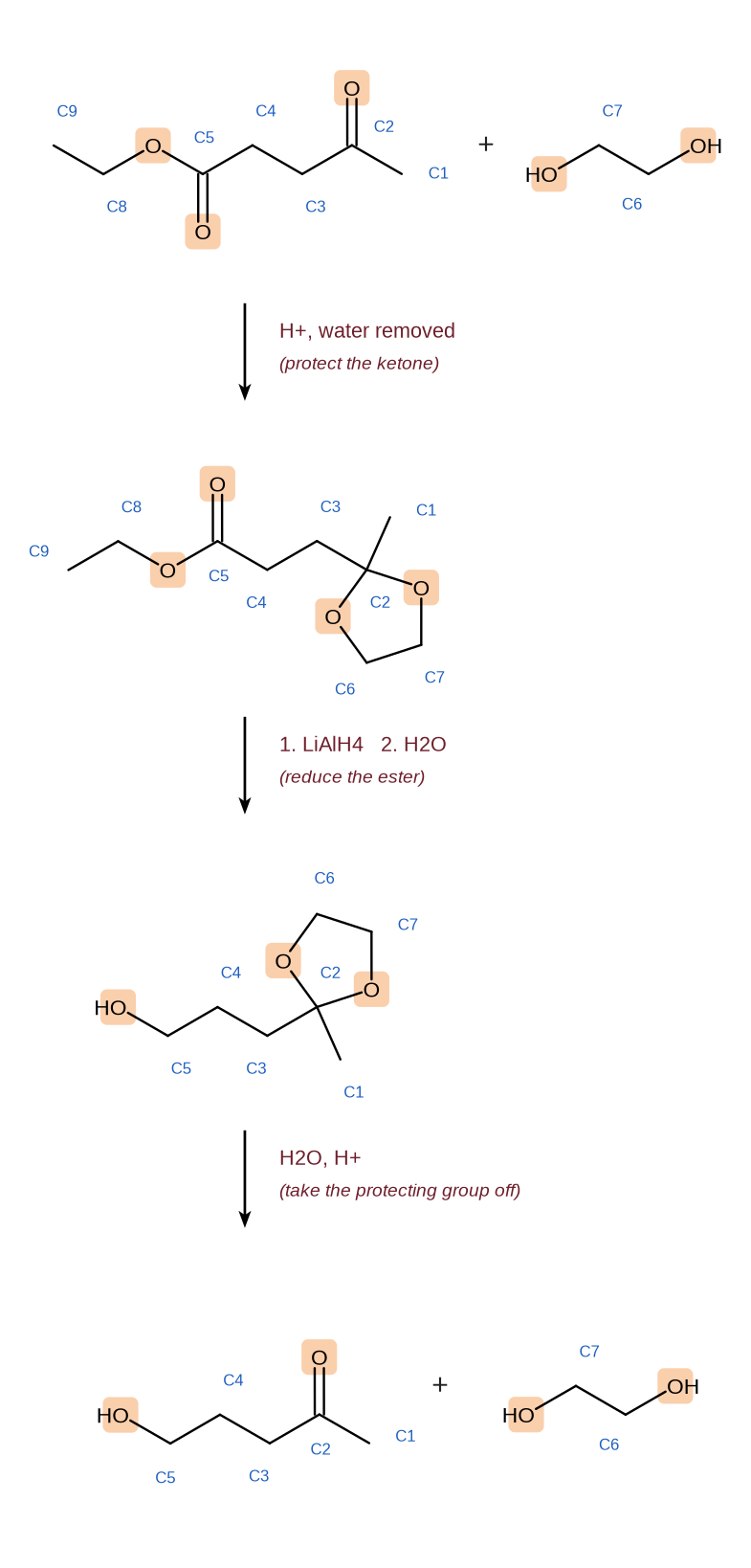
The first two moves are quick to state. The third one, the acetal coming off, is the one worth a whole explanation, because it is the acid-catalysed formation of an acetal run backwards, and it only works in water and acid. Why does water take the diol off, and why does a basic or neutral solution leave it alone?
Why an acetal is a good hiding place
A ketone is attacked by nucleophiles and reduced by hydrides because its C=O carbon is electron-poor and has a π bond to give up. Once the ketone has become an acetal, C2 has no π bond to open and no good leaving group. It carries four single bonds, two of them to oxygen. A base has nothing to attack, and the two C–O bonds cannot break, because an OR group on its own is a very poor leaving group (the acid it comes from, an alcohol, has a pKa around 16). The acetal therefore survives bases, nucleophiles and hydride reagents.
The ring helps. Ethane-1,2-diol has two OH groups on neighbouring carbons, so once the first oxygen is attached, the second is held right next to C2, and the five-membered dioxolane closes easily and stays closed. This is why a diol is so often the alcohol of choice for a protecting group.
Acid is a different matter. As the mechanism of acetal formation shows, protonation gives an OR group somewhere to go. In water and acid the acetal falls apart, and the three-step plan works because the conditions of the middle step (hydride, base) and the conditions of the last step (water, acid) are opposite.
Steps 1 and 2: protonate a ring oxygen, open the ring
We follow the acetal of Figure 1, now the alcohol 3-(2-methyl-1,3-dioxolan-2-yl)propan-1-ol. The reaction is the formation of an acetal read backwards, one arrow at a time.
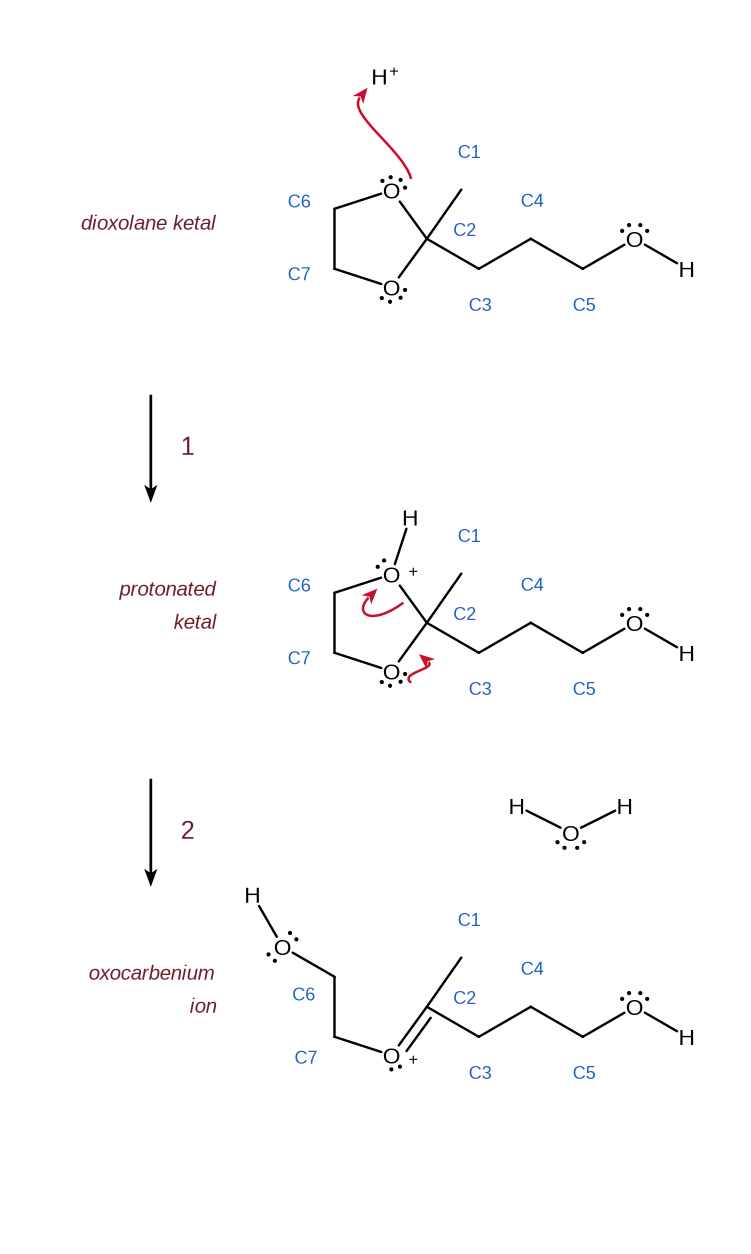
Step 1: protonation. A lone pair on one of the ring oxygens takes up H⁺. The oxygen now has three bonds and a positive charge: the protonated ketal. Either ring oxygen will do, because the molecule is symmetric at that point, and the proton comes and goes quickly.
Step 2: the ring opens. Two arrows. The C2–O⁺ bond breaks and its electrons go onto the oxygen, which leaves as a neutral OH on the end of the C6–C7 chain. At the same time a lone pair on the other ring oxygen swings in between that oxygen and C2 and becomes a C2=O⁺ double bond. Without that second arrow C2 would be left with only six electrons. With it, every atom has its octet, and the charge sits on the oxygen. This is the oxocarbenium ion. The leaving group has not left the molecule: the diol is still attached at the other end of the C6–C7 chain, so the OH can fall back onto C2 and close the ring again. This is one reason hydrolysis needs a large excess of water: it is a race between the water and the loose end of the chain. The other is that every step is reversible, so the excess of water is also what drives the equilibrium towards the ketone.
Steps 3 and 4: water adds, a proton leaves
The oxocarbenium ion is the electrophile of the whole reaction, exactly as it was in the formation. A water molecule is the nucleophile.
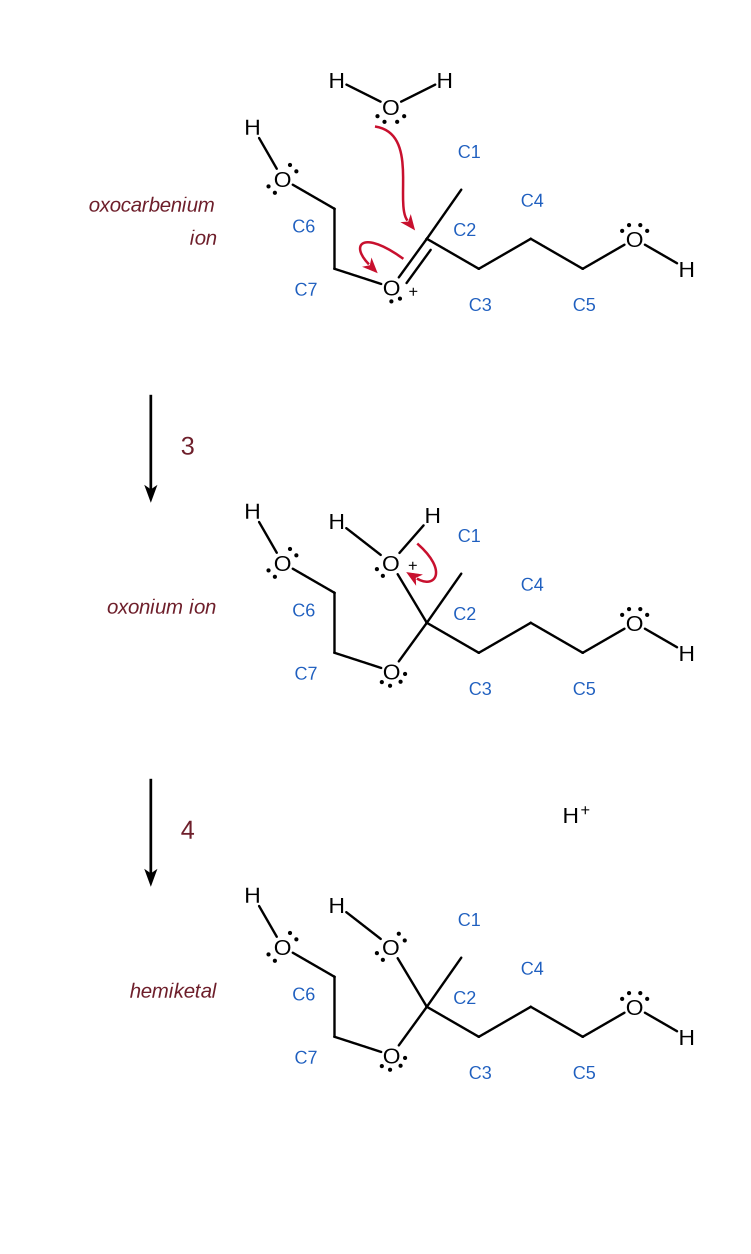
Step 3: water attacks. A lone pair on the water oxygen bonds to C2 and the C2=O⁺ π electrons go back onto the ether oxygen, which is neutral again (two arrows). The new oxygen has three bonds and a positive charge. C2 is tetrahedral once more.
Step 4: a proton leaves. The O⁺–H bond breaks and its electrons stay on the oxygen. The proton goes into the solution. C2 now carries an OH and an O–CH₂CH₂OH group. Compounds with this pattern are called hemiketals (hemiacetals, if C2 had been an aldehyde carbon). We are halfway.
Steps 5 to 7: the diol leaves and the ketone returns
The hemiketal is not the end: it still carries the diol on one oxygen. To finish, that ether oxygen must leave, and, as in step 2, it can only do so after being protonated.
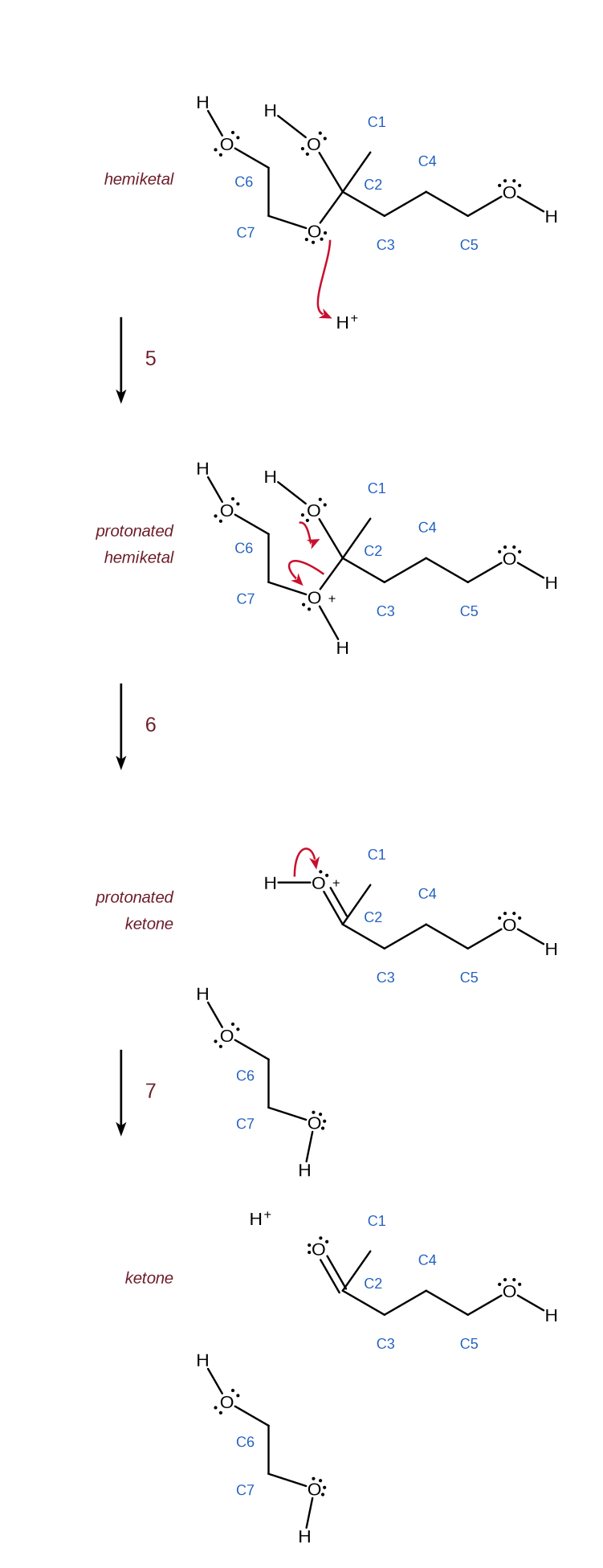
Step 5: protonation. A lone pair on the ether oxygen, the one that carries the C7–C6 chain, takes up H⁺. This oxygen is now a good leaving group: it is about to leave as part of a neutral alcohol. (Protonating the OH on C2 instead would only send water out again and return the oxocarbenium ion, so the productive route is the one drawn.)
Step 6: ethane-1,2-diol leaves. Two arrows again. The C2–O⁺ bond breaks and its electrons go onto the oxygen, so the diol leaves as an ordinary molecule with two OH groups. At the same time a lone pair on the OH oxygen on C2 swings in and becomes a C2=O⁺ double bond. The result is the protonated ketone. The diol is no longer attached to the molecule, so it cannot ring-close again unless the ketone is back in the presence of acid and diol, which is just the formation in the forward direction.
Step 7: a proton leaves. The O⁺–H bond breaks, its electrons stay on the oxygen, and H⁺ is back in solution. The product is 5-hydroxypentan-2-one, with its ketone restored on C2 and the OH of C5 untouched. (That OH can attack the ketone to give a five-membered cyclic hemiketal, but in water this is a small equilibrium and the open form dominates.) Two protons went in (steps 1 and 5) and two came out (steps 4 and 7), so the acid is not consumed.
How to push it to the ketone, and what to avoid
Every step is reversible, so the equilibrium has to be pushed the other way from the formation: instead of removing water you add a lot of it, often as a mixture of water with a solvent that dissolves the organic compound, together with a little acid. Ketals tend to hydrolyse faster than the acetals of aldehydes, because the extra carbon group on C2 helps to stabilise the oxocarbenium ion of step 2. In practice that means a ketal can come off in milder acid than an aldehyde acetal does.
The same reasoning tells you what not to do. If the acetal has to survive a step, that step must not be acidic and wet. Bases, nucleophiles and hydride reagents are fine, and so is a work-up with water alone; aqueous acid is not.
Key idea. Hydrolysis is the formation read backwards: protonate an oxygen, let it leave while the neighbouring oxygen pushes (oxocarbenium ion), add water, lose a proton, then do it all again on the other oxygen. Protect with diol and acid while removing the water; deprotect with water and acid. Between the two, the acetal is untouchable by bases and nucleophiles.
More from Structure
Hemiacetal or acetal? How to tell them apart
One carbon, two oxygens, and one hydrogen of difference. What a hemiacetal is, what an acetal is, why only one of them fits in a bottle, and how a sugar ring is a hemiacetal.
How does an acetal form? The full mechanism
An aldehyde, an alcohol and a drop of acid. Seven steps later two O–R groups sit on one carbon and the acid is untouched. Every arrow, every intermediate.
Why does acetal formation need acid and not base?
Base makes methanol a stronger attacker, so why does the acetal only form in acid? Two jobs, and the second one is the one base can never do.
What does a pKa tell you? Acid strength from one number
One small number says how hard an acid pushes its proton away, and with it you can tell which hydrogen in a molecule leaves first. Here is how to read it.