
 PossieChem
Hemiacetal or acetal? How to tell them apart
One carbon, two oxygens, and one hydrogen of difference. What a hemiacetal is, what an acetal is, why only one of them fits in a bottle, and how a sugar ring is a hemiacetal.
- Lone pairs and formal charges
- Curly arrows: one arrow moves one pair of electrons
- The C=O bond is polarised: the carbon is the electron-poor end
Take an aldehyde, add an alcohol and a pinch of acid, and the carbon that used to be the C=O loses its double bond and ends up with single bonds to oxygen only. Stop halfway and that carbon holds one OH and one O–R. Go all the way and it holds two O–R. The first compound is a hemiacetal, the second is an acetal.
Figure 1 shows the three stages on benzaldehyde. The carbon we follow is C1, the carbon of the former C=O, and the only thing that changes from the middle structure to the right-hand one is one small detail: an O–H becomes an O–CH₃.
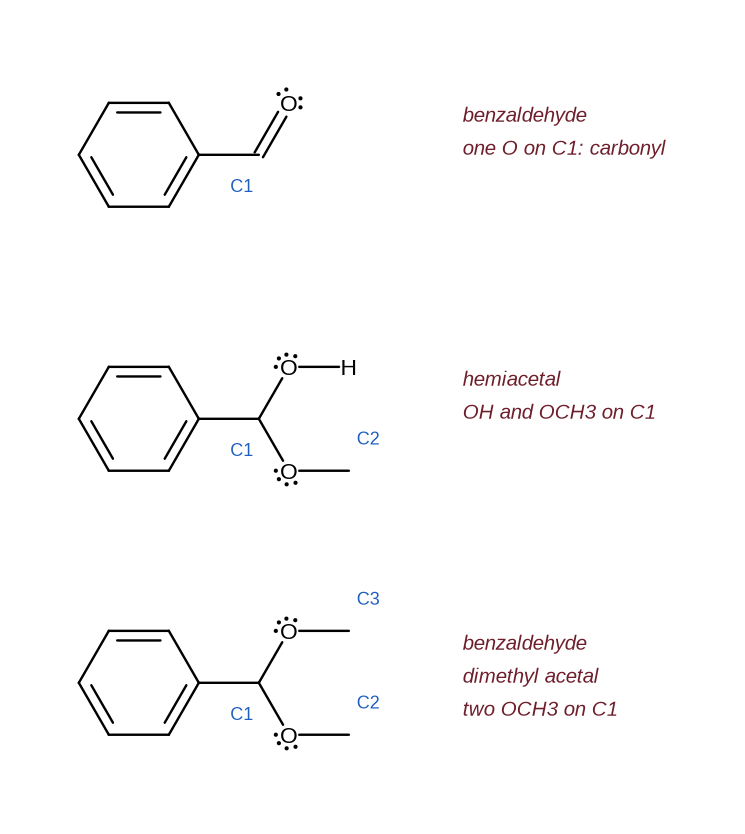
That one hydrogen changes a great deal. You can buy the acetal in a bottle and keep it for years; you will almost never find the open-chain hemiacetal on a shelf. And yet the hemiacetal is exactly where every acetal begins, and it is also the molecule that closes the ring of a sugar. So what is it, why is it so shy, and when does it stay? Below: the three steps that build it, why it falls apart, the ring that holds it together, and the two further steps that turn it into an acetal.
Counting oxygens on C1 settles the name
Look at the carbon that carries the oxygens, and ask two questions. How many oxygens are on it? And does one of them carry a hydrogen?
- One oxygen, double-bonded: it is still a carbonyl, an aldehyde (or a ketone if C1 had two carbon groups).
- Two single-bonded oxygens, one of them an O–H and the other an O–R: a hemiacetal. "Hemi" means half: half of the way from carbonyl to acetal. It is an alcohol and an ether on the same carbon.
- Two single-bonded oxygens, both O–R, no O–H: an acetal. It is two ethers on the same carbon.
When the starting material is a ketone instead of an aldehyde, the same compounds are called a hemiketal and a ketal. The chemistry is the same, and in practice both families are often just called hemiacetals and acetals. The test also works the other way round: if the carbon with two oxygens has no hydrogen on either of them but has an O–H somewhere else in the molecule, it is not a hemiacetal. The OH has to be on that same carbon. (Two OH groups on one carbon make a hydrate, and an oxygen double-bonded to the carbon makes an ester or an acid: neither is a hemiacetal.)
Key idea. The carbon with two single-bonded oxygens is the acetal carbon. If one of those oxygens still carries its H, the compound is a hemiacetal. If neither does, it is an acetal.
Steps 1 to 3: how the hemiacetal is built
A hemiacetal appears when an alcohol adds to the C=O of an aldehyde. Acid speeds it up, so we draw the acid-catalysed route, three steps, on benzaldehyde and methanol. C1 is the carbonyl carbon and C2 the methyl carbon of the methanol.
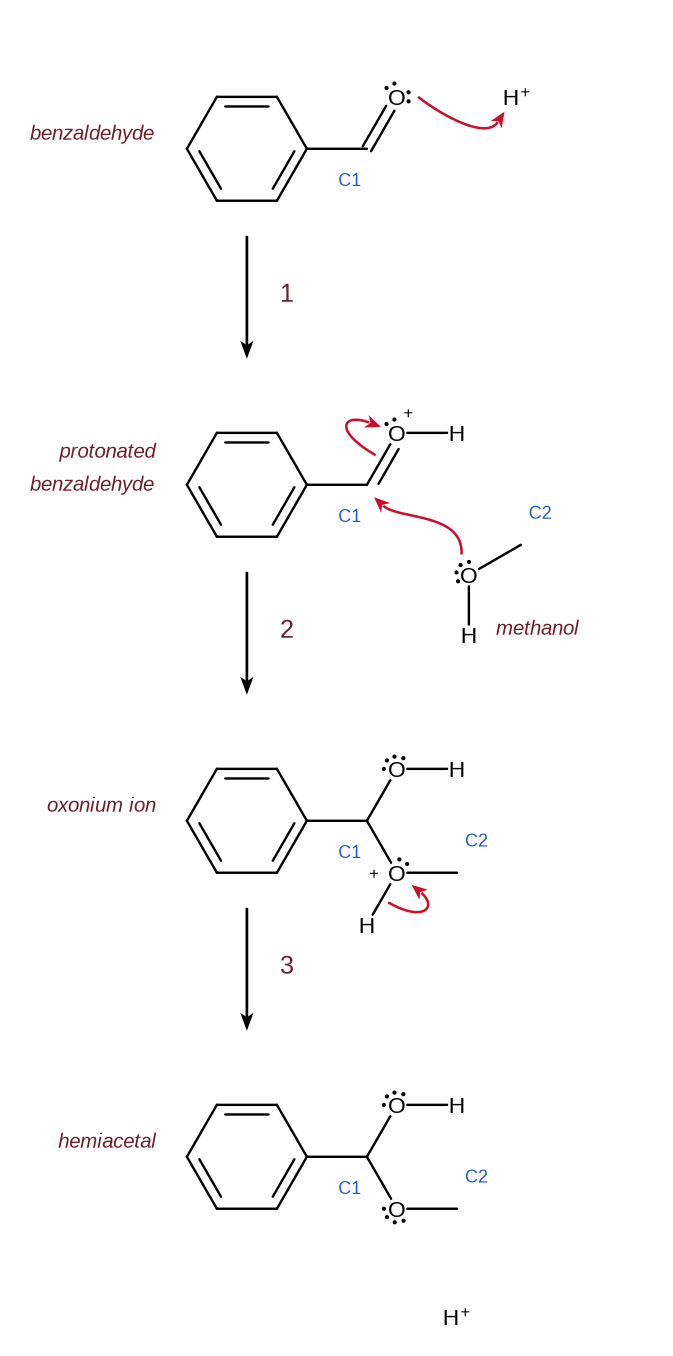
Step 1: protonation. A lone pair on the carbonyl oxygen takes up H⁺. The oxygen ends up with three bonds and a positive charge. The carbon beside it shares that charge, so C1 turns into a far hungrier electrophile.
Step 2: the alcohol attacks. A lone pair on the methanol oxygen bonds to C1 while the C=O π electrons move onto the carbonyl oxygen, which becomes a neutral OH. Two arrows. The newcomer oxygen carries three bonds and a positive charge, which makes it an oxonium ion. C1 has changed from flat to tetrahedral.
Step 3: a proton leaves. The O⁺–H bond breaks and its electrons stay on the oxygen. In reality a solvent molecule takes the proton; we draw it simply leaving. What remains is neutral: C1 carries OH and OCH₃. That is the hemiacetal. One proton came out of the solution in step 1 and one went back in step 3, so the acid is a catalyst, not a reagent.
Why an open-chain hemiacetal does not fit in a bottle
Every one of these three steps can run backwards, and the hemiacetal sits in an equilibrium with the aldehyde and the alcohol it came from. Two molecules combine into one, which costs entropy, and the gain in bond energy is small, so the equilibrium usually does not lie far on the hemiacetal side. As soon as you remove the alcohol (by evaporation or distillation) the hemiacetal falls apart again. For a ketone it is even less favourable. This is why you rarely isolate an open-chain hemiacetal: it exists in solution, in balance, and it leaves when the alcohol does.
The exception: a ring that stays closed
There is one common situation in which a hemiacetal stays. When the OH and the C=O belong to the same molecule and a five- or six-membered ring can form, they do not have to find each other in solution. They are always nearby, the reaction runs inside the molecule, no entropy is lost by bringing two molecules together, and the ring-closed form is favoured. We show this with 5-hydroxypentanal, whose chain has an aldehyde at one end (C1) and an OH at the other (C5). The drawing folds the chain on purpose, so that the OH oxygen sits next to C1 and the new bond closes a six-membered ring.
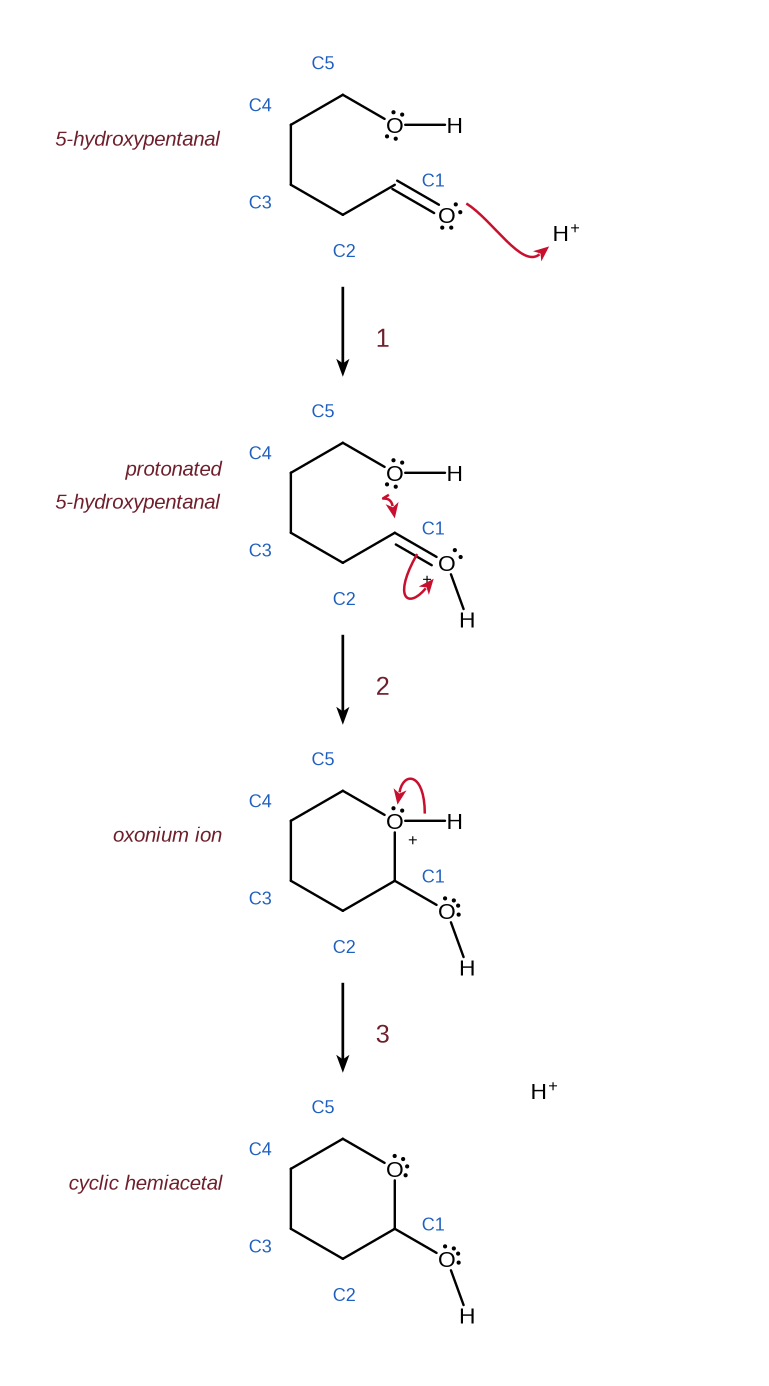
The three steps are the same as in Figure 2. The carbonyl oxygen is protonated (step 1); the lone pair of the OH oxygen on C5 attacks C1 and the C=O π electrons go onto the oxygen (step 2, the ring closes); a proton leaves the ring oxygen (step 3). The product is a ring with an OH and a ring oxygen on C1: a cyclic hemiacetal, tetrahydropyran-2-ol. In water, most 5-hydroxypentanal is in this closed form, not as the open aldehyde.
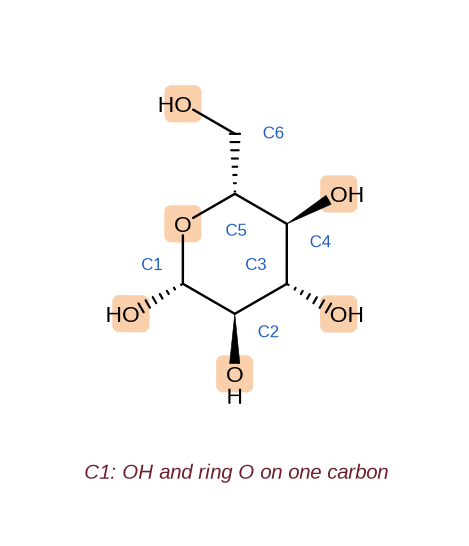
This is how a free sugar closes its ring. A sugar chain carries an aldehyde (or a ketone) and several OH groups, and one of those OH groups attacks the carbonyl to give a five- or six-membered ring, a cyclic hemiacetal. Figure 4 shows β-D-glucopyranose: its C1 carries an OH and the ring oxygen, so it is a hemiacetal carbon exactly like the one in Figure 3. (In sucrose, the sugar of the sugar bowl, the OH on that carbon has been replaced by a bond to the second ring, so there it is an acetal.)
From hemiacetal to acetal: the OH has to leave
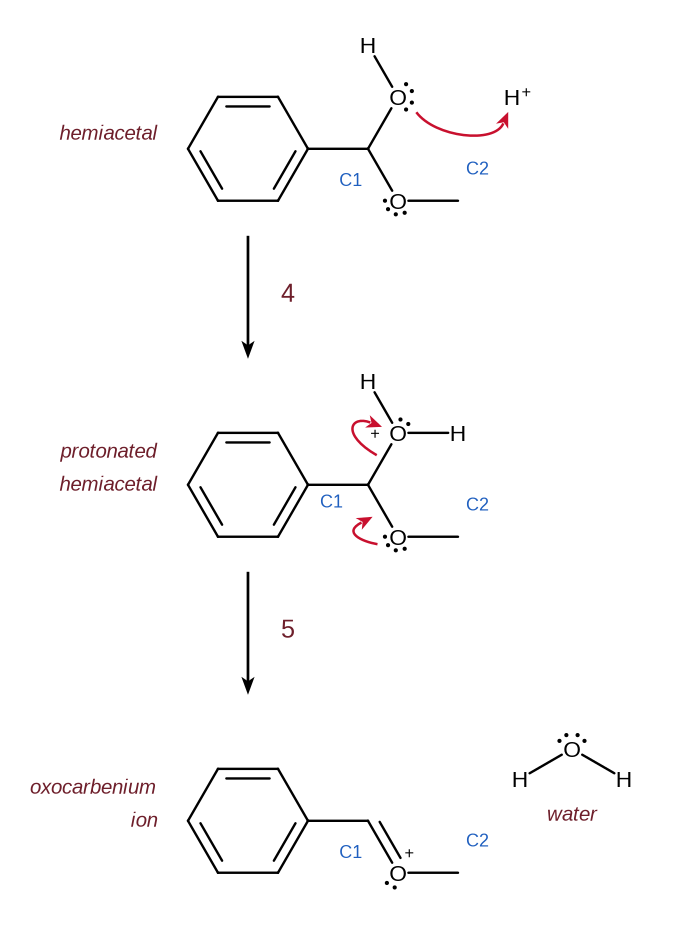
The hemiacetal is a stopping place only as long as its OH stays. To reach the acetal the OH on C1 has to be replaced by OCH₃, and for that an OH has to leave, which it will only do as water. Two more steps in acid make that happen (Figure 5): the OH is protonated, and the lone pair on the neighbouring oxygen pushes the water out and forms a C1=O⁺ double bond, an oxocarbenium ion.
A second methanol then does what the first one did (Figure 6): it attacks C1 of the oxocarbenium ion, and a proton leaves. The result has two OCH₃ groups on C1 and no O–H: the acetal.
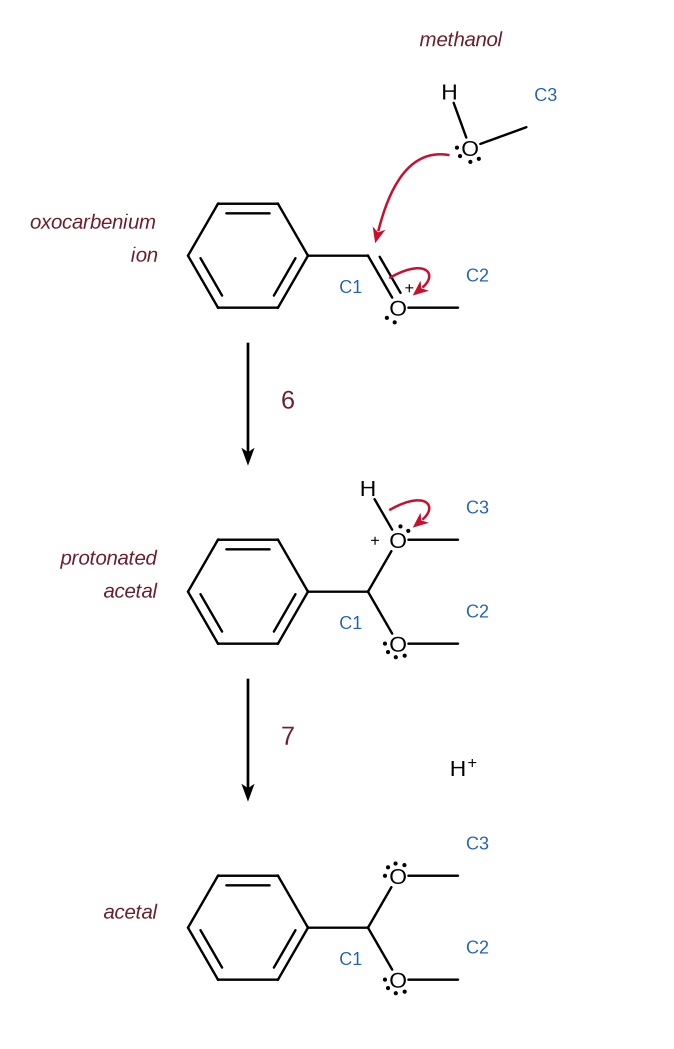
So the whole story fits on the carbon C1. A carbonyl has one oxygen. Add one alcohol and you have a hemiacetal, with an OH and an OR. Add a second alcohol, throw out a water, and you have an acetal, with two OR groups. Free sugars are the hemiacetal that stays, benzaldehyde dimethyl acetal is the acetal that can be kept, and the oxocarbenium ion in the middle is the molecule that connects them.
More from Structure
How does an acetal form? The full mechanism
An aldehyde, an alcohol and a drop of acid. Seven steps later two O–R groups sit on one carbon and the acid is untouched. Every arrow, every intermediate.
Why does acetal formation need acid and not base?
Base makes methanol a stronger attacker, so why does the acetal only form in acid? Two jobs, and the second one is the one base can never do.
How does acetal hydrolysis work? How an acetal protects a ketone
Hide a ketone behind an acetal, reduce the ester next to it, then take the acetal off with water and a drop of acid. The full hydrolysis mechanism, arrow by arrow, on a real molecule.
What does a pKa tell you? Acid strength from one number
One small number says how hard an acid pushes its proton away, and with it you can tell which hydrogen in a molecule leaves first. Here is how to read it.