
 PossieChem
What does a pKa tell you? Acid strength from one number
One small number says how hard an acid pushes its proton away, and with it you can tell which hydrogen in a molecule leaves first. Here is how to read it.
- What a lone pair and a formal charge are
- Curly arrows: one arrow moves one pair of electrons
- Reading a line drawing (carbons at the corners)
Many reactions in organic chemistry start with a proton moving from one atom to another. Before anything else happens, something takes a hydrogen off something else. So the question "which hydrogen leaves, and what is strong enough to take it?" comes up on nearly every page of the course, and one number answers most of it: the pKa.
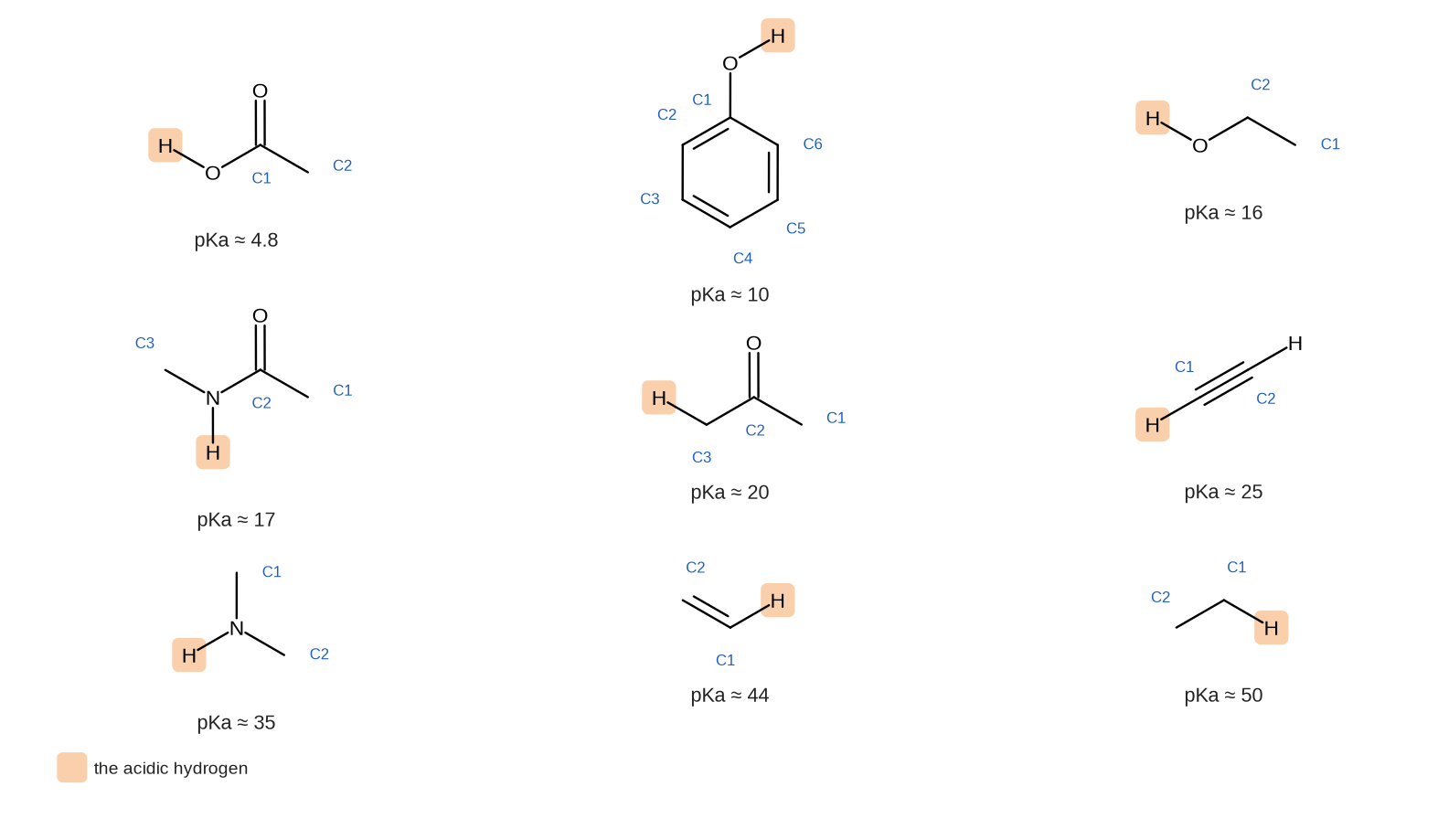
Figure 1 lists the most acidic hydrogen of nine ordinary molecules, from acetic acid at about 5 to ethane at about 50. Every one of them is a hydrogen bonded to O, N or C, and every one can in principle leave as a proton. The numbers run from 5 to 50: forty-five units, and each unit is a factor of ten.
What does that number actually say, and how do you use it to decide which of these hydrogens a base would take first? The answer is a way of reading the scale that works for every acid you will meet.
What the pKa measures: how far an acid gives its proton
In water, an acid HA hands its proton to a water molecule. Figure 2 shows it for acetic acid, with one arrow per electron pair. Arrow 1: a lone pair on the oxygen of water forms a bond to the highlighted hydrogen. Arrow 2: the O–H bond of the acid breaks and its two electrons stay on that oxygen as a lone pair.
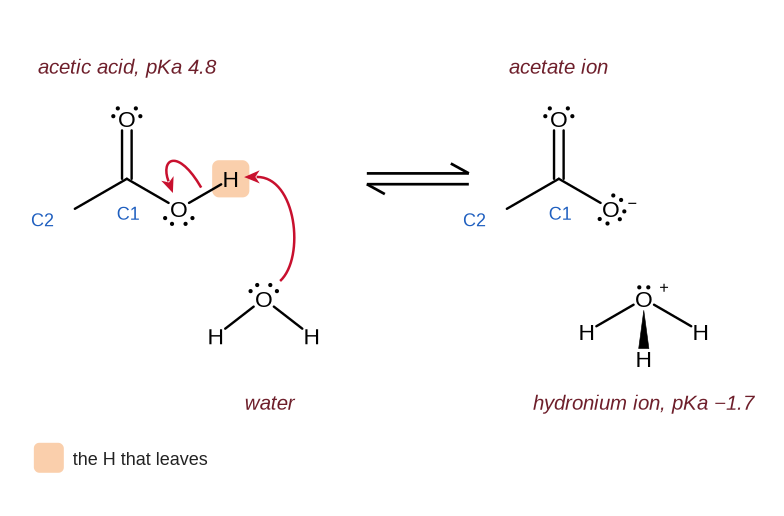
The particle that is left behind, here the acetate ion, is the conjugate base of the acid. How far the reaction goes is measured by the acid dissociation constant (square brackets are concentrations in mol/L), and its logarithmic form is the pKa:
A large means the reaction runs to the right: strong acid. A large is a small pKa, because of the minus sign. Acetic acid has , so . In a 0.1 mol/L solution that works out at roughly one molecule in a hundred having given its proton to water. The other ninety-nine are still acetic acid, so a solution of a weak acid is mostly acid.
Key idea. The pKa is a logarithm, so one unit is a factor of ten in and ten units are a factor of ten billion. A small pKa is a strong acid. The stronger the acid, the weaker its conjugate base, because the more stable the conjugate base is, the less it wants the proton back.
Which proton goes first? Compare the pKa of each one
A molecule with two acidic hydrogens loses them one at a time, and the lower pKa goes first. Lactic acid (Figure 3) has two O–H groups. The one on the carboxyl carbon C1 has a pKa of 3.9. The one on the alcohol oxygen, which sits on C2, is a typical alcohol O–H with a pKa of about 16. That is twelve units apart, so when water is the base, only the carboxyl proton leaves; the alcohol O–H stays exactly where it was.
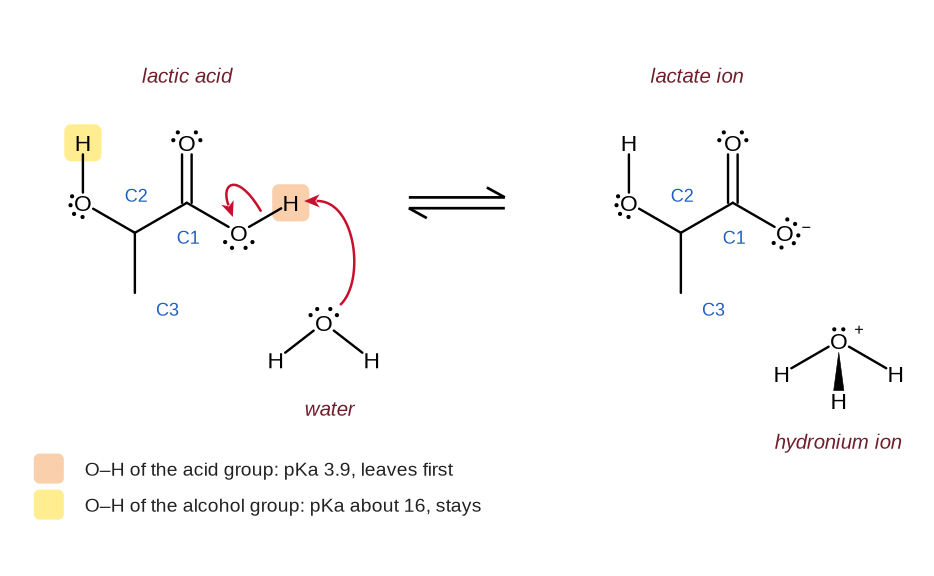
This is the whole use of the number inside one molecule: list every acidic hydrogen, find the lowest pKa, and that is the hydrogen a base meets first. Figure 1 is that list for nine different groups. The O–H hydrogen of ethanol (16) goes before the C–H hydrogens of acetone (20), which go long before the hydrogens of ethane (50).
Using the scale: from a pKa to a decision
Three habits cover most of it.
First, compare pKa values, not feelings. "Acidic" and "basic" are relative, and the pKa puts a number on the comparison. Phenol (10) is more acidic than ethanol (16) by six units, a factor of a million, and the next page shows what that does to the equilibrium.
Second, remember where the numbers come from. The values in Figure 1 are for water at 25 °C. Water itself is an acid (pKa 15.7) and a base (its conjugate acid, hydronium, has a pKa of −1.7), so in water you cannot measure acids stronger than hydronium or weaker than water directly. The pKa values for ethyne, ethene, ethane and dimethylamine, far beyond that window, are estimates made in other solvents and by calculation. They are good for ranking and not good to the second decimal.
Third, keep the proton and the pair straight: the pKa belongs to an acid, the molecule that still has its hydrogen.
Watch out. A pKa always belongs to the acid. The 35 in Figure 1 is for the N–H of dimethylamine losing a proton from the neutral amine, and a neutral amine is a hopeless acid. It says nothing about how basic that amine is. For basicity you use the pKa of the protonated amine, which sits near 11 for a simple alkylamine and gets its own page.
With a pKa for the acid you have, and a pKa for the acid your base would turn into, you can say which way the reaction runs and by how much. That is the next step.
More from Structure
Which way does an acid–base reaction go? Predict it with pKa
Put phenol and pyridine in a flask and ask which way the proton moves. One subtraction of two pKa values gives the direction and how far it goes.
Why is acetic acid so much more acidic than ethanol?
Both lose a proton from an O–H bond, yet acetic acid is about a hundred billion times more acidic than ethanol. The reason is where the leftover charge can sit.
Why is HI a stronger acid than HF, though F is more electronegative?
Fluorine pulls electrons harder than iodine, so H–F should be the strongest of the hydrogen halides. It is the weakest. The trend turns around when you go down a group.
Why is ethyne so much more acidic than ethane? The s character
Ethane, ethene and ethyne all lose a proton from a C–H bond, yet their pKa values run 50, 44 and 25. Same two elements, 25 units apart. The difference is the hybrid orbital.