
 PossieChem
Why does acetal formation need acid and not base?
Base makes methanol a stronger attacker, so why does the acetal only form in acid? Two jobs, and the second one is the one base can never do.
- Lone pairs and formal charges
- Curly arrows: one arrow moves one pair of electrons
- What pKa means (a small pKa is a strong acid)
- What a leaving group is
Benzaldehyde and methanol on their own do almost nothing. Add a drop of strong acid and, after a while (best in methanol as the solvent, or with the water removed), the acetal in Figure 1 appears: two OCH₃ groups on one carbon and a molecule of water thrown out. Add a base instead, one that turns methanol into a much better nucleophile, and you can wait as long as you like: no acetal.
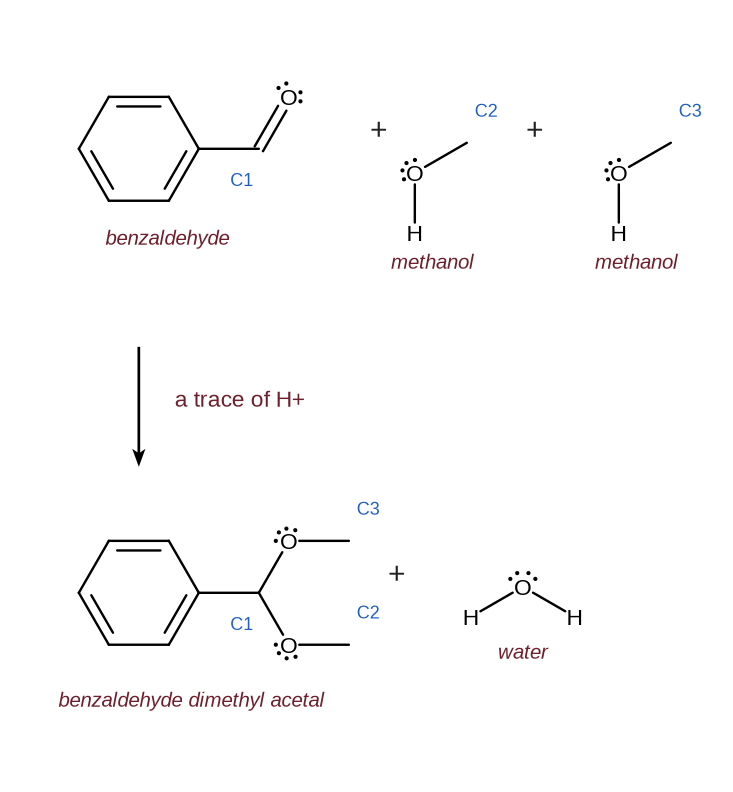
That looks backwards. A base makes the attacker stronger. An acid does the opposite for methanol: it can only make it less eager. So what does acid do for this reaction that no base can?
It does two different jobs, at two different places in the mechanism. Base can do neither of them.
Job one: acid makes C1 hungry
The first obstacle is the starting material. The carbon of a C=O is only moderately electron-poor, and methanol is a weak nucleophile. Together they meet and, mostly, ignore each other.
Acid fixes this in the very first step of the mechanism. A lone pair on the carbonyl oxygen takes up H⁺ (arrow 1 in Figure 2). The oxygen now has three bonds and carries a positive charge, and that charge does not stay on the oxygen: the π bond can move onto the oxygen, which leaves the positive charge on carbon (the curved arrow in the second row). The cation is a hybrid of these two resonance forms, and in the second one the carbon has only six electrons. C1 has become a far better electrophile.
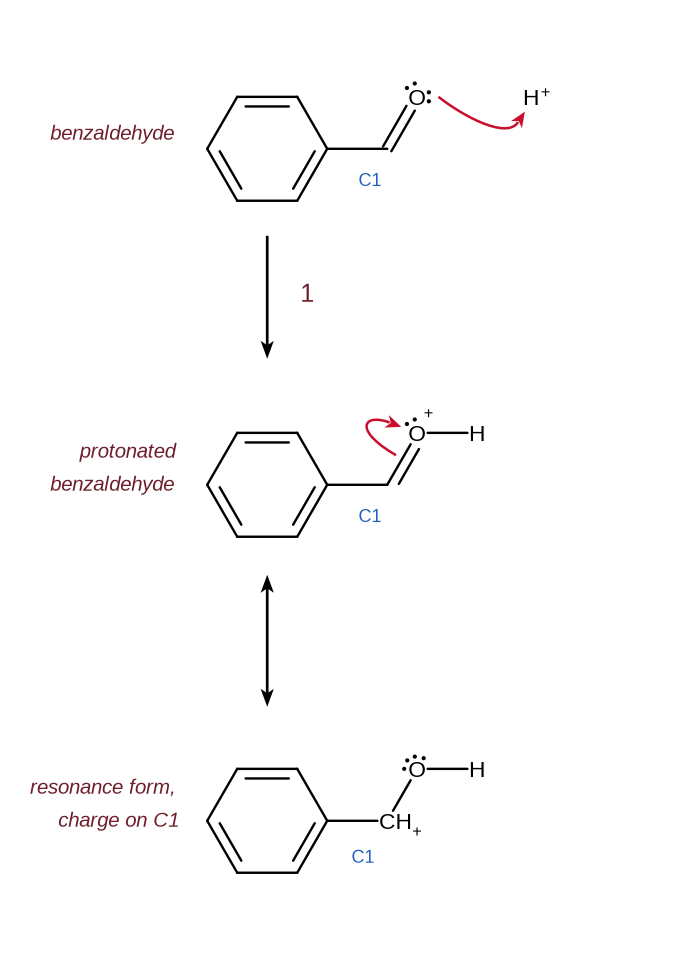
Watch out. The arrow that protonates the carbonyl starts at a lone pair on the oxygen, not at the C=O double bond. The π bond becomes the start of an arrow only once something has attacked C1 (as in Figure 3) or the oxygen already carries the H⁺.
Base does nothing for the carbonyl. It cannot protonate it, so C1 stays only moderately electron-poor.
What base does: it stops at the hemiacetal
Base does help with one thing: attack. If methanol loses a proton to a base it becomes methoxide, a much better nucleophile than methanol. Figure 3 follows it on benzaldehyde. The lone pair of the methoxide ion attacks C1 and the C=O π electrons go onto oxygen (two arrows), which gives an alkoxide intermediate. That oxygen carries a negative charge and takes a proton from a methanol molecule (two more arrows), which regenerates a methoxide ion and leaves the neutral hemiacetal.
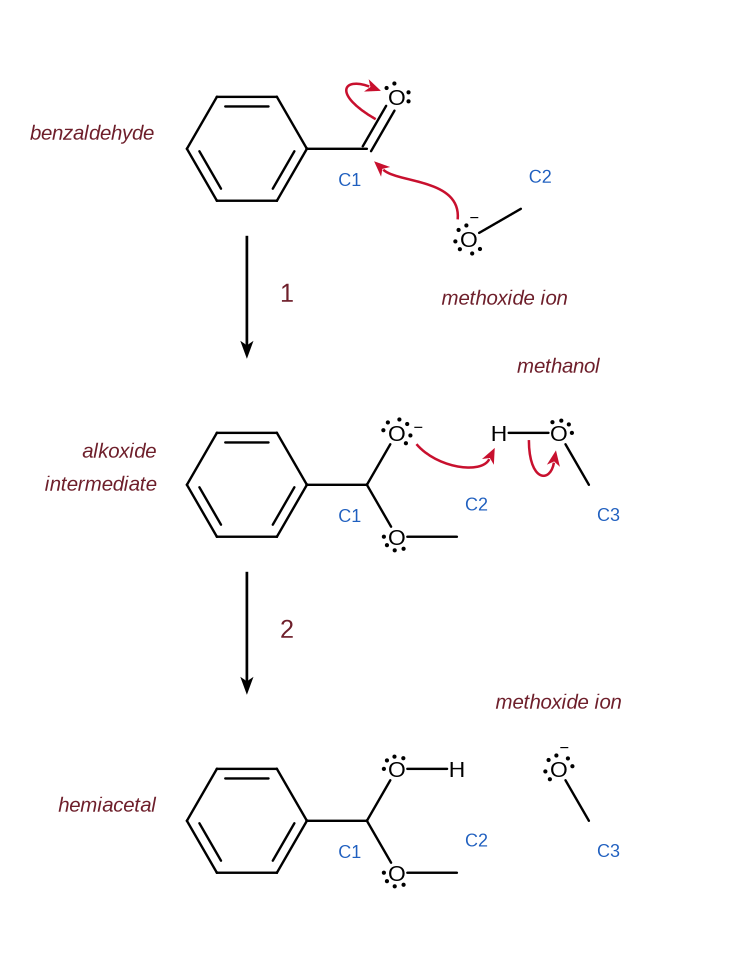
So a base can make a hemiacetal, and every step is reversible. What a base cannot do is go further, and that brings us to the second job.
Job two: acid gives the OH somewhere to go
To turn the hemiacetal into the acetal, the OH on C1 has to be replaced by OCH₃. That means the OH has to leave, and leaving groups are judged by the acid they come from: the smaller the pKa of that acid, the more comfortable the group is on its own.
The top half of Figure 4 asks what happens if the OH leaves as it is. It takes the C1–O bond electrons with it, with help from a lone pair on the neighbouring oxygen, and leaves as a hydroxide ion. The acid hydroxide comes from is water, with a pKa of 15.7. That is a very poor leaving group, and in a basic solution there is nothing around to improve it, so the hemiacetal simply stays where it is.
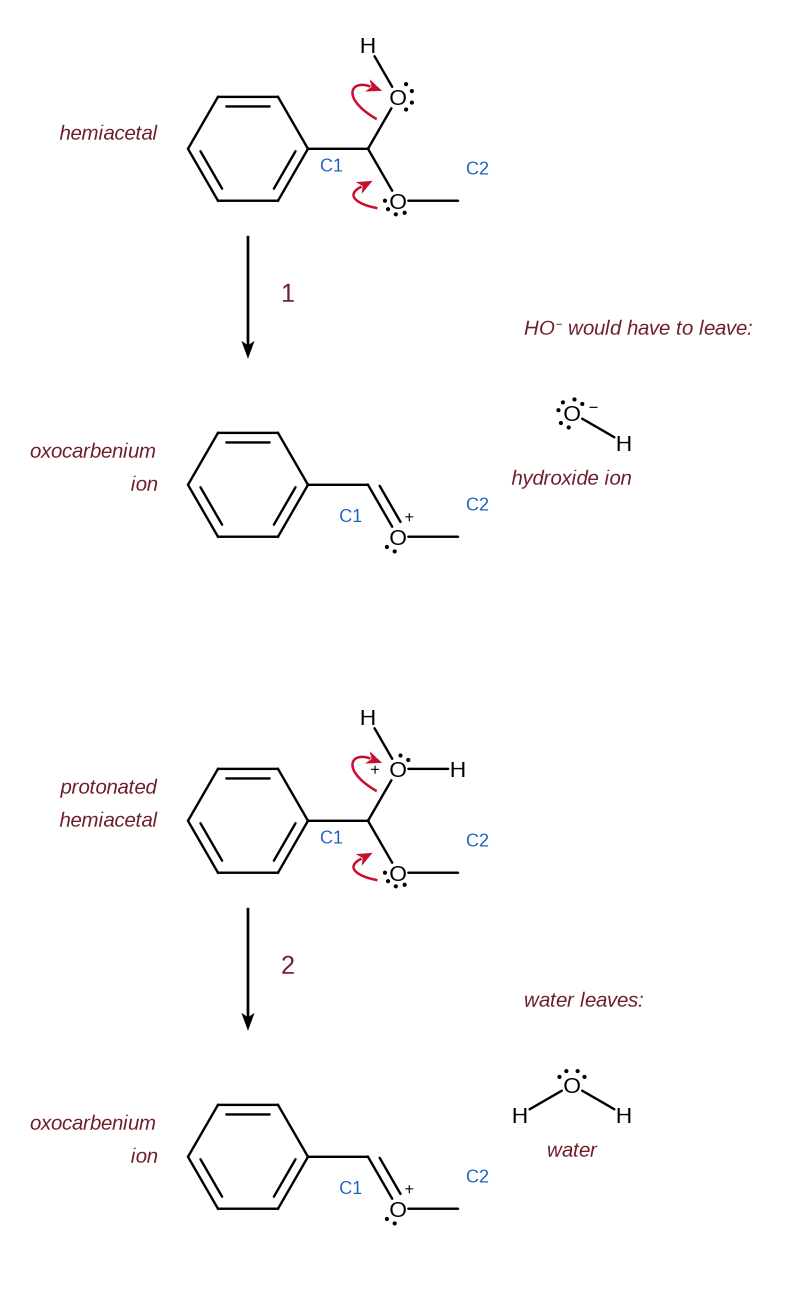
The bottom half uses the same two arrows on the protonated hemiacetal. The oxygen that has taken up an H⁺ now leaves as a neutral water molecule, and the acid that water comes from here is protonated water, with a pKa of −1.7. The gap between 15.7 and −1.7 is more than seventeen pKa units, and it is the difference between a reaction that stalls and a reaction that goes. The lone pair on the neighbouring OCH₃ oxygen pays for the departure, and the cation that results, the oxocarbenium ion, is stabilised for that very reason.
Key idea. Acid does two jobs that base cannot: it makes the carbonyl carbon electrophilic (protonate the C=O) and it turns the OH of the hemiacetal into a good leaving group (protonate the OH). Base can only speed up the attack, and the OH never gets a way out.
Why a drop is enough
The acid is a catalyst. The H⁺ that goes onto the carbonyl oxygen is handed back as soon as the first methanol has added and its adduct loses a proton (that gives the hemiacetal), and the H⁺ that goes onto the OH is handed back at the very end, when the last proton leaves and the acetal is formed. Two protons go in, two come out, and no acid is used up: it only has to be present, in a trace, when the molecules meet.
The amount can be tiny because the protonated carbonyl is so reactive. A carbonyl oxygen is a very weak base: the protonated benzaldehyde of Figure 2 has a pKa of about −7. In round numbers, even in a solution as acidic as pH 2, the ratio of protonated to unprotonated benzaldehyde is , one molecule in a thousand million. That one molecule is enormously reactive, and it hands its proton back straight away. A strong acid is needed so that these few protonated molecules appear at all, and only a trace of it is needed because it is never consumed.
The rule that follows
Acid is needed to form an acetal and to take one apart. In base the two oxygens of an acetal are never given a leaving group, which is why acetals are stable to bases, nucleophiles and organometallic reagents. In acid with water the whole mechanism runs backwards, and the acetal is gone. That is the next explanation: the acetal as a protecting group.
More from Structure
Hemiacetal or acetal? How to tell them apart
One carbon, two oxygens, and one hydrogen of difference. What a hemiacetal is, what an acetal is, why only one of them fits in a bottle, and how a sugar ring is a hemiacetal.
How does an acetal form? The full mechanism
An aldehyde, an alcohol and a drop of acid. Seven steps later two O–R groups sit on one carbon and the acid is untouched. Every arrow, every intermediate.
How does acetal hydrolysis work? How an acetal protects a ketone
Hide a ketone behind an acetal, reduce the ester next to it, then take the acetal off with water and a drop of acid. The full hydrolysis mechanism, arrow by arrow, on a real molecule.
What does a pKa tell you? Acid strength from one number
One small number says how hard an acid pushes its proton away, and with it you can tell which hydrogen in a molecule leaves first. Here is how to read it.