
 PossieChem
Why is acetic acid so much more acidic than ethanol?
Both lose a proton from an O–H bond, yet acetic acid is about a hundred billion times more acidic than ethanol. The reason is where the leftover charge can sit.
- What pKa means (a small pKa is a strong acid)
- What a lone pair and a formal charge are
- σ and π bonds
- Curly arrows: one arrow moves one pair of electrons
Look at the two molecules in Figure 1. Each has an oxygen with a hydrogen on it, and in both the hydrogen can leave as a proton. Same atom, same bond.
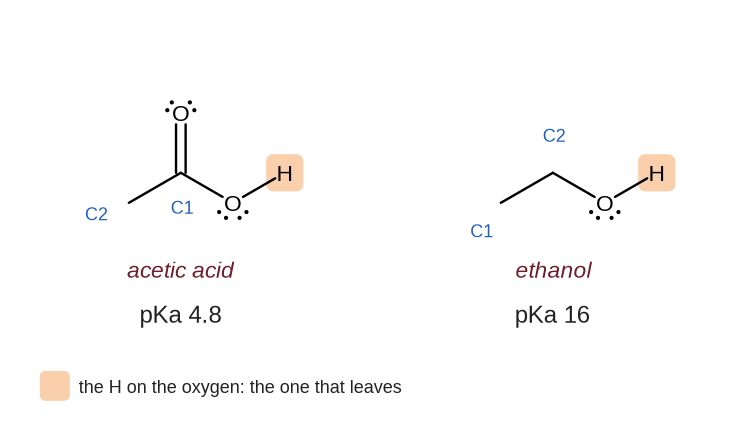
And yet vinegar will make you wince, while vodka will do many things to you, but not that. Acetic acid has a pKa of 4.8, ethanol one of about 16 (both in water at 25 °C). That is 11 units apart, and every unit is a factor of ten in the acid constant , so acetic acid is about times the stronger acid: a hundred billion times. The only difference between the two molecules is on the carbon the oxygen is attached to. In ethanol the oxygen sits on C2, a CH₂ with no C=O, just a CH₃ and two hydrogens. In acetic acid it sits on C1, a carbon that already has a C=O of its own.
A strong acid has a happy conjugate base
When an acid HA gives away its proton, the two electrons of the H–A bond stay behind on A. What is left is A⁻, the conjugate base, and the whole question is how comfortable A⁻ is with that extra negative charge. The acid constant and its logarithm measure exactly this, in water (square brackets mean concentration in mol/L):
A small pKa means a strong acid. A comfortable conjugate base means the proton leaves gladly, and an uncomfortable one means it clings on. So to compare two acids, look first at what is left when the proton has gone.
Acetic acid hands its proton to water
In water the proton goes to a water molecule. Figure 2 shows it with two arrows, and each arrow moves one pair of electrons. Arrow 1: a lone pair on the oxygen of water forms a new bond to the highlighted hydrogen. Arrow 2: the O–H bond of the acid breaks, and its two electrons become a lone pair on that oxygen.
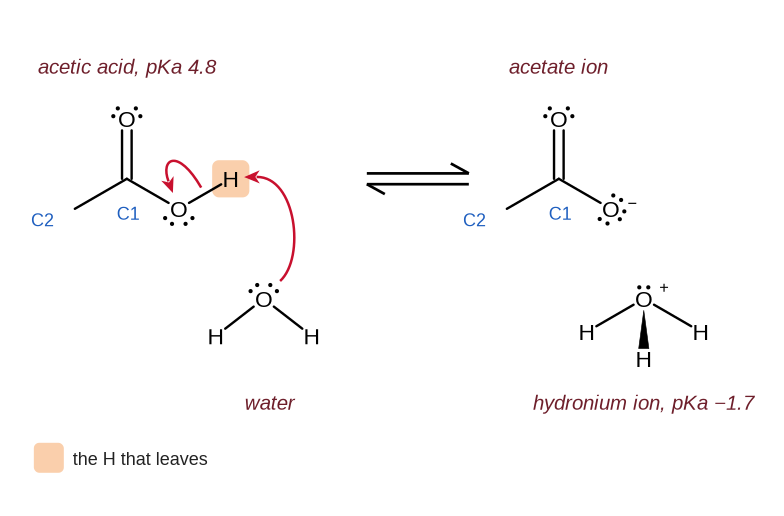
Water has become a hydronium ion, and acetic acid has become the acetate ion, with the negative charge on an oxygen. The pKa values in the figure tell you which way it runs: the hydronium ion (−1.7) is a far stronger acid than acetic acid (4.8), so the equilibrium lies on the left. (For hydronium the usual convention also divides by the 55.5 mol/L of water, which is how you get −1.7.) In a 0.1 mol/L solution of acetic acid, about one molecule in a hundred has handed over its proton.
Ethanol does exactly the same
Figure 3 is Figure 2 with the C=O taken away. The same water, the same two arrows, the same oxygen and hydrogen.
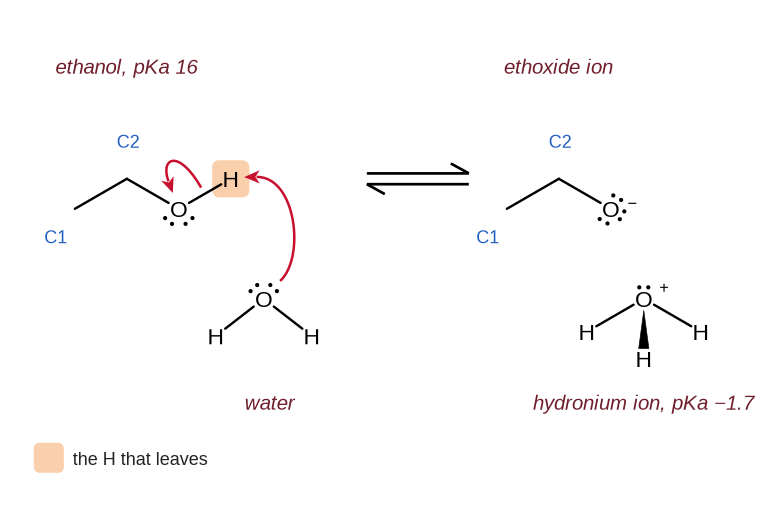
The mechanism is identical, so the mechanism cannot be the reason. What differs is the product on the right: the ethoxide ion instead of the acetate ion. The equilibrium lies much further to the left, so a solution of ethanol in water is as neutral as water itself.
Where can the charge go?
Both anions have an oxygen with a full negative charge. They differ in what that oxygen is attached to. In ethoxide it is attached to C2, a CH₂ whose bonds are all σ bonds (single bonds). There is no π bond (the second bond of a double bond) for the charge to move into, so the whole −1 stays on one oxygen, alone.
In acetate the oxygen is attached to C1, and C1 already has a C=O (top of Figure 4). Two more arrows. Arrow 1: a lone pair of the O⁻ moves in between the oxygen and C1 and becomes a new C1=O π bond. Arrow 2: the old C1=O π bond moves onto the other oxygen as a lone pair. C1 never has more than four bonds, because a π bond leaves as one arrives. What comes out is the same ion, with the roles of the two oxygens swapped.
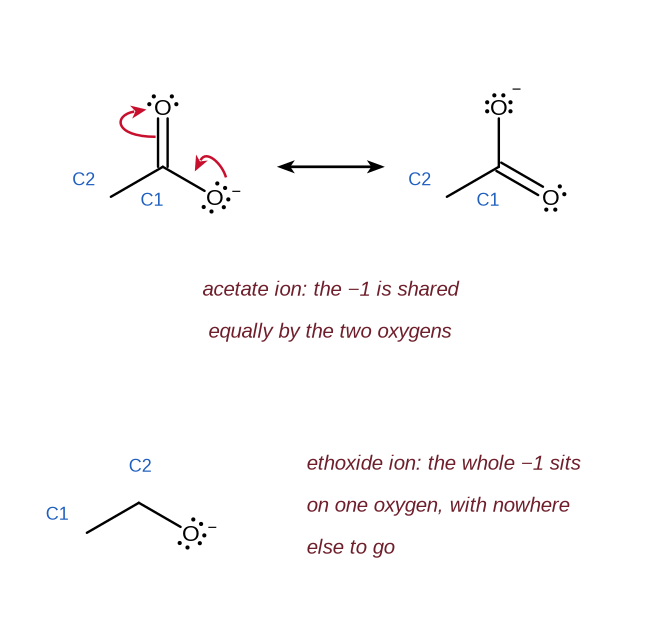
The two drawings are resonance structures, joined by the double-headed arrow ↔. They are not two molecules that keep swapping. The ion is one thing, a hybrid, and it needs two drawings because one drawing cannot show it. A mule is not a horse on Monday and a donkey on Tuesday either: it is a mule all week, and you can only describe it with two other animals. The evidence is in the ion itself. The two C–O bonds of acetate are equal in length (about 1.26 Å, between a C–O single bond and a C=O double bond), and by symmetry the two oxygens share the −1 equally.
Watch out. The double-headed arrow ↔ means "two drawings of the same particle". The two half arrows ⇌ in Figures 2 and 3 mean "two different particles, in balance". Mixing them up turns acetate into a molecule that flickers.
Ethoxide is a one-seat stool: the whole charge has to sit on it. Acetate is a two-seat sofa: the charge spreads out over two oxygens, and a charge spread out is lower in energy than a charge piled up. That is why acetate is so much more comfortable, why acetic acid is so much the stronger acid, and why its pKa is 4.8 and not 16.
What 11 pKa units look like
Eleven units is a factor of about in . In energy: one pKa unit is kJ/mol at 25 °C ( the gas constant, K), so 11 units are about 63 kJ/mol. The deprotonation of acetic acid is that much more favourable than that of ethanol, in free energy (Gibbs energy).
In water held at pH 7 (neutral), the ratio of anion to acid is . For acetic acid that is : there are about 160 acetate ions for every acetic acid molecule. For ethanol it is : about one ethoxide ion for every billion ethanol molecules.
Resonance is the standard explanation, but not the only factor. The C=O also pulls electrons through the σ bond towards itself, which takes some of the charge off the oxygen. That effect is called induction, and it helps acetate as well. Chemists still argue about the exact split between the two.
Compare the conjugate bases first. Acetate shares its −1 over two oxygens through resonance, and the C=O pulls on it as well; ethoxide has one oxygen and only one place to put it. Together that is worth about 11 pKa units, a factor of .
More from Structure
What does a pKa tell you? Acid strength from one number
One small number says how hard an acid pushes its proton away, and with it you can tell which hydrogen in a molecule leaves first. Here is how to read it.
Which way does an acid–base reaction go? Predict it with pKa
Put phenol and pyridine in a flask and ask which way the proton moves. One subtraction of two pKa values gives the direction and how far it goes.
Why is HI a stronger acid than HF, though F is more electronegative?
Fluorine pulls electrons harder than iodine, so H–F should be the strongest of the hydrogen halides. It is the weakest. The trend turns around when you go down a group.
Why is ethyne so much more acidic than ethane? The s character
Ethane, ethene and ethyne all lose a proton from a C–H bond, yet their pKa values run 50, 44 and 25. Same two elements, 25 units apart. The difference is the hybrid orbital.