
 PossieChem
Why is HI a stronger acid than HF, though F is more electronegative?
Fluorine pulls electrons harder than iodine, so H–F should be the strongest of the hydrogen halides. It is the weakest. The trend turns around when you go down a group.
- What pKa means (a small pKa is a strong acid)
- Electronegativity and the polar bond
- Curly arrows: one arrow moves one pair of electrons
Fluorine is the most electronegative element there is. It pulls the shared electrons of an H–F bond so hard that the bond is strongly polar, with a hydrogen that is quite positive. If acidity were only about polarity, hydrogen fluoride should push its proton away more eagerly than any other hydrogen halide.
Figure 1 has the numbers. Hydrogen fluoride has a pKa of 3.2: a weak acid. Hydrogen chloride (HCl), hydrogen bromide (HBr) and hydrogen iodide (HI) are about −6, −9 and −10, which makes them strong acids. Between HF and HI there are 13 pKa units, a factor of ten trillion, and it goes the opposite way from electronegativity.
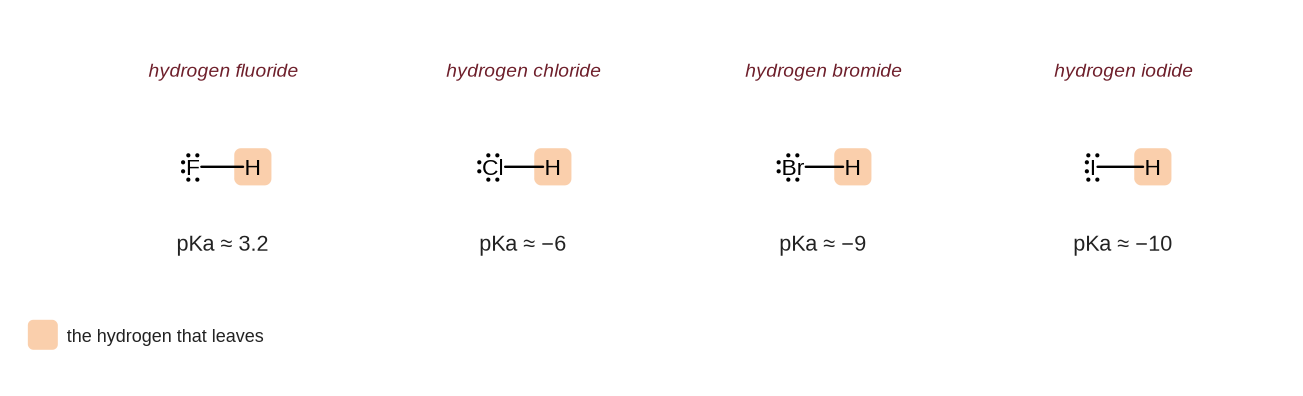
So why does the trend run the wrong way for electronegativity? Because something else takes over when you go down a column of the periodic table.
Same two arrows for HF and HI
When a hydrogen halide meets water, the same two arrows apply as for any acid. Arrow 1: a lone pair of the oxygen of water forms a bond to the hydrogen. Arrow 2: the H–X bond breaks and its two electrons become a fourth lone pair on the halogen. Figure 2 does it for HF, and Figure 3 for HI.
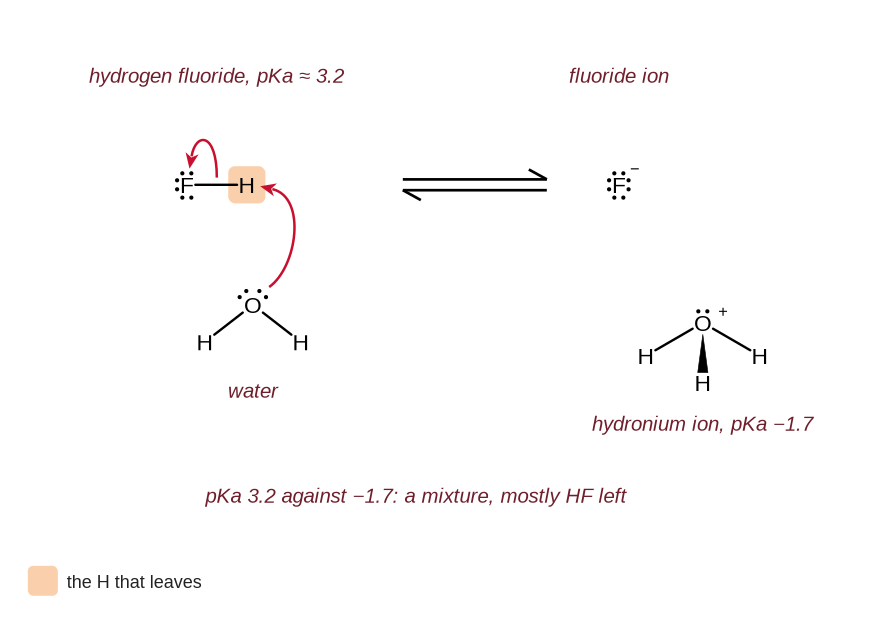
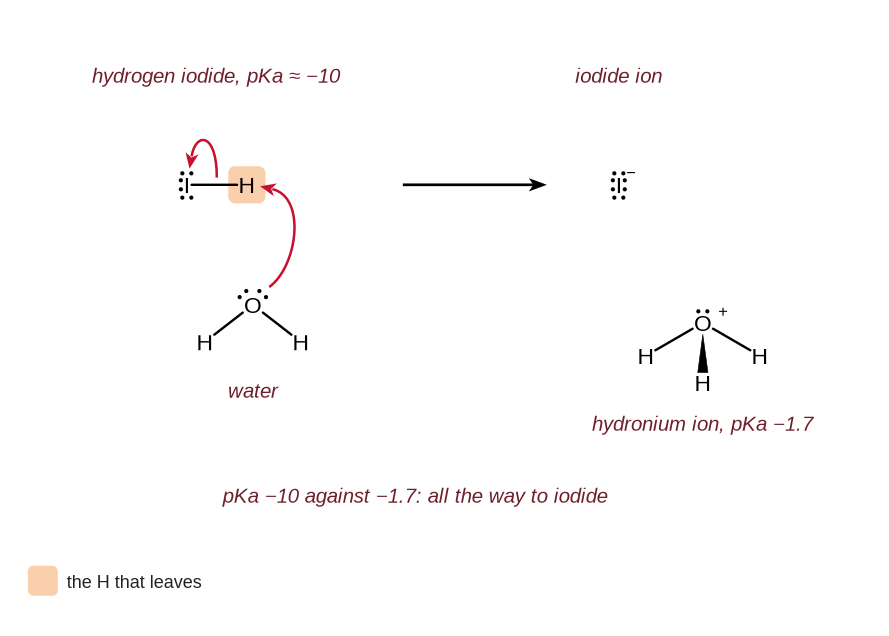
The pKa values underneath tell you how far each runs. The hydronium ion has a pKa of −1.7, and HF (3.2) is a weaker acid than that, so most of it stays as HF. HI (−10) is a far stronger acid than hydronium, so it gives up its proton to water completely. The mechanism is identical, so the difference lies in what it costs to break the bond and what the anion looks like afterwards.
Reason 1: the bond to be broken gets longer and weaker
Going down the group the halogen atoms get bigger, and the H–X bond gets longer and weaker:
| H–F | H–Cl | H–Br | H–I | |
|---|---|---|---|---|
| bond length / pm | 92 | 127 | 141 | 161 |
| bond energy / kJ mol⁻¹ | about 570 | about 430 | about 366 | about 298 |
| pKa | 3.2 | about −6 | about −9 | about −10 |
H–F is about twice as strong as H–I. That is the first part of the answer: the bond that holds the proton on iodine is much weaker than the one that holds it on fluorine, and a weak bond breaks more easily.
Reason 2: a bigger anion spreads its charge thinner
The ion left behind is X⁻. The fluoride ion is small (radius about 133 pm) and the iodide ion is big (about 220 pm). The same one negative charge sits in a much larger volume on iodide, so the charge is less concentrated and the ion is more comfortable.
Key idea. Electronegativity decides the order across a row of the periodic table. Down a column, size and bond strength decide it: a bigger atom has a longer, weaker bond to hydrogen and a more spread-out negative charge.
Here is the fine print, because the textbook answer is not the whole ledger. In water, an anion is held by the surrounding water molecules, and the small fluoride ion is held far more tightly than the large iodide ion. That partly cancels the cost of the strong H–F bond: the dissociation of HF in water is in fact slightly exothermic. What makes HF a weak acid is mostly entropy, since water has to arrange itself around the fluoride ion. "H–F is a strong bond" is the headline, and the full account has these other terms too.
The same trend within the oxygen family
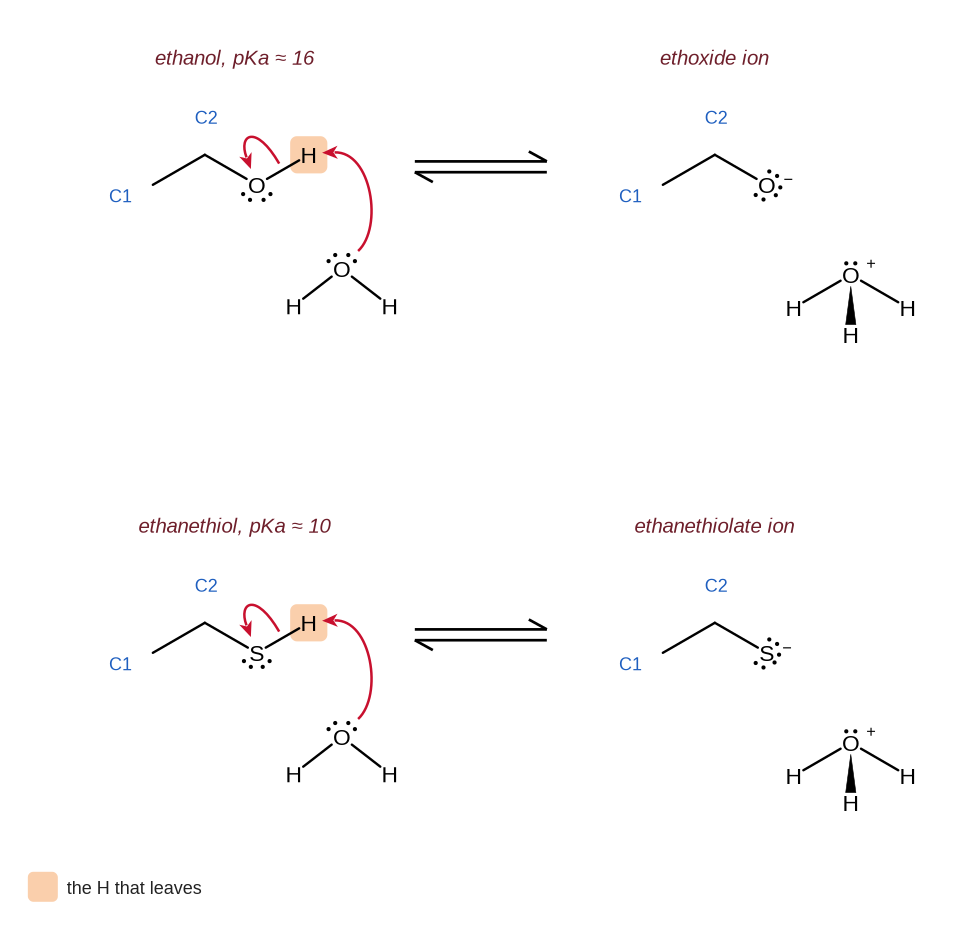
The same reasoning works one column over. Sulfur sits below oxygen, so an S–H bond is longer and weaker than an O–H bond, and a sulfur anion is bigger. Figure 4 compares ethanol and ethanethiol, the sulfur analogue of ethanol, each with water. Same two arrows, and the S–H hydrogen leaves far more easily: pKa about 10 for ethanethiol against about 16 for ethanol. A thiol is about a million times more acidic than the matching alcohol.
Watch out. HCl, HBr and HI are all "strong" in water, and in water you cannot rank them. Each one gives its proton to water completely, so the acid in the solution is the hydronium ion every time. Their pKa values of −6, −9 and −10 are estimates from other solvents and from calculation. The ranking is real, but water hides it.
More from Structure
What does a pKa tell you? Acid strength from one number
One small number says how hard an acid pushes its proton away, and with it you can tell which hydrogen in a molecule leaves first. Here is how to read it.
Which way does an acid–base reaction go? Predict it with pKa
Put phenol and pyridine in a flask and ask which way the proton moves. One subtraction of two pKa values gives the direction and how far it goes.
Why is acetic acid so much more acidic than ethanol?
Both lose a proton from an O–H bond, yet acetic acid is about a hundred billion times more acidic than ethanol. The reason is where the leftover charge can sit.
Why is ethyne so much more acidic than ethane? The s character
Ethane, ethene and ethyne all lose a proton from a C–H bond, yet their pKa values run 50, 44 and 25. Same two elements, 25 units apart. The difference is the hybrid orbital.