
 PossieChem
Which way does an acid–base reaction go? Predict it with pKa
Put phenol and pyridine in a flask and ask which way the proton moves. One subtraction of two pKa values gives the direction and how far it goes.
- What a pKa means (a small pKa is a strong acid)
- What a conjugate base is
- Curly arrows: one arrow moves one pair of electrons
Here is a small experiment you can do on paper. Take phenol, an acid with a pKa of about 10, and pyridine, a base. Pyridine can take a proton on its nitrogen, and then it is the pyridinium ion, an acid with a pKa of about 5. If phenol hands over its proton you get the phenolate ion and the pyridinium ion. Figure 1 shows both sides of the equilibrium.
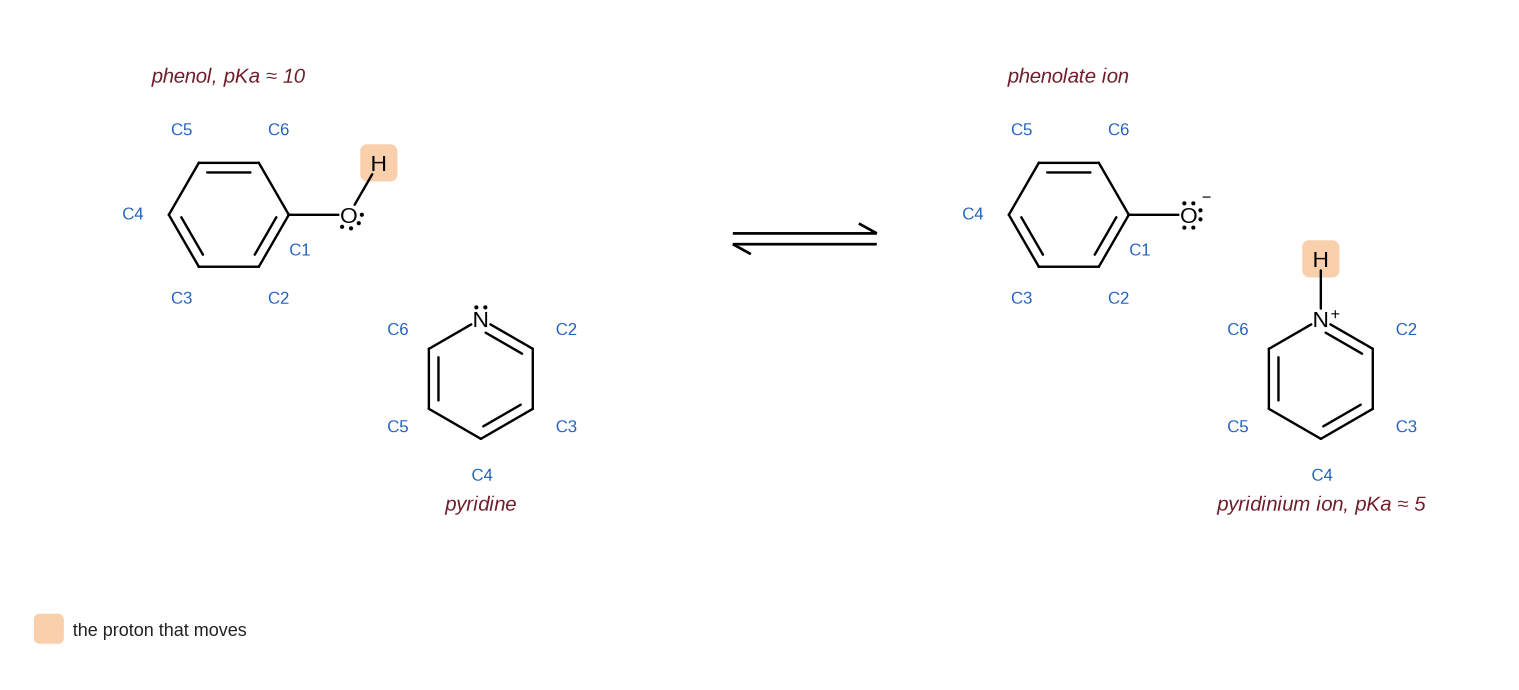
Does the proton go from phenol to pyridine? All of it, none of it, or half? You do not need a calculator or a lab: you need the two pKa values in the figure and one subtraction. It works for the acid–base reactions of this course, from the mildest to the most violent.
The rule: subtract the two pKa values
Write the reaction as an acid HA giving its proton to a base B⁻, which turns into HB (for a neutral base such as pyridine, B is neutral and HB is its protonated form). The equilibrium constant is the ratio of the two acid constants:
HA is the acid you start with, and HB is the acid that forms. In words: take the pKa of the acid on the right, subtract the pKa of the acid on the left, and raise ten to that power. The equilibrium lies on the side of the weaker acid, the one with the higher pKa, because that is the side where the proton is more tightly held.
Key idea. . The proton moves towards the acid with the higher pKa. Every unit of difference is a factor of ten.
Example 1: phenol and pyridine go the wrong way
The acid on the left is phenol (pKa about 10), the acid on the right is the pyridinium ion (about 5). Figure 2 puts in the arrows: the lone pair on the nitrogen of pyridine takes the hydrogen (arrow 1), and the O–H bond becomes a lone pair on the oxygen (arrow 2). Two arrows, one proton.
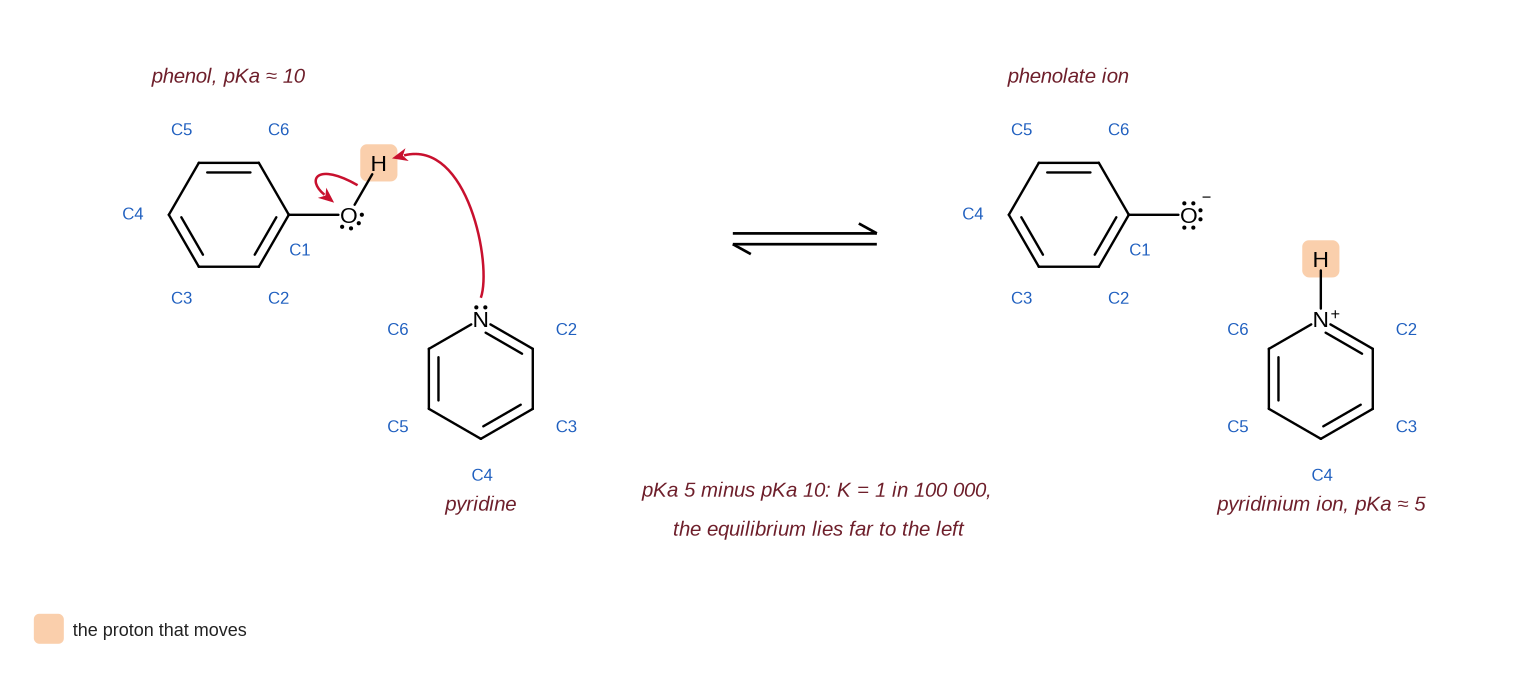
One part in a hundred thousand. Pyridine is too weak a base to deprotonate phenol to any real extent: at equilibrium nearly all of the phenol is still phenol. The reaction is not wrong, it is just far to the left.
Example 2: an amide and the amide ion go all the way
Now turn it around. The N–H of an amide, here the N-methylacetamide of Figure 3, has a pKa of about 17. The amide ion NH₂⁻, a very strong base (it exists in liquid ammonia or an ether, not in water, where it would simply give hydroxide), would turn into ammonia (pKa about 38) by taking that proton, so the acid on the right is far weaker than the acid on the left.
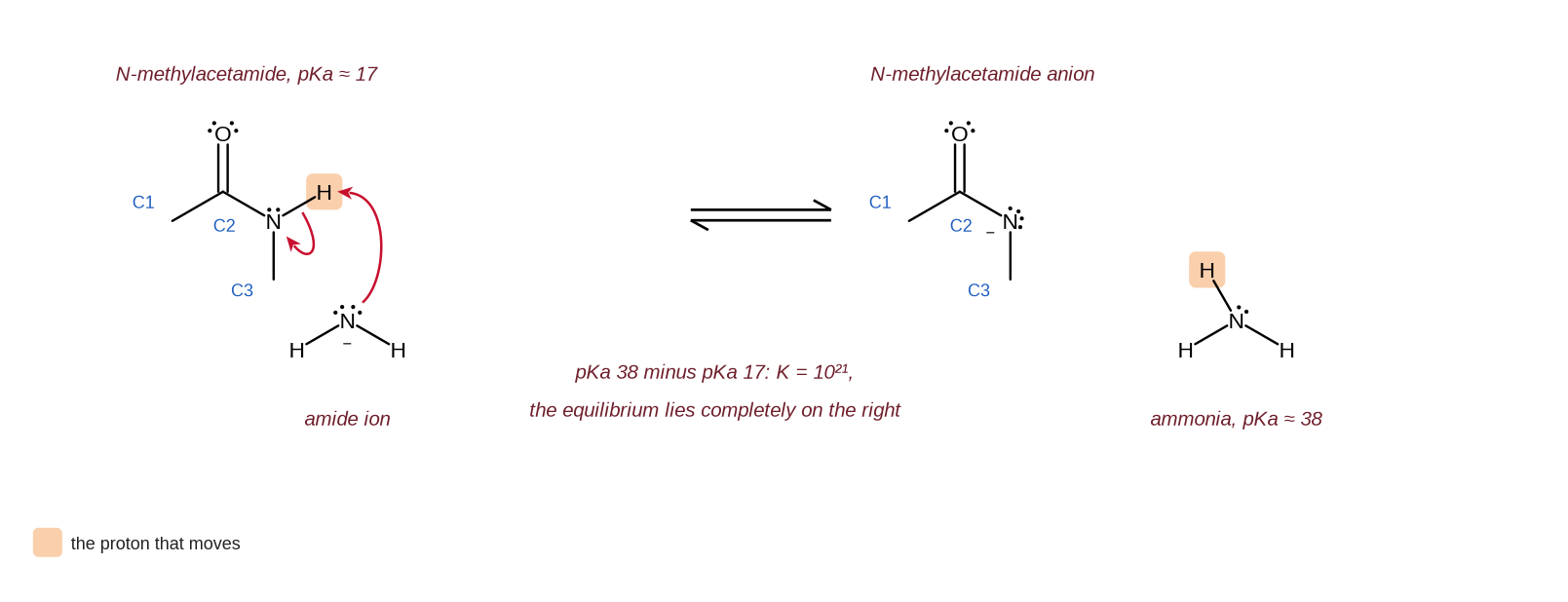
is a number so large that the left side is, for any practical purpose, empty. When the pKa values differ by this much, the question "does it react?" has the answer "completely".
Example 3: acetic acid and hydroxide
A reaction you can do in a beaker: acetic acid (pKa 4.8) and hydroxide ion. The proton goes to the oxygen of hydroxide and water is formed. On the right the acid is water, with a pKa of 15.7.
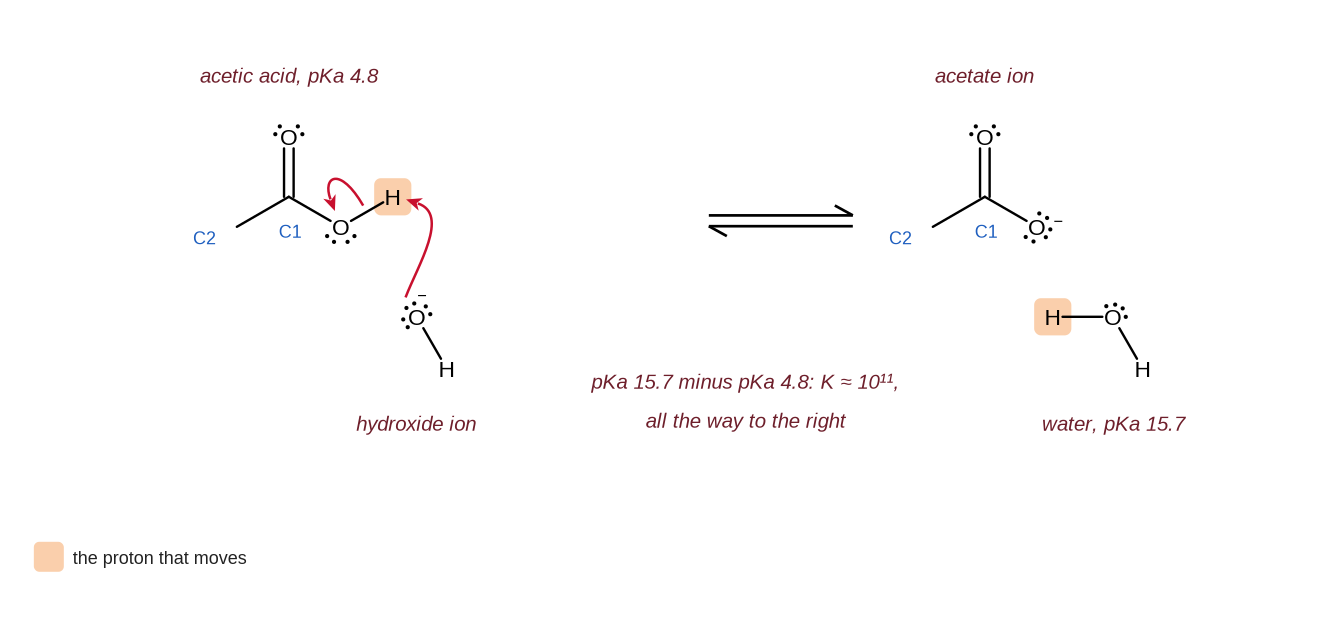
So hydroxide is a lot more than strong enough: a hundred billion to one, in favour of the acetate ion and water. This is why aqueous sodium hydroxide converts a carboxylic acid completely into its carboxylate.
How big is big enough? A table
Start from equal amounts of acid and base, and look at what fraction of each has reacted at equilibrium. For and a fraction converted, , which gives:
| (right) − (left) | Fraction converted | What you see | |
|---|---|---|---|
| +3 | 1000 | 97% | almost complete |
| +2 | 100 | 91% | mostly products |
| +1 | 10 | 76% | a real mixture |
| 0 | 1 | 50% | half and half |
| −1 | 0.1 | 24% | a mixture, reactants favoured |
| −2 | 0.01 | 9% | mostly reactants |
| −3 | 0.001 | 3% | almost nothing |
The rule of thumb that comes out of it: a difference of three or more means the equilibrium lies almost completely on one side. A difference of one or two is a real mixture. That is why a base is "strong enough" for an acid when the pKa of its own conjugate acid is at least about three units higher than the pKa of the acid.
Watch out. These numbers assume equal starting amounts and ideal behaviour. Even a bad equilibrium can be pulled over if one product leaves the mixture, as a gas or a precipitate does, and the pKa values are approximations that depend on the solvent. Use the subtraction to decide whether a reaction can work, and be a little suspicious of anything within a unit or two of zero.
More from Structure
What does a pKa tell you? Acid strength from one number
One small number says how hard an acid pushes its proton away, and with it you can tell which hydrogen in a molecule leaves first. Here is how to read it.
Why is acetic acid so much more acidic than ethanol?
Both lose a proton from an O–H bond, yet acetic acid is about a hundred billion times more acidic than ethanol. The reason is where the leftover charge can sit.
Why is HI a stronger acid than HF, though F is more electronegative?
Fluorine pulls electrons harder than iodine, so H–F should be the strongest of the hydrogen halides. It is the weakest. The trend turns around when you go down a group.
Why is ethyne so much more acidic than ethane? The s character
Ethane, ethene and ethyne all lose a proton from a C–H bond, yet their pKa values run 50, 44 and 25. Same two elements, 25 units apart. The difference is the hybrid orbital.