
 PossieChem
Why is ethyne so much more acidic than ethane? The s character
Ethane, ethene and ethyne all lose a proton from a C–H bond, yet their pKa values run 50, 44 and 25. Same two elements, 25 units apart. The difference is the hybrid orbital.
- sp3, sp2 and sp hybridisation
- What pKa means (a small pKa is a strong acid)
- Lone pairs and formal charge
Look at the three molecules in Figure 1. Each one has a hydrogen bonded to a carbon. Same two elements, a C–H bond each time, the same hydrogen leaving as a proton in each case. And yet their pKa values are 50 for ethane, 44 for ethene and 25 for ethyne.
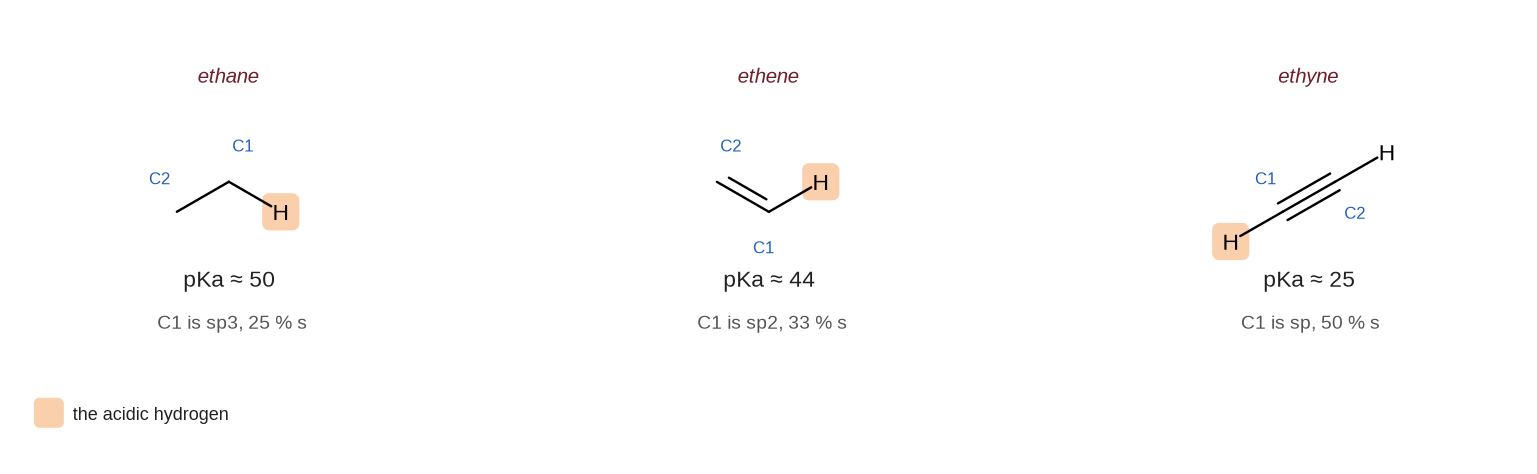
Between ethane and ethyne there are 25 units, so ethyne gives up its proton times more easily. That is a difference of about 140 kJ/mol in the free energy of losing the proton. Something on the carbon changes, and it is not the element.
When the proton leaves, the lone pair stays behind
A C–H bond that loses its proton as H⁺ leaves its two bonding electrons on carbon. What you get is a carbanion, a carbon with a lone pair and a negative charge. Figure 2 shows it for ethyne with the amide ion NH₂⁻ as the base (in liquid ammonia, where this ion exists). Arrow 1: the lone pair of the amide ion forms a bond to the hydrogen. Arrow 2: the C1–H bond breaks and its electrons become a lone pair on C1. The ion that results is the acetylide ion.
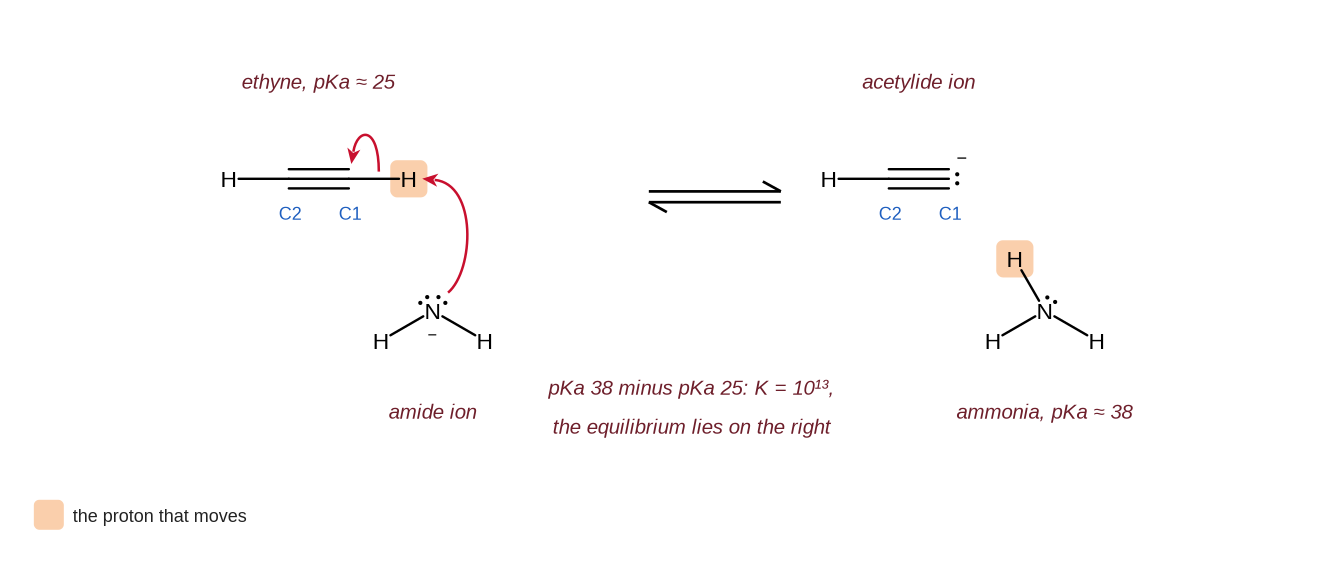
The pKa of ammonia is about 38 and that of ethyne about 25, so : the amide ion is easily strong enough. For ethene the same arithmetic gives and for ethane . The amide ion cannot deprotonate either of them to any useful extent; they need a much stronger base, such as an organolithium, which has a page of its own.
Where does the lone pair sit? In the hybrid orbital
The lone pair of the carbanion sits in the orbital the C–H bond came from, and that orbital differs. In ethane the carbon is sp³, in ethene sp², in ethyne sp (Figure 3). An sp³ orbital is one part s and three parts p mixed together, so it has 25% s character. An sp² orbital has 33% and an sp orbital 50%.
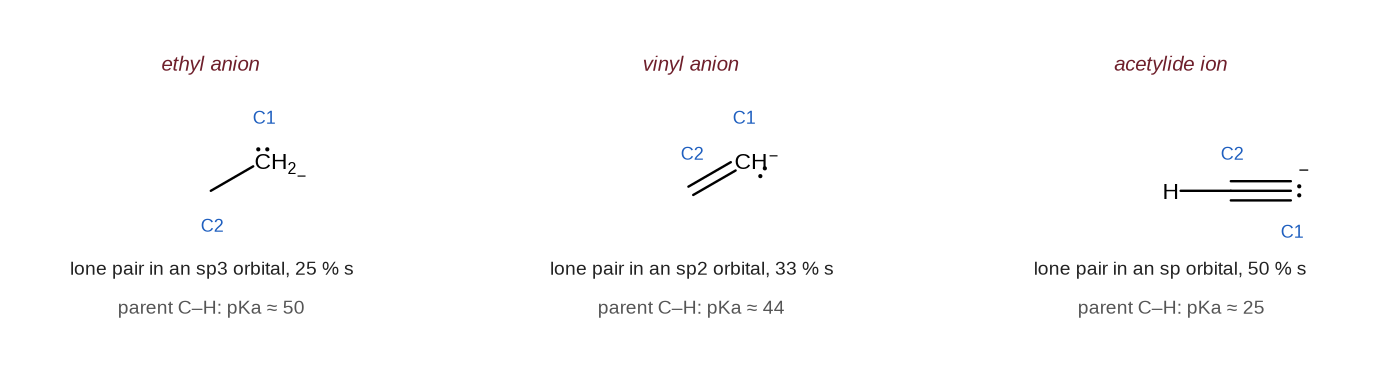
An s orbital lies closer to the nucleus than a p orbital, and an electron in it is lower in energy and held more tightly by the positive charge of the nucleus. The more s character the orbital has, the more tightly it holds a lone pair, and the happier the carbanion is. Ethyne's acetylide ion keeps its lone pair in a 50% s orbital, the ethyl anion in a 25% orbital. Acidity follows the same order, sp > sp² > sp³.
Key idea. Same element, different hybrid. The more s character of the orbital that holds the lone pair, the more stable the carbanion and the more acidic the C–H: acidity runs sp (pKa 25) > sp² (44) > sp³ (50).
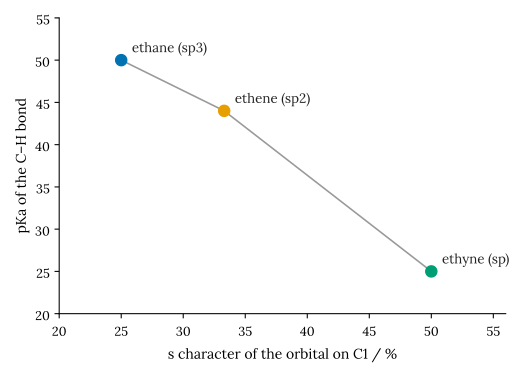
Figure 4 plots pKa against s character. It is not a straight line, so use it as a ranking and not as a formula.
One way to say it: the carbon is more electronegative
Chemists put it another way: an sp carbon is "more electronegative" than an sp³ carbon. It is the same carbon atom, but its electrons in an s-rich orbital sit closer to the nucleus, which is exactly what a higher electronegativity means. So a carbon in ethyne holds the electrons of the C1–H bond, and the pair that stays behind, more tightly than a carbon in ethane does.
Watch out. Compare like with like. At the same hybridisation, electronegativity along a row of the periodic table wins, so an O–H (about 16) or an N–H (about 35) on an sp³ atom is more acidic than an sp³ C–H (about 50). Across different hybridisations, read the pKa values: the sp C–H of ethyne (25) is more acidic than the N–H of an amine (about 35), although nitrogen is the more electronegative atom.
More from Structure
What does a pKa tell you? Acid strength from one number
One small number says how hard an acid pushes its proton away, and with it you can tell which hydrogen in a molecule leaves first. Here is how to read it.
Which way does an acid–base reaction go? Predict it with pKa
Put phenol and pyridine in a flask and ask which way the proton moves. One subtraction of two pKa values gives the direction and how far it goes.
Why is acetic acid so much more acidic than ethanol?
Both lose a proton from an O–H bond, yet acetic acid is about a hundred billion times more acidic than ethanol. The reason is where the leftover charge can sit.
Why is HI a stronger acid than HF, though F is more electronegative?
Fluorine pulls electrons harder than iodine, so H–F should be the strongest of the hydrogen halides. It is the weakest. The trend turns around when you go down a group.