
 PossieChem
Alcohol, ether or acetal? Oxygen with only single bonds
One oxygen, three personalities. How to tell an alcohol, an ether and an acetal apart, and why the second oxygen of an acetal changes everything.
- Lewis structures
- What a functional group is
Take an oxygen atom and give it only single bonds. It has two bonds to spend, so in these molecules it does one of three jobs: carry an H and one carbon (an alcohol), sit between two carbons (an ether), or sit on a carbon that has a second oxygen next to it (an acetal, which has two of these oxygens on one carbon).
Same element, same single bonds, and yet the three behave very differently. The alcohol can hand out a hydrogen bond, the ether cannot, and the acetal looks like a pair of ethers but falls apart in acid in a way that no ordinary ether does. Figure 1 shows a small example of each.
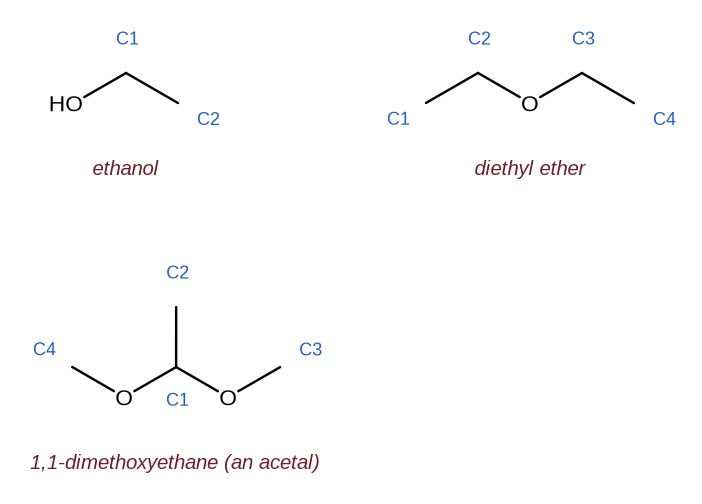
The difference between the three is the answer to a simple question: what is on the other side of the oxygen, and is there a second oxygen close by?
The alcohol: an OH on a carbon
An alcohol has an OH group on a carbon. In ethanol the OH sits on C1. That one hydrogen, attached to the very electronegative oxygen, is the whole story: it can form a hydrogen bond to the oxygen of a neighbouring molecule. Hydrogen bonds hold molecules together, so alcohols boil much higher than their size suggests. Ethanol (, 46 g/mol) boils at 78 °C.
The name uses the suffix -ol, or the prefix hydroxy- when a higher-ranking group has taken the suffix.
The ether: an oxygen between two carbons
An ether has an oxygen between two carbon groups: C–O–C, with an angle of about 110°. Diethyl ether (Figure 1) has C2 and C3 on either side of the oxygen. There is no O–H, so an ether cannot donate a hydrogen bond to its neighbours. Diethyl ether (, 74 g/mol) is more than one and a half times heavier than ethanol and still boils at about 35 °C, more than 40 °C below ethanol. The missing hydrogen bond is the difference.
Ethers are also chemically calm. The C–O bonds are strong, nothing on the molecule is acidic, and the oxygen has to be given a very good reason to let go of a carbon. That is why ethers such as diethyl ether are common solvents: they dissolve plenty and react with little.
In names an ether is never the suffix. It shows up as the prefix alkoxy- (methoxy-, ethoxy-, ...), or in the common-name form "diethyl ether", with the two groups named in front.
The acetal: two oxygens on one carbon
An acetal has one carbon that carries two O–R groups at once. In 1,1-dimethoxyethane, C1 holds both OCH₃ groups, a CH₃ (C2) and one hydrogen. The strict definition of acetal asks for that hydrogen. When the carbon has a second carbon group instead of the hydrogen, the compound is a ketal, but nearly everyone calls both types acetals, and so does this page. How they are made from aldehydes and ketones has an explanation of its own; this page only asks what the second oxygen does.
Each of the two oxygens in an acetal looks like an ether oxygen, and in base an acetal behaves like an ether too: stable. In acid it is another story, and the reason is the mechanism below.
What the second oxygen changes: the mechanism in acid
Add a little acid to 1,1-dimethoxyethane. Figure 2 shows the first two steps, every arrow on the real molecules, with the carbons numbered as in Figure 1.
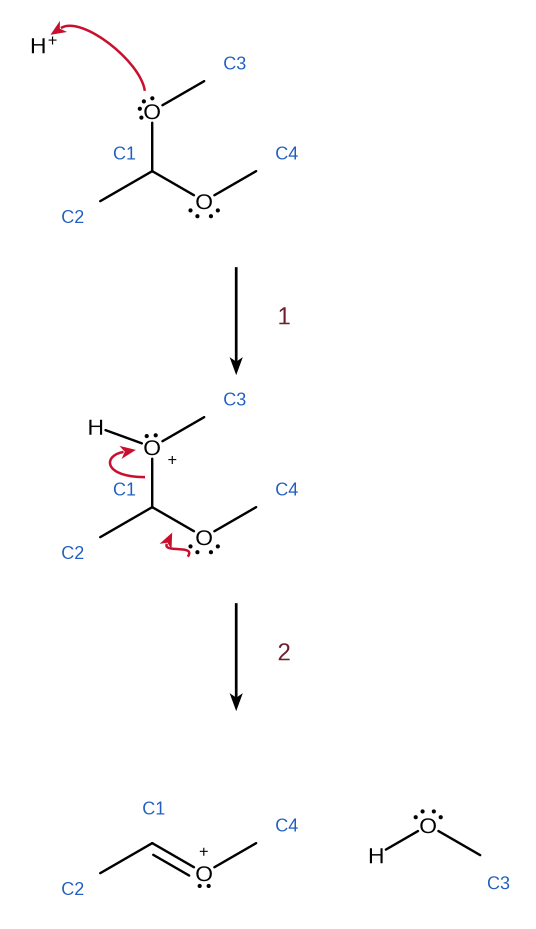
Step 1: an oxygen takes a proton. A lone pair on the oxygen attached to C3 reaches for H⁺ (first arrow). The oxygen now has three bonds (to C1, to C3 and to the new H) and a positive charge. That is a much better leaving group than a bare OCH₃⁻ would ever be, because what leaves will be a neutral molecule.
Step 2: the neighbour pushes. The bond between C1 and the protonated oxygen breaks, and its two electrons go onto that oxygen (second arrow), which leaves as methanol. But C1 would be left with only six electrons, a carbocation. This is where the other oxygen comes in: one of its lone pairs swings in to form a C1=O double bond (first arrow of step 2). The oxygen pays for that with a positive charge, because it now has three bonds, but every atom still has an octet. The result is an oxocarbenium ion: C1 is a carbon with a double bond to oxygen, and the positive charge sits on the oxygen. Its other resonance form puts the positive charge on C1 (a carbocation next to an oxygen with a lone pair), which is why the ion is so much more stable than a carbocation without any oxygen.
Why an ether cannot do this. An ordinary ether can be protonated too, but then nobody is next to the carbon to push. Losing the protonated oxygen would leave a bare carbocation on a carbon with no stabilising oxygen, and that costs so much energy that the reaction effectively does not happen in mild acid. The acetal carbon has a built-in helper, and in the same mild acid the first two steps run easily. The oxocarbenium ion is then caught by water, and after a few more steps the acetal is back to the aldehyde or ketone it was made from. The explanation on acetal hydrolysis draws that whole path.
The helper works only when the acid is there. Without a proton the oxygen has nothing to leave with, so in base an acetal is as quiet as an ether. That mismatch is the reason acetals are used to hide a carbonyl group: they survive base, and a drop of acid takes them off again.
One oxygen, three jobs. An OH on a carbon is an alcohol (hydrogen bonds, boils high). An oxygen between two carbons is an ether (no H to donate, boils low, calm). One carbon carrying two O–R groups is an acetal (or a ketal, if it has no H): stable in base, but in acid the second oxygen pushes the first one out and an oxocarbenium ion forms.
More from Structure
Alkane, alkene, alkyne or arene? The four hydrocarbon families
Four families, made of nothing but carbon and hydrogen. One count, the hydrogens, tells saturated from unsaturated, and the double bond shows why it matters.
Which functional group wins the name? IUPAC priority, explained
A molecule with an acid, an alcohol and a ketone gets only one kind of suffix. The priority list decides who gets it: five molecules worked out.
Aldehyde, ketone, acid, ester, anhydride, acid chloride: the carbonyl family
The C=O group is the busiest address in organic chemistry. Six families sit on it, three of them are the carboxylic acid with its OH swapped for something else.
Amine, imine, nitrile, amide, carbamate, nitro: nitrogen's functional groups
Six families built on one nitrogen. How to tell an amine, an imine, a nitrile, an amide, a carbamate and a nitro group apart, and why the nitro group is drawn with charges.