
 PossieChem
Aldehyde, ketone, acid, ester, anhydride, acid chloride: the carbonyl family
The C=O group is the busiest address in organic chemistry. Six families sit on it, three of them are the carboxylic acid with its OH swapped for something else.
- Lewis structures
- What a functional group is
- Lone pairs and curved arrows
The carbonyl group, a carbon double-bonded to an oxygen, is the busiest address in organic chemistry. Hang an H or a carbon group on it and you get an aldehyde or a ketone. Hang an oxygen or a chlorine on it and you get a carboxylic acid, an ester, an anhydride or an acid chloride. One tiny unit, six families, and a large part of organic chemistry is about what they do to each other.
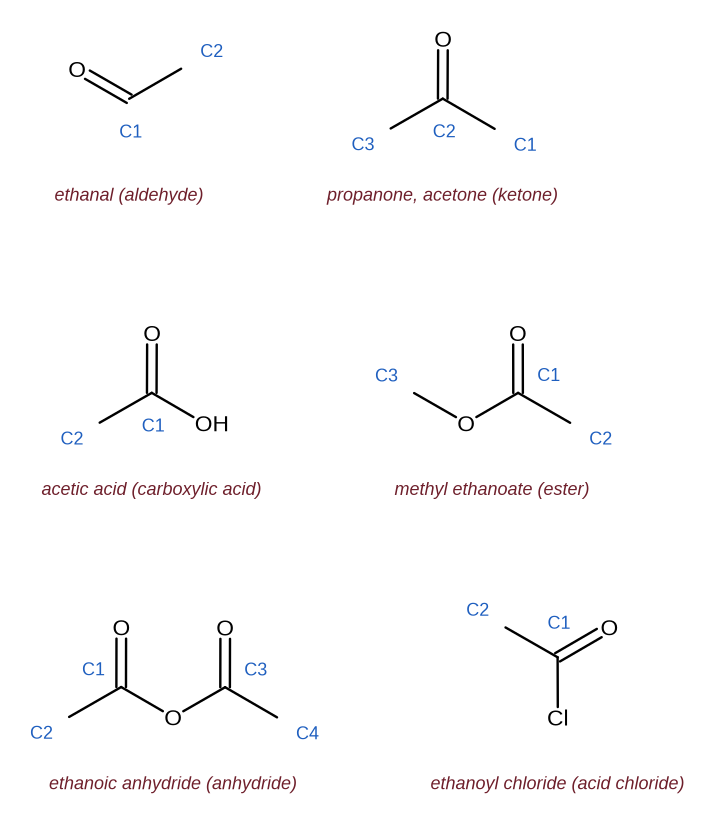
Figure 1 shows one small member of each family, all with the same arrangement around the carbonyl carbon (C1 in most of the drawings): the C=O, a methyl group, and one more partner. In ethanal that partner is an H and in propanone it is a second carbon. Look at the other four. In acetic acid the partner is an OH, in methyl ethanoate it is an O–C, in ethanoic anhydride it is an O–C=O, and in ethanoyl chloride it is a Cl.
The last four are one family: the carboxylic acid, and three relatives made by swapping its OH for something else. A family built on one swap suggests that one reaction should be able to turn the more reactive ones into the others. It does, and the way it works also explains why the first two behave differently.
Aldehyde and ketone: a carbonyl with nothing to swap
In an aldehyde the carbonyl carbon carries an H, so the C=O always sits at the end of a chain. In ethanal it is C1 (Figure 1). In a ketone the carbonyl carbon sits between two carbons, as C2 does in propanone, so it is somewhere in the middle of the chain. The names follow: aldehydes end in -al, ketones in -one.
Neither has a group on the carbonyl carbon that a nucleophile could swap out: an H or a carbon group would have to leave as H⁻ or as a carbanion, and almost nothing leaves as those. Keep that fact in mind, because it explains why they behave differently from the other four families further down.
The acid and its relatives: swap the OH
A carboxylic acid has an OH on the carbonyl carbon: in acetic acid, C1 carries the C=O and the OH. Now replace that OH:
| Family | What replaces the OH on C1 | Example in Figure 1 | Name pattern |
|---|---|---|---|
| carboxylic acid | OH (the parent) | acetic acid | -oic acid |
| ester | O–C | methyl ethanoate (the O–C3 part) | alkyl -oate |
| anhydride | O–C(=O)–C | ethanoic anhydride (C1 and C3 are both carbonyl carbons) | -oic anhydride |
| acid chloride | Cl | ethanoyl chloride | -oyl chloride |
Together with the amides (covered in the explanation on nitrogen functional groups, the nitrogen version of the same swap), these are the carboxylic acid derivatives. They all sit at the same oxidation level as the acid: the carbonyl carbon has two bonds to the oxygen of the C=O and one bond to a second heteroatom (O, Cl or N), three bonds to heteroatoms in all. That is the reason one reaction can interconvert them: no oxidation or reduction is needed, just a swap of the group on the carbonyl carbon.
Who swaps most eagerly?
The derivatives are not equally eager. In rough order of reactivity: the acid chloride is the most reactive, then the anhydride, then the ester and the acid, and the amide is the least reactive. Two things set the order. The first is how good a leaving group the swapped atom makes: chloride is a very good one, a carboxylate is decent, an alkoxide is poor, and an amide ion is poorer still. The second is how much the group donates electrons into the C=O: the lone pair on an amide nitrogen is shared with the carbonyl carbon and calms it down, while a chlorine hardly donates at all and leaves the carbonyl carbon very electron-poor and open to attack.
The mechanism: add, then eliminate
The reaction that links the family is a substitution on the carbonyl carbon in two stages, addition followed by elimination. Figure 2 shows it on the real molecules: ethanoyl chloride reacting with ethanol to give ethyl ethanoate (ethyl acetate) and HCl. The carbonyl carbon is C1 and the ethanol carbons are C3 and C4.
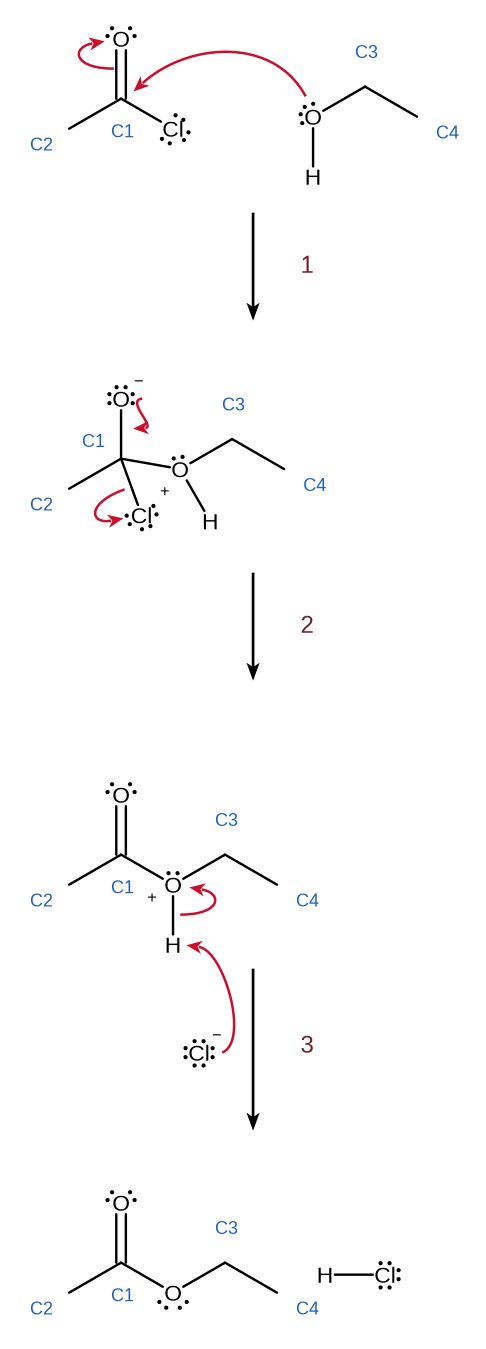
Step 1: the alcohol attacks. Ethanol is a nucleophile through the lone pair on its oxygen. C1 is electron-poor, because both the O and the Cl pull electrons away from it, and the lone pair attacks it (first arrow). A carbon cannot keep five bonds, so the π bond of the C=O breaks and its electrons move onto the carbonyl oxygen (second arrow). The result is the tetrahedral intermediate: C1 now has four single bonds (to O⁻, Cl, C2 and the ethanol oxygen), the old carbonyl oxygen carries a negative charge, and the ethanol oxygen carries a positive one (three bonds, one lone pair).
Step 2: the C=O comes back and chloride leaves. The negative oxygen pushes a lone pair back towards C1 to rebuild the C=O (first arrow). C1 again would have five bonds, so one must break: the C–Cl bond goes, its electrons moving onto chlorine (second arrow), which leaves as the chloride ion. Of the four groups on C1, chloride is the one that can leave most easily. What is left is the ester with an extra H on its oxygen: a protonated ester.
Step 3: the proton goes. Chloride takes the H from the positively charged oxygen (first arrow) and the O–H electron pair stays behind on the oxygen (second arrow). The products are ethyl ethanoate and HCl. In practice a base is often added to catch the HCl, but the carbon skeleton does not change.
Why an aldehyde or ketone stops after step 1
Run the same attack on propanone and step 1 works fine: the alcohol attacks C2, the C=O electrons go onto oxygen, and a tetrahedral intermediate forms. Then there is nothing to expel. The four groups on that carbon are an O⁻ (which can only go back), two carbons and the new O. A carbon group would have to leave as a carbanion, which is far too poor a leaving group, so the intermediate just falls back to the starting materials. In ethanoyl chloride the same intermediate has a chloride on it, and chloride leaves easily. The family is defined by that leaving group: an aldehyde or ketone adds things to the carbonyl carbon and, under these conditions, stops, a carboxylic acid derivative adds and then eliminates.
Six families, one carbonyl carbon. Aldehyde: carbonyl carbon with an H. Ketone: with two carbons. The acid and its derivatives: carbonyl carbon with an OH (acid), O–C (ester), O–C=O (anhydride) or Cl (acid chloride), plus amides with N. The derivatives swap their group by add-then-eliminate, and the better the leaving group, the faster: acid chloride, then anhydride, then ester and acid, then amide.
More from Structure
Alkane, alkene, alkyne or arene? The four hydrocarbon families
Four families, made of nothing but carbon and hydrogen. One count, the hydrogens, tells saturated from unsaturated, and the double bond shows why it matters.
Alcohol, ether or acetal? Oxygen with only single bonds
One oxygen, three personalities. How to tell an alcohol, an ether and an acetal apart, and why the second oxygen of an acetal changes everything.
Which functional group wins the name? IUPAC priority, explained
A molecule with an acid, an alcohol and a ketone gets only one kind of suffix. The priority list decides who gets it: five molecules worked out.
Amine, imine, nitrile, amide, carbamate, nitro: nitrogen's functional groups
Six families built on one nitrogen. How to tell an amine, an imine, a nitrile, an amide, a carbamate and a nitro group apart, and why the nitro group is drawn with charges.