
 PossieChem
Amine, imine, nitrile, amide, carbamate, nitro: nitrogen's functional groups
Six families built on one nitrogen. How to tell an amine, an imine, a nitrile, an amide, a carbamate and a nitro group apart, and why the nitro group is drawn with charges.
- Lewis structures and formal charge
- What a functional group is
- Lone pairs and curved arrows
Nitrogen is the busiest heteroatom in organic chemistry after oxygen, and it has a long list of functional groups, and this page covers six. Three of them are quick to tell apart: an amine has a nitrogen with three single bonds, an imine has a C=N double bond, and a nitrile has a C≡N triple bond. The other three are nitrogen next to something: an amide has the nitrogen on a carbonyl carbon, a carbamate has the nitrogen and an oxygen on the same carbonyl carbon, and a nitro group has the nitrogen bonded to two oxygens.
Figure 1 shows one small example of each, with the carbons numbered: ethylamine, N-methylethanimine, acetonitrile, acetamide, methyl carbamate and nitromethane. Look at what is next to the nitrogen in each one. The rest of this page is a tour of that neighbourhood, because what sits next to a nitrogen decides what the nitrogen can do.
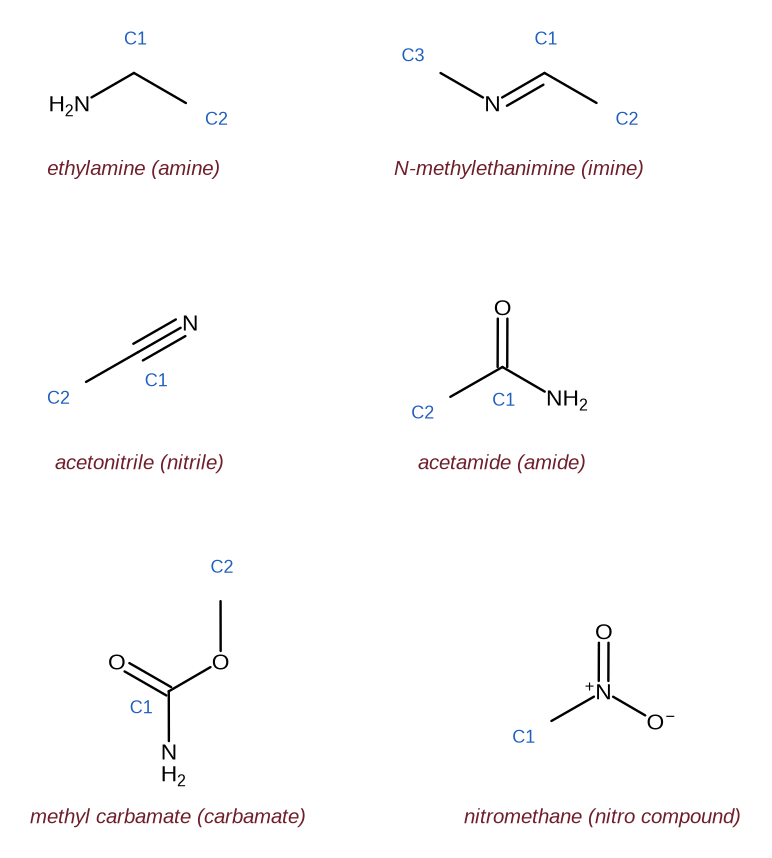
Pay special attention to the last of them. Nitromethane is drawn with a positive nitrogen and a negative oxygen, and that is not decoration.
The amine: three single bonds and a lone pair
An amine has a nitrogen with three single bonds to H or to carbon groups, at least one of them a carbon. Ethylamine (Figure 1) has C1 on the nitrogen and two N–H bonds. The nitrogen keeps one lone pair, and that lone pair is what makes an amine do things: it is a base and it is a nucleophile.
The base side is the easiest to draw. Figure 2 shows ethylamine taking a proton.
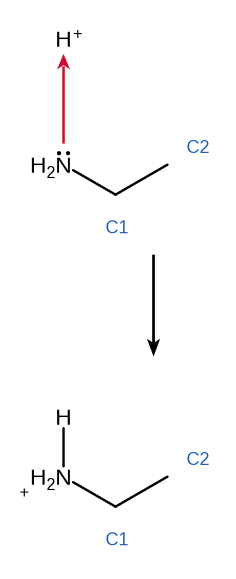
One arrow does the whole job: from the lone pair to the proton. The nitrogen now has four bonds and no lone pair, so its formal charge is +1 (it has 5 valence electrons as a free atom and is assigned 4 here), and the product is the ethylammonium ion. The conjugate acid of ethylamine has a pKa of about 10.7, so in water at neutral pH an amine like this is mostly protonated. The explanation on pKa returns to that number.
Primary, secondary and tertiary mean something specific for amines (a separate explanation is about it): you count the carbon groups on the nitrogen. Ethylamine has one, so it is a primary amine.
Imine and nitrile: a C=N and a C≡N bond
An imine has a C=N double bond. In N-methylethanimine the double bond runs between C1 and the nitrogen, and the nitrogen carries a methyl group (C3) and a lone pair. Imines are the nitrogen version of the carbonyl group: the same C=X unit with N in place of O.
A nitrile has a C≡N triple bond, and it is also called a cyanide. In acetonitrile the triple bond joins C1 and the nitrogen, and the three atoms C2–C1–N lie on a straight line, because a carbon with a triple bond is sp-hybridised and bonds at 180°. Of the six families this is the only one that is linear.
Amide and carbamate: nitrogen on a carbonyl
An amide has a nitrogen on the carbonyl carbon: acetamide has C1 doubly bonded to O, singly bonded to the NH₂ and bonded to C2. Amides are the nitrogen member of the family of carboxylic acid derivatives from the carbonyl explanation: take the acid and swap its OH for an N. They are called primary, secondary or tertiary by the number of carbon groups on that nitrogen, which is a different count from the carbon-based one used for alcohols.
The difference between an amine and an amide is large, though the only change in the drawing is a C=O next to the nitrogen. The lone pair on an amide nitrogen is not free: it is shared with the carbonyl carbon, which makes the N–C bond partly a double bond. An amide is therefore flat, not pyramidal, and it is a very weak base. Protonating an amide happens on the carbonyl oxygen instead, and the conjugate acid has a pKa of about −0.5, compared with about 10.7 for ethylammonium. That is a difference of eleven pKa units for one carbonyl group. Why the lone pair is shared (resonance) is the business of a later explanation.
A carbamate (the group that gives polyurethanes their name) is an ester and an amide at once: the carbonyl carbon carries an O–carbon and an N. In methyl carbamate, C1 is the carbonyl carbon, with the NH₂ on one side and the O–C2 on the other.
The nitro group: why the charges are there
A nitro group is an NO₂ attached to a carbon through the nitrogen, as in nitromethane (C1 carries the NO₂). The nitrogen is bonded to three atoms (C1 and two oxygens) and one of the bonds is a double bond, so it has four bonds in total. A neutral nitrogen with four bonds does not exist in this arrangement, and one with five bonds does not exist at all, because nitrogen has no orbitals for a tenth electron. The only Lewis structure that works puts a formal charge of +1 on nitrogen and −1 on the singly bonded oxygen.
That raises an obvious question. The two oxygens are drawn differently, but in the real molecule they are the same. Figure 3 shows why: there is a second drawing, with the double bond on the other oxygen, and the two are related by moving two electron pairs.
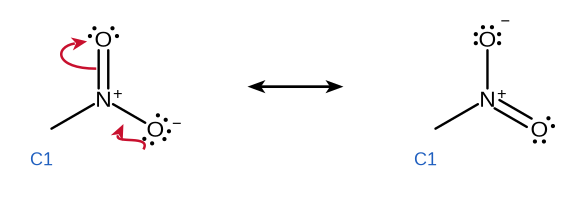
A lone pair on the negative oxygen moves in to form a second bond to nitrogen (first arrow). Nitrogen cannot take a fifth bond, so the electrons of the other N=O π bond move onto the other oxygen (second arrow). Every atom keeps its octet. The two drawings are two ways of writing one molecule, with the electrons spread over both N–O bonds, which are therefore identical in length, about 1.22 Å, with each oxygen carrying about half a negative charge. The positive nitrogen and the negative oxygen are bookkeeping that you cannot get rid of.
Look at what is next to the nitrogen. Three single bonds and a lone pair: an amine (a base). C=N: an imine. C≡N, linear: a nitrile. N on a carbonyl: an amide (flat, a very weak base, lone pair shared), and a carbamate if the carbonyl also carries an O–C. N bonded to two oxygens: a nitro group, always drawn with N⁺ and O⁻, and the two N–O bonds are really identical.
More from Structure
Alkane, alkene, alkyne or arene? The four hydrocarbon families
Four families, made of nothing but carbon and hydrogen. One count, the hydrogens, tells saturated from unsaturated, and the double bond shows why it matters.
Alcohol, ether or acetal? Oxygen with only single bonds
One oxygen, three personalities. How to tell an alcohol, an ether and an acetal apart, and why the second oxygen of an acetal changes everything.
Which functional group wins the name? IUPAC priority, explained
A molecule with an acid, an alcohol and a ketone gets only one kind of suffix. The priority list decides who gets it: five molecules worked out.
Aldehyde, ketone, acid, ester, anhydride, acid chloride: the carbonyl family
The C=O group is the busiest address in organic chemistry. Six families sit on it, three of them are the carboxylic acid with its OH swapped for something else.