
 PossieChem
Which functional group wins the name? IUPAC priority, explained
A molecule with an acid, an alcohol and a ketone gets only one kind of suffix. The priority list decides who gets it: five molecules worked out.
- What the common functional groups look like (alcohol, ketone, carboxylic acid, ester, amine)
- Naming a straight chain (meth-, eth-, prop-, but-)
A molecule can carry five functional groups at once. Its name has room for exactly one kind of suffix. It is a band with five lead singers and one microphone, and somebody has to decide who sings.
IUPAC decided long ago. There is a ranking, the group at the top of it takes the suffix, and everybody else is demoted to a prefix. Learn the ranking once and every crowded molecule becomes a matter of looking things up.
The ranking
The group that gets the suffix is the principal group. Here are the common classes, highest first:
| Rank | Family | As the suffix | As a prefix |
|---|---|---|---|
| 1 | carboxylic acid | -oic acid | carboxy- |
| 2 | sulfonic acid | -sulfonic acid | sulfo- |
| 3 | anhydride | -oic anhydride | (none) |
| 4 | ester | -oate | alkoxycarbonyl- |
| 5 | acid chloride | -oyl chloride | chlorocarbonyl- |
| 6 | amide | -amide | carbamoyl- |
| 7 | nitrile | -nitrile | cyano- |
| 8 | aldehyde | -al | oxo- (or formyl-) |
| 9 | ketone | -one | oxo- |
| 10 | alcohol | -ol | hydroxy- |
| 11 | thiol | -thiol | sulfanyl- |
| 12 | amine | -amine | amino- |
| – | ether | never a suffix | alkoxy- (methoxy-, ethoxy-, ...) |
| – | halogen | never a suffix | fluoro-, chloro-, bromo-, iodo- |
| – | alkene, alkyne, alkane | -ene, -yne, -ane, inside the chain name |
A rough way to remember the top: the more oxidised the carbon, the higher it sits. Acids and their derivatives first, then nitriles, aldehydes and ketones, then alcohols, then the sulfur and nitrogen crowd. It is a memory aid, not a law: the list is a fixed convention, and the aldehyde and ketone carbons both have two bonds to oxygen while the list still puts the aldehyde higher. Ethers and halogens never get the microphone at all. Double and triple bonds are not even in the competition: they live inside the chain name, as the -en- and -yn- in the middle.
Three moves
- Find every group on the molecule.
- The highest-ranking one becomes the suffix. The parent chain is chosen to contain it (the carbon of an -oic acid, -oate, -amide, -nitrile or -al counts as part of the chain), and it is numbered so that the suffix gets the lowest possible number.
- Every other group becomes a prefix (double and triple bonds stay in the chain name), and the prefixes go in alphabetical order.
That is all. Here it is on five molecules, each one a little more crowded than the last.
Acid against alcohol
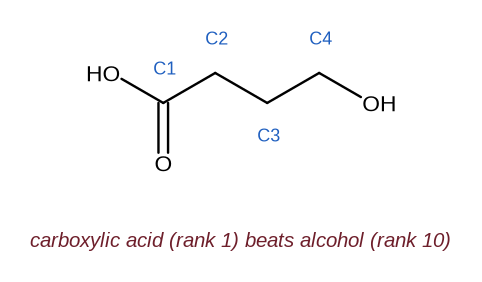
The carboxylic acid is rank 1, the alcohol rank 10. The acid wins without breaking a sweat. Its carbon is part of the chain and is C1, so the OH lands on C4 and becomes the prefix 4-hydroxy. The four-carbon acid is butanoic acid, and the whole thing is 4-hydroxybutanoic acid.
Alcohol against a double bond
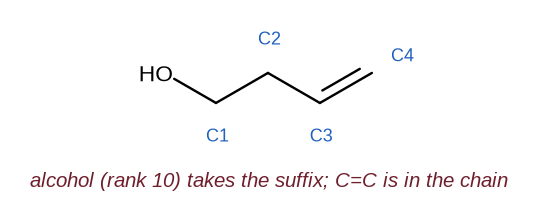
The alcohol takes the suffix, -ol. The double bond is not a rival: it simply turns the -an- of the chain into -en-. Number from the OH end so that the suffix gets the lowest number: the OH is on C1 and the double bond starts at C3. The name is but-3-en-1-ol, every locant sitting right in front of the part it belongs to.
Ketone against alcohol and amine
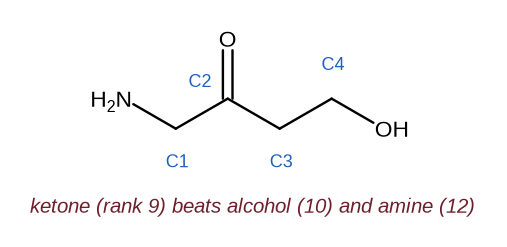
Three groups now. The ketone is rank 9, ahead of the alcohol (10) and the amine (12), so it takes the suffix, -one. Numbering from the left puts the C=O on C2; from the right it would be on C3. Lowest number for the suffix wins, so we number from the NH₂ end: the amine sits on C1 and the OH on C4.
The two losers become prefixes, amino- and hydroxy-, in alphabetical order: amino first. The name is 1-amino-4-hydroxybutan-2-one.
Watch out. Rank and alphabet do two different jobs. The rank decides who gets the suffix. Among the prefixes, only the alphabet counts: amino comes before hydroxy, even though the amine ranks lower than the alcohol.
Ester against ketone
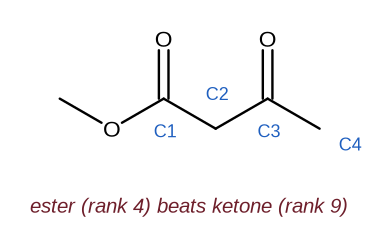
The ester is rank 4, the ketone rank 9. The ester takes the suffix, -oate, and its carbonyl carbon is C1. The ketone is demoted to the prefix oxo- on C3: 3-oxobutanoate. The methyl on the ester oxygen is not part of the chain at all; an ester's name starts with that group as a separate word. So: methyl 3-oxobutanoate.
Nobody qualifies
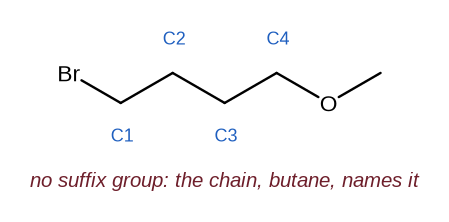
A bromine and an ether. Neither of them is ever allowed a suffix, so the microphone goes to the chain itself, butane. Both groups become prefixes, bromo- and methoxy-. Numbering from either end gives the locants 1 and 4, a tie, and a tie goes to the prefix that comes first in the alphabet: bromo gets C1. The name is 1-bromo-4-methoxybutane.
In one line
One kind of suffix per molecule. The highest-ranking group takes it, together with the lowest possible number. Every other group becomes a prefix, in alphabetical order. Ethers and halogens are always prefixes, and double and triple bonds live inside the chain name.
More from Structure
Alkane, alkene, alkyne or arene? The four hydrocarbon families
Four families, made of nothing but carbon and hydrogen. One count, the hydrogens, tells saturated from unsaturated, and the double bond shows why it matters.
Alcohol, ether or acetal? Oxygen with only single bonds
One oxygen, three personalities. How to tell an alcohol, an ether and an acetal apart, and why the second oxygen of an acetal changes everything.
Aldehyde, ketone, acid, ester, anhydride, acid chloride: the carbonyl family
The C=O group is the busiest address in organic chemistry. Six families sit on it, three of them are the carboxylic acid with its OH swapped for something else.
Amine, imine, nitrile, amide, carbamate, nitro: nitrogen's functional groups
Six families built on one nitrogen. How to tell an amine, an imine, a nitrile, an amide, a carbamate and a nitro group apart, and why the nitro group is drawn with charges.