
 PossieChem
Alkane, alkene, alkyne or arene? The four hydrocarbon families
Four families, made of nothing but carbon and hydrogen. One count, the hydrogens, tells saturated from unsaturated, and the double bond shows why it matters.
- Lewis structures (single, double and triple bonds)
Hydrocarbons are the simplest organic molecules there are: only carbon and hydrogen, nothing else on the guest list. And still they come in four families, with four different personalities. The alkanes are the quiet ones. The alkenes and alkynes are the restless ones. The arenes, the benzene relatives, look restless on paper and turn out to be surprisingly calm.
The families are told apart by what the carbons are joined with: only single bonds, a double bond, a triple bond, or a special ring. Figure 1 shows one of each, plus two rings. Butane has only C–C single bonds. But-1-ene has a double bond between C1 and C2, but-1-yne a triple bond in the same place. Cyclohexane closes the chain into a ring, cyclohexene is the ring with a double bond, benzene is the aromatic ring, and cyclooctyne is the ring that has to be big before it can hold a triple bond at all.
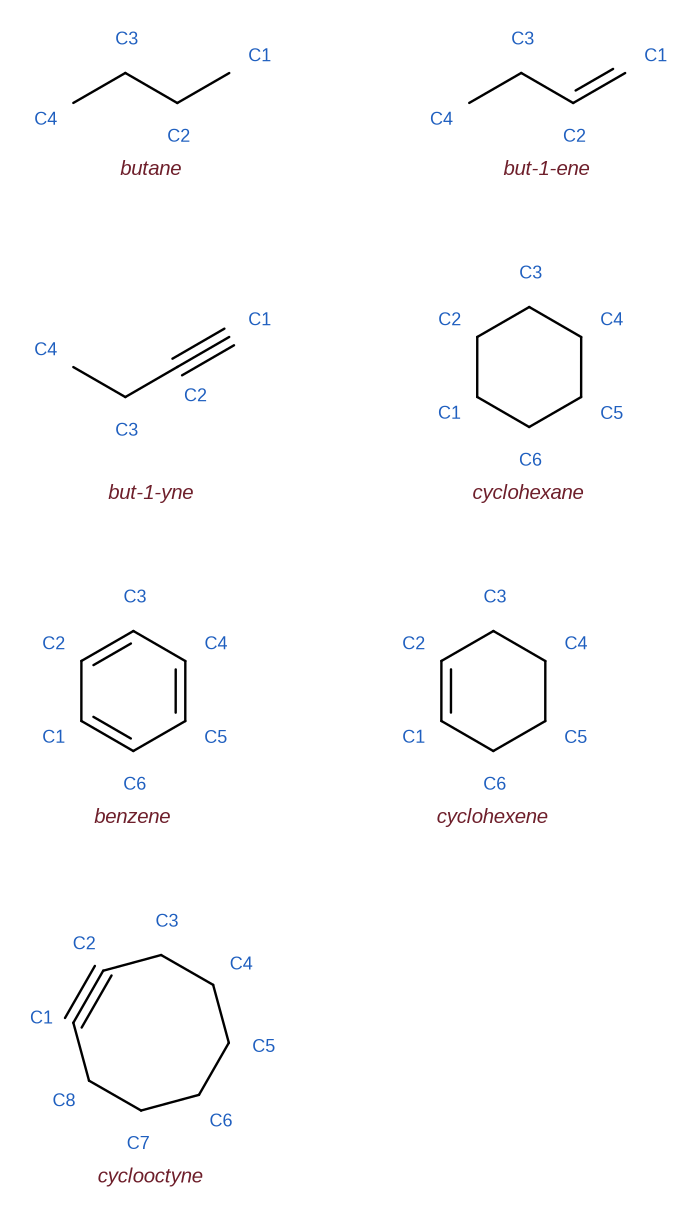
The names hide a single question that decides almost everything about how these molecules behave: has each carbon got all the hydrogens it could possibly hold, or has it traded some of them for extra bonds to its neighbour? Count the hydrogens and you can tell how many double bonds or rings a hydrocarbon has before you have looked at a single bond.
Saturated or unsaturated: count the hydrogens
A carbon makes four bonds. In butane every carbon spends all four on single bonds, to other carbons or to hydrogens, so the molecule holds as many hydrogens as the chain can carry: . It is saturated.
Now take two hydrogens off neighbouring carbons. Those two carbons are one bond short each, and the cure is a second bond between them: a double bond. That is but-1-ene, , two hydrogens fewer than butane. Take two more away and you get a triple bond: but-1-yne, . A molecule with a double or triple bond is unsaturated: it could still bind more hydrogens.
For a chain with carbons the pattern is simple:
| Family | Open-chain general formula | Hydrogens compared with the alkane | Example (n = 4) |
|---|---|---|---|
| alkane | the maximum | butane, | |
| alkene (one C=C) | 2 fewer | but-1-ene, | |
| alkyne (one C≡C) | 4 fewer | but-1-yne, |
Every missing pair of hydrogens is one degree of unsaturation: it is paid for by one extra π bond or by one ring. Cyclohexane, , has two hydrogens fewer than an open chain of six carbons would carry (), and the missing pair went into closing the ring: one degree of unsaturation, no double bond. Cyclohexene, , has two: the ring and the double bond. So a formula alone cannot tell you whether you have a ring or a double bond. It only counts how many of them there are in total.
Watch out. "Unsaturated" means "has a π bond", but the hydrogen count alone cannot show it. A ring costs the same two hydrogens as a double bond, so cyclohexane has one degree of unsaturation and is still a saturated hydrocarbon: it has no π bond.
Aliphatic or aromatic: what benzene does not do
Everything in Figure 1 except benzene is aliphatic: open chains and ordinary rings. Benzene is the odd one out, and the hydrogen count shows why it looks suspicious. Benzene is , eight hydrogens short of the open chain : four degrees of unsaturation, which the drawing pays with three double bonds and one ring.
On that evidence you would expect benzene to behave like three cyclohexenes glued together, eagerly adding things across its double bonds. It does not. Benzene is a famously unreactive molecule, and it keeps its ring intact in reactions where an alkene would fall to pieces. That calm is the reason arenes (aromatic hydrocarbons) get a family of their own. What exactly earns a ring that label is the subject of a later explanation on aromaticity, and the short answer is a count of π electrons, not the number of double bonds drawn. For now, the working rule is the sorting at the start of this explanation: benzene and its relatives are the arenes, and every other ring is a cycloalkane, cycloalkene or cycloalkyne.
The triple bond that does not fit in a small ring
A triple bond wants its four atoms in a straight line: C–C≡C–C, 180° at both ends of the bond. That is trivial in an open chain and a real problem in a ring, because a small ring simply has no room for a straight stretch.
Cyclooctyne (Figure 1, numbered C1 to C8) is about the smallest ring that survives on a shelf. Even there the line is bent: the C2–C1–C8 angle is about 160° instead of 180°. That bending is strain, and strained triple bonds are far more eager to react than ordinary ones. Smaller cycloalkynes are so strained that they cannot be isolated at room temperature.
Why it matters: the double bond is where things happen
Everything above is bookkeeping. Here is why a chemist cares: an alkane and an alkene look nearly the same on paper and behave completely differently. To see it, add HBr to but-1-ene and watch the electrons. Figure 2 shows the whole reaction, every arrow on the real molecules.
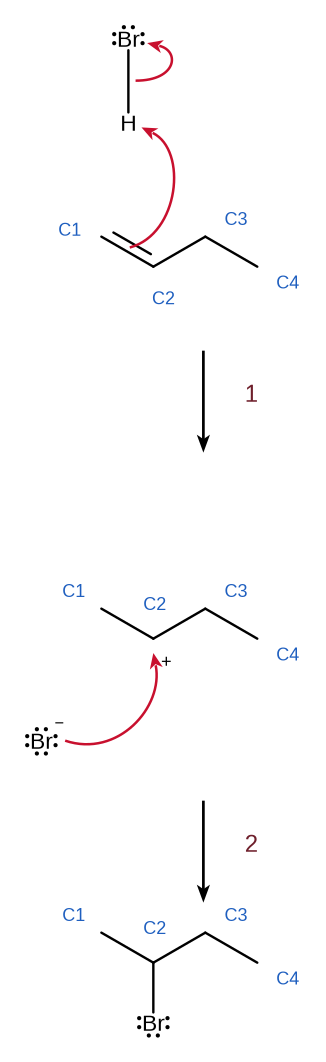
Step 1: the π bond takes the proton. The two electrons of the π bond between C1 and C2 are the most exposed electrons in the molecule, because a π bond sits above and below the C–C axis, away from the nuclei. They reach out to the hydrogen of HBr (first arrow). The hydrogen cannot keep two bonds, so the H–Br bond breaks and its electron pair goes onto bromine (second arrow). The hydrogen now sits on C1, and C2, which lost its half of the π bond, is left with only three bonds and a positive charge: a carbocation.
Why the hydrogen lands on C1. The proton could have gone to either end of the double bond. If it went to C2, the positive charge would end up on C1, a carbon with only one carbon neighbour. Landing on C1 puts the charge on C2, which has two carbon neighbours, and carbon groups help to carry a positive charge. The more carbon neighbours the charged carbon has, the more stable the cation, so the route through C2 is the faster one and 2-bromobutane is the main product.
Step 2: bromide closes the gap. The bromide ion has four lone pairs and a negative charge, and C2 has an empty orbital and a positive charge. A lone pair on bromine (arrow) forms the new C–Br bond. Nothing is left over: the formula of the product, , is the sum of and HBr.
Now try the same with butane. It has no π bond. Its electrons are all in σ bonds, held tightly between nuclei, and there is nothing to offer the proton. Under these conditions butane and HBr simply sit next to each other. That is the real difference between the families, and it is why "unsaturated" is worth knowing: a double or triple bond is a place where reactions can start.
Count the hydrogens first. Only single bonds and the full hydrogen count ( for a chain): an alkane. Two hydrogens fewer: a double bond or a ring. Four fewer: a triple bond, two double bonds, two rings, or a ring plus a double bond. Benzene and its relatives are the arenes: unsaturated on paper, calm in practice. A π bond is the part that reacts, because its electrons are the easiest to reach.
More from Structure
Alcohol, ether or acetal? Oxygen with only single bonds
One oxygen, three personalities. How to tell an alcohol, an ether and an acetal apart, and why the second oxygen of an acetal changes everything.
Which functional group wins the name? IUPAC priority, explained
A molecule with an acid, an alcohol and a ketone gets only one kind of suffix. The priority list decides who gets it: five molecules worked out.
Aldehyde, ketone, acid, ester, anhydride, acid chloride: the carbonyl family
The C=O group is the busiest address in organic chemistry. Six families sit on it, three of them are the carboxylic acid with its OH swapped for something else.
Amine, imine, nitrile, amide, carbamate, nitro: nitrogen's functional groups
Six families built on one nitrogen. How to tell an amine, an imine, a nitrile, an amide, a carbamate and a nitro group apart, and why the nitro group is drawn with charges.