
 PossieChem
Alphabetical order in IUPAC names: why 1,1-dimethylpropyl sorts under d
In a crowded name the branches go in alphabetical order, but di, iso and tert are treated differently. Why 1,1-dimethylpropyl sorts under d and not under p.
- Naming a straight chain (meth-, eth-, prop-, but-, ..., dec-)
- What a substituent is (a group hanging off the parent chain, such as methyl or ethyl)
Here is a name that looks like somebody fell asleep on the keyboard: 5-(1,1-dimethylpropyl)-4-isopropyl-7-methyl-6-propyldecane. Look at the order of the branches: dimethylpropyl, isopropyl, methyl, propyl. Three of them end in propyl, so you would expect them to sit together near the p. Instead, 1,1-dimethylpropyl goes first, in front of isopropyl, and plain propyl is stranded at the back behind methyl.
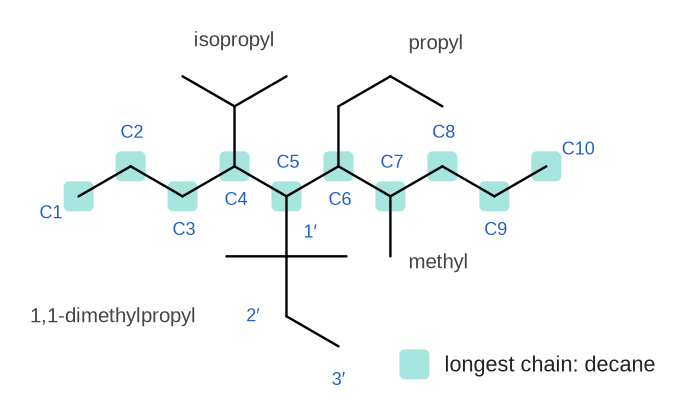
It is not a typo. The alphabet in a chemical name does not look at the ending of each branch name. Think of a phone book where "Jan Van Den Broeck" could be filed under B or under V: somebody has to fix the rule once and for all, and chemists did. Here is the molecule, so every branch has a face.
First the chain, then the numbers
Parent chain first. Count carefully: the highlighted chain has ten carbons, and every other route through the branches gives at most nine. So the parent is decane, and the four branches are its substituents.
Next the numbering. You number from the end that gives the branches the lowest set of numbers. Numbered as drawn, the branches sit on 4, 5, 6 and 7. Numbered from the other end they also sit on 4, 5, 6 and 7:
| Position | Numbered as drawn | Numbered from the other end |
|---|---|---|
| 4 | isopropyl | methyl |
| 5 | 1,1-dimethylpropyl | propyl |
| 6 | propyl | 1,1-dimethylpropyl |
| 7 | methyl | isopropyl |
Same set of numbers, so the numbers cannot decide. This is where the alphabet does its first job: when the sets of numbers tie, the branch that comes first in alphabetical order gets the lowest possible number. If 1,1-dimethylpropyl is the first in the alphabet, it gets 5 as drawn and only 6 the other way, so we number as drawn. That means we need to know very precisely what "first in the alphabet" means.
The four sorting rules
Write down the full name of each branch, and then:
- Di-, tri-, tetra- do not count. They only say how many of a simple branch there are. Dimethyl sorts under m.
- Iso- and neo- do count. They are part of the name of the group. Isopropyl sorts under i.
- Tert- and sec- do not count (both are written in italics, with a hyphen). Tert-butyl sorts under b.
- A branch that is itself branched is sorted under the first letter of its complete name, and there the multiplier does count. 1,1-Dimethylpropyl sorts under d.
Numbers, commas and hyphens never count, in any of the rules. Rules 1 and 4 look like they contradict each other; we come back to that below. First two small molecules that show rules 1, 2 and 3.
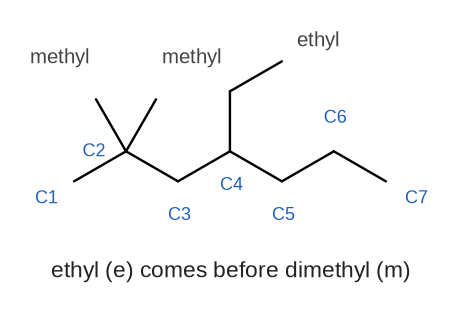
In Figure 2 the two methyls on C2 are simple branches, so the di of dimethyl is only a counter and is ignored: dimethyl sorts under m, and ethyl (e) comes first. The name is 4-ethyl-2,2-dimethylheptane, with the ethyl in front even though its number, 4, is higher than 2. The numbers follow the chain, the order of the words follows the alphabet. If di counted, dimethyl would sort under d and jump to the front.
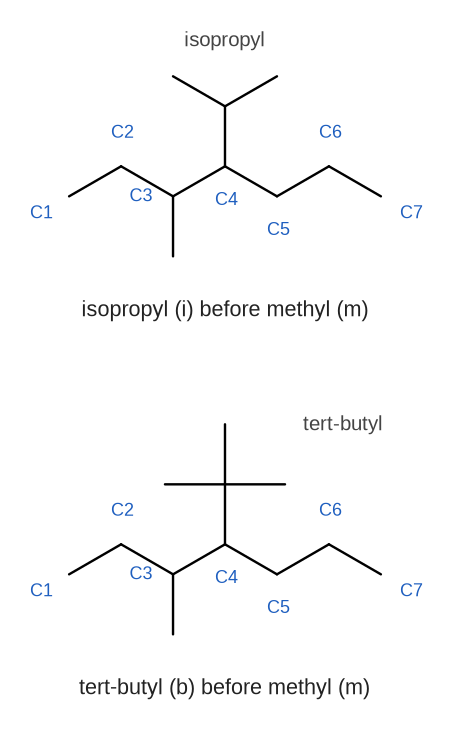
Figure 3 shows the difference between iso and tert. In 4-isopropyl-3-methylheptane the iso is part of the name, so the branch sorts under i and goes before methyl (m). If the iso were ignored, the branch would sort under p, and methyl would come first. In 4-tert-butyl-3-methylheptane the tert is ignored, so the branch sorts under b and again goes before methyl. Had the tert counted, it would have sorted under t and come last. So iso is in and tert is out. It is a convention, not a law of nature, and you simply learn it.
Back to 1,1-dimethylpropyl
Now Rule 4 on the big molecule. A branch that is branched gets its own numbering, counted from the carbon that is attached to the main chain. Look at the carbon attached to C5 in Figure 1: that is carbon 1′ of the branch. It carries two methyls, which is the "1,1-dimethyl", and the propyl chain runs 1′, 2′, 3′. A compound branch goes in brackets, so that its own numbers cannot be mistaken for the numbers of the main chain.
Because it is one group with one name, the alphabet reads the whole thing: dimethylpropyl starts with a d. It does not matter that it ends in propyl. The order is therefore:
dimethylpropyl (d), isopropyl (i), methyl (m), propyl (p).
Dimethylpropyl is first, so it gets the lowest of the tied numbers, 5, and the name reads 5-(1,1-dimethylpropyl)-4-isopropyl-7-methyl-6-propyldecane.
Watch out. Do not sort by the ending of a branch name. 1,1-Dimethylpropyl is not a kind of propyl for the alphabet: it goes under d, in front of isopropyl, not next to propyl. And note the difference with a simple dimethyl: the di inside the name of a branched branch (dimethylpropyl) counts, the di of two simple branches (dimethyl) does not.
One more thing, to keep you out of an argument with your textbook. The current IUPAC recommendations (2013) call 1,1-dimethylpropyl by its systematic name, 2-methylbutan-2-yl, and that name starts with an m, so it sorts in a different place. The older names used on this page are still the ones in most textbooks, and the rule you just learned is how they are sorted.
In one line
Sort under the first letter of the complete branch name. Ignore di-, tri-, tetra-, tert- and sec-, count iso- and neo-, and for a branch that is itself branched, count its full name, multiplier included. The alphabetical order sets the order of the words and breaks ties in the numbering: the first branch in the alphabet gets the lowest number.
More from Structure
How to name an organic compound: the recipe in four moves
Most IUPAC names are built in four moves: parent, suffix, numbering, writing. Learn the order and even the longest names stop being scary.
How to name an ester: two words, and C1 is the C=O
An ester name is two words: the group on the oxygen, then the acid part ending in -oate. Which half goes first, and why counting starts on the C=O.
What do cis and trans in a ring name really mean? Naming rings
Rings are named from the ring up: cyclo- plus the stem, numbers from the suffix, and cis or trans for which face each group points to.
From name to structure: how to draw a molecule from its name
Nobody sees a whole molecule in a name. Draw the parent first, number it, hang each group on its number, then name your own drawing to check it.