
 PossieChem
How to name an ester: two words, and C1 is the C=O
An ester name is two words: the group on the oxygen, then the acid part ending in -oate. Which half goes first, and why counting starts on the C=O.
- What an ester looks like (the C=O carbon with an OR group on it)
- Names for straight chains (meth-, eth-, prop-, but-)
- The priority list of functional groups
Almost every organic name is one long word. Esters are one of the exceptions: ethyl acetate has a space in the middle. The space is not decoration. It marks the seam where the molecule was put together from two pieces, and each word names one piece. Figure 1 shows the seam.
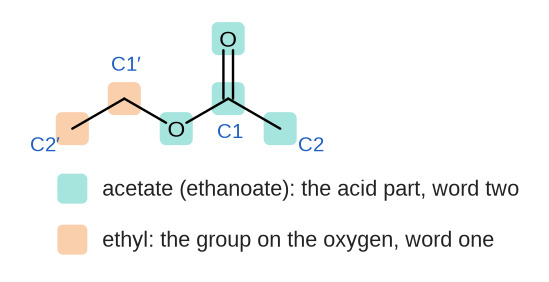
The second word, acetate, is everything that came from the acid: the CH₃, the C=O and the oxygen that ties the acid part to the rest. The first word, ethyl, is the group sitting on that oxygen. Acetate is the everyday name; the systematic one is ethanoate, and ethyl ethanoate and ethyl acetate are the same compound.
Swap the halves and you get a different molecule with a different name. So why does the counting of the acid part start on the C=O carbon, what happens when the acid part carries other groups, and what do you do with a branched group on the oxygen?
Word one: the group on the oxygen
An ester has two parents, an acid and an alcohol, and the name keeps them apart. The group that sits on the single-bonded oxygen comes from the alcohol, and it is named like any other substituent: methyl, ethyl, propyl, with the ending -yl. It is written first, as a word of its own, and it gets no number: it is a word of its own, not a substituent on the acid chain.
In Figure 1 the carbon on the oxygen is C1′ and the next one is C2′. The primes keep the carbons of this group apart from the numbered carbons of the acid part. They are not part of the name; they are there so that you can tell the two halves apart on the drawing.
Word two: the acid part, counted from the C=O
The acid part is named as a chain, with the ending -oic acid changed into -oate. It is the chain that includes the C=O carbon, and the numbering starts there: C1 is the C=O carbon. It could not be anything else. The C=O carbon is the end of the chain and carries the suffix, and the suffix must get the lowest number, which is 1.
So ethanoate is two carbons: C1 is the C=O and C2 is the CH₃. Everything else on the acid part is counted from C1 outwards.
Other groups on the acid part become prefixes
An ester ranks very high on the priority list (acid, anhydride, ester, acid halide, amide, nitrile, aldehyde, ketone, alcohol, amine), above nitriles, aldehydes, ketones, alcohols and amines. When the acid part carries one of those, the ester keeps the suffix and the other group is demoted to a prefix. Figure 2 shows two examples.
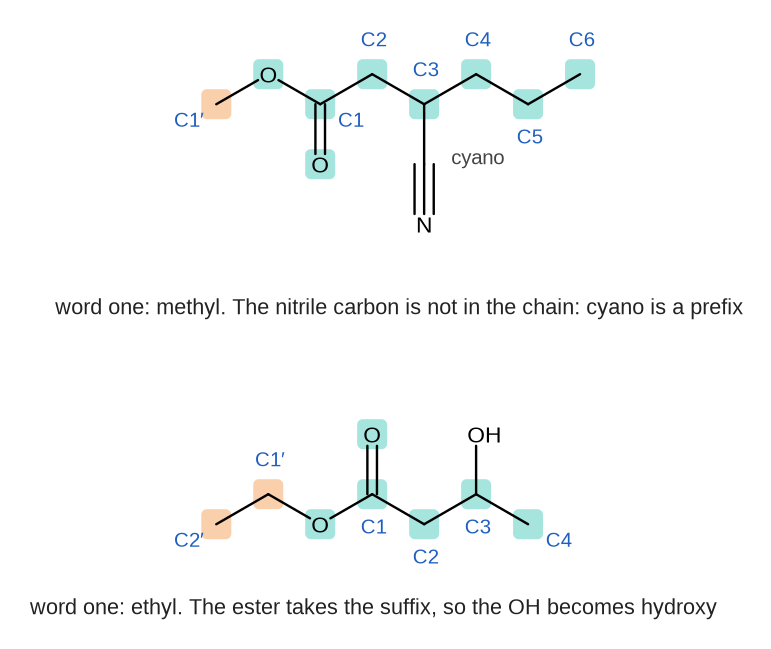
Take the top molecule. It has an ester and a nitrile, and the ester wins, so the nitrile becomes the prefix cyano. The group on the oxygen is a methyl, so word one is methyl. For word two, start on the C=O carbon, C1, and follow the longest chain: the chain runs through the carbon that carries the cyano group and on through the three-carbon branch, which makes six carbons in total, so the acid part is hexanoate. The nitrile carbon is not in that count, because the prefix cyano already contains it. The cyano group sits on C3. Put it together: methyl 3-cyanohexanoate.
The bottom molecule works the same way. The ester outranks the alcohol, so the OH becomes the prefix hydroxy. The group on the oxygen is an ethyl. The acid part is four carbons counted from the C=O, so butanoate, with the hydroxy group on C3: ethyl 3-hydroxybutanoate. The prefix goes inside the second word, right in front of the part it belongs to, and never in front of the whole name.
Same atoms, different esters
Because the two halves are named separately, it matters which carbons end up in which half. Figure 3 shows two esters built from exactly the same atoms.
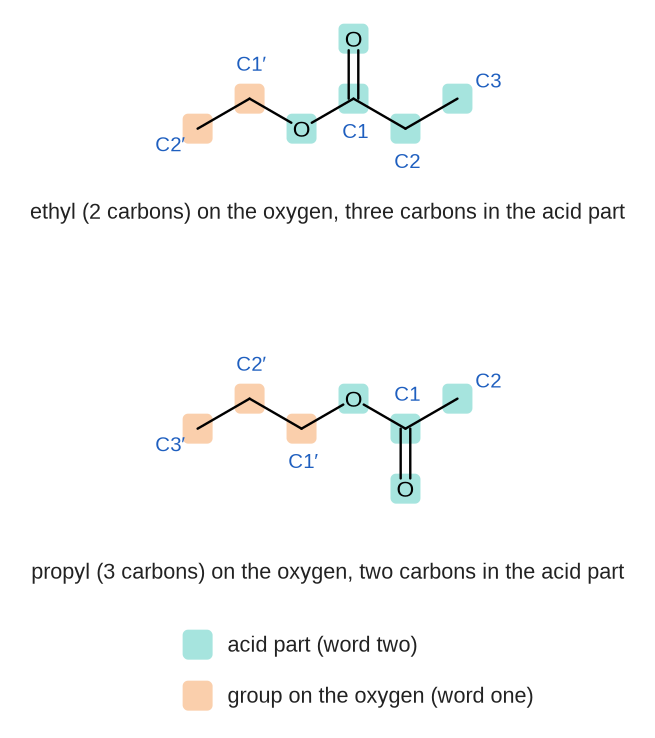
In ethyl propanoate the acid part has three carbons and the group on the oxygen has two. In propyl ethanoate it is the other way round. They are isomers: both have five carbons and two oxygens, and the only difference is how the five carbons are shared between the two halves. The name tells you exactly where: the word before the space is the group on the oxygen, whatever its length.
Names you will meet on a bottle
Acetate, for ethanoate, is the common name that IUPAC still accepts, so ethyl acetate is a perfectly good name. Other old acid names, such as propionate (the propanoate of Figure 3) and butyrate (the butanoate of Figure 4), show up on labels and in older books. You can translate them with the same two-word rule.
A branched group on the oxygen is named as a substituent too. Figure 4 shows isopropyl butanoate.
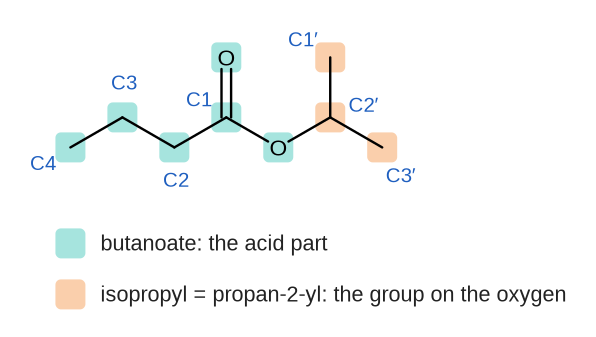
The acid part is butanoate, four carbons from the C=O. The group on the oxygen is isopropyl, which is the older name; the systematic name is propan-2-yl, because the carbon that sits on the oxygen is the middle carbon of a three-carbon chain (C2′ in the figure). So the same molecule is isopropyl butanoate or propan-2-yl butanoate, and both are in use.
An ester is two words. First the group on the oxygen (methyl, ethyl, isopropyl). Then the acid part, counted from the C=O carbon as C1, with the ending -oate. Any lower-ranked group on the acid part becomes a prefix inside word two.
Watch out. The group on the oxygen is not part of the chain you count, and it is never numbered with the acid part. Ethyl propanoate and propyl ethanoate are different molecules.
More from Structure
How to name an organic compound: the recipe in four moves
Most IUPAC names are built in four moves: parent, suffix, numbering, writing. Learn the order and even the longest names stop being scary.
Alphabetical order in IUPAC names: why 1,1-dimethylpropyl sorts under d
In a crowded name the branches go in alphabetical order, but di, iso and tert are treated differently. Why 1,1-dimethylpropyl sorts under d and not under p.
What do cis and trans in a ring name really mean? Naming rings
Rings are named from the ring up: cyclo- plus the stem, numbers from the suffix, and cis or trans for which face each group points to.
From name to structure: how to draw a molecule from its name
Nobody sees a whole molecule in a name. Draw the parent first, number it, hang each group on its number, then name your own drawing to check it.