
 PossieChem
How to name an organic compound: the recipe in four moves
Most IUPAC names are built in four moves: parent, suffix, numbering, writing. Learn the order and even the longest names stop being scary.
- What the common functional groups look like (alcohol, ketone, ester, nitrile)
- The priority list of functional groups
- Names for straight chains (meth-, eth-, prop-, but-)
A name like 2-bromo-4-methylhexane looks like a password somebody invented in a bad mood. It is not. It is a recipe, written so that anyone who knows the recipe can rebuild the exact molecule on a napkin without ever having seen it. Figure 1 is that molecule.
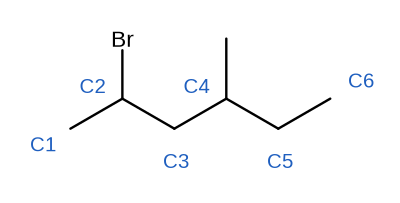
Hexane says six carbons in a row. Bromo and methyl say what hangs on the chain, and the numbers say where. But look again: the chain can be counted from the left or from the right, and each way gives different numbers. Only one of those can end up in the name, and the molecule does not care which.
Who decides? A fixed set of four moves, always in the same order. Do them in a different order and you get the wrong name for a perfectly innocent molecule.
Move 1: find the parent, the longest chain
The parent is the longest continuous chain of carbon atoms that carries the main group (or, if the main group is on a ring, or there is none, the ring). Its length gives the stem: meth- for one carbon, eth- for two, prop-, but-, pent-, hex-, hept-, oct-, non-, dec- for three to ten. A chain with only single bonds gets the ending -ane, so six carbons make hexane. A double bond turns -ane into -ene and a triple bond into -yne, with the number of its first carbon in front: hex-1-ene.
Count carbons, not bends in the drawing. The chain is allowed to turn corners, and it may run straight through the middle of a branched structure. Figure 2 shows the trap.
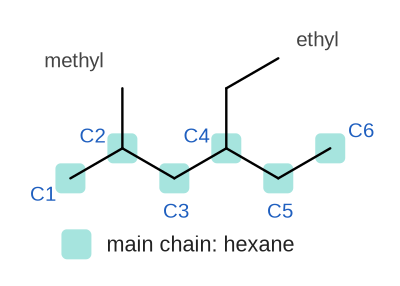
The highlighted chain has six carbons, and no route through the structure is longer. Some routes tie with it: you can leave C4 through the ethyl instead of through C5 and C6, or start on the other methyl on C2 instead of on C1. Those routes only swap one end for an identical one, so they give the same name. Whatever is left over is a branch: the methyl and the ethyl here. Branches become prefixes, and they are the part that is easiest to miss when you stare at a drawing for too long.
Two more rules for the cases where it is not so tidy. If two different routes tie for longest, take the one that leaves more branches. And when the molecule has a double bond, the chain should contain it (the 2013 IUPAC recommendations put length first, but every example on this page comes out the same either way).
Move 2: pick the suffix, the rest become prefixes
Look for the functional group with the highest rank on the priority list (acid, anhydride, ester, acid halide, amide, nitrile, aldehyde, ketone, alcohol, amine, in that order). That group becomes the ending of the name: -ol, -one, -oate, -amide. The parent chain must contain the carbon it sits on, and every lower-ranked group is demoted to a prefix: hydroxy, oxo, amino, cyano.
Some groups never get the suffix at all: halogens and ethers are always prefixes (bromo, chloro, methoxy, ethoxy). Our molecule from Figure 1 has no suffix group: bromine is a prefix, so the name is just the chain, hexane, with its branches in front.
Move 3: number from the end that wins
Number the chain from one end, and then decide whether that end was the right one. The tests come in a fixed order, and you stop at the first one that gives a winner:
- The suffix gets the lowest number possible.
- Then double and triple bonds get the lowest numbers possible.
- Then all the prefixes together get the lowest numbers possible.
Comparing sets of numbers is done term by term, at the first place where they differ. {2,4} beats {3,5}, because 2 is lower than 3. And {2,9} beats {3,4}, even though 9 is a big number and 3 and 4 are small ones, because the first terms already decide: 2 comes before 3. The total does not matter. Figure 3 is the test on our molecule.
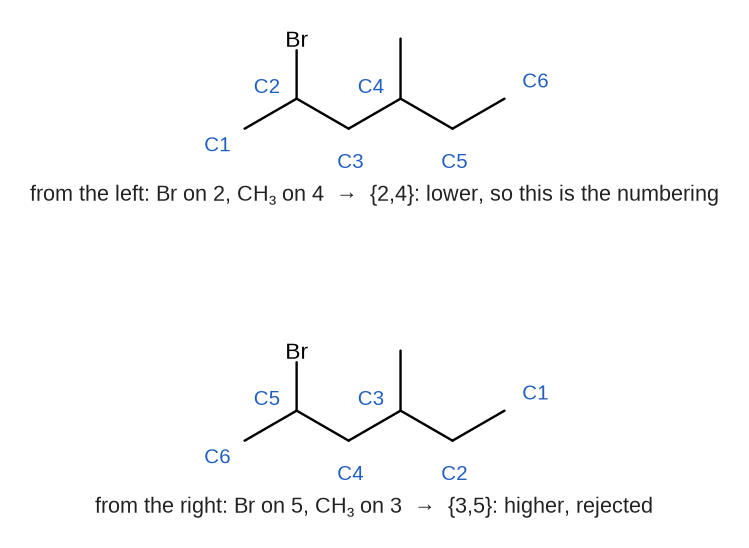
From the left the bromine is on C2 and the methyl on C4: {2,4}. From the right the methyl is on C3 and the bromine on C5: {3,5}. The first set wins at the first term, so we number from the left. There is no suffix and no double bond, so test 3 is the one that decides.
When a suffix group or a double bond is present, it decides first, and the prefixes get no say. Figure 4 shows both cases.
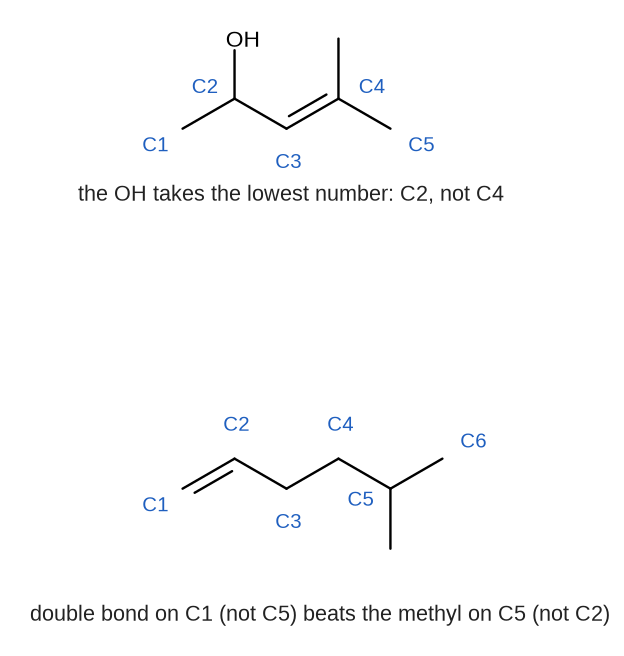
In 4-methylpent-3-en-2-ol the alcohol is the suffix, so the OH must get the lowest number: C2, and not C4. The double bond (C3=C4) and the methyl on C4 simply go where they fall. In 5-methylhex-1-ene there is no suffix group, so the double bond comes next: it starts on C1, not on C5. The methyl lands on C5, even though numbering from the other end would have given it a much nicer 2. A double bond outranks a prefix, and "nicer" is not a rule.
Move 4: write it, prefixes in alphabetical order
Now assemble the name. Prefixes go in front, in alphabetical order, each with its number or numbers. The numbers follow the chain; the order of the words follows the alphabet, and those are two separate decisions. Multipliers (di-, tri-, tetra-) do not count for the alphabet, so dimethyl sorts under m. Hyphens go between numbers and words, commas between numbers, and the name is written as one word. Each number sits right in front of the part of the name it belongs to (the 2 in front of the -ol, the 3 in front of the -en-), and the final -e of -ane or -ene is dropped when the suffix starts with a vowel: pent-3-en-2-ol, not pent-3-ene-2-ol.
Back to Figure 2: the ethyl is on C4 and the methyl on C2, and e comes before m, so the ethyl is named first. The name is 4-ethyl-2-methylhexane, with the higher number first and nobody blinking. In Figure 1 it is b before m: 2-bromo-4-methylhexane.
If two numberings still tie after all three tests, the alphabet breaks the tie: the prefix that comes first alphabetically gets the lower number.
The recipe. Parent chain (longest, containing the main group). Suffix from the priority list; everything else becomes a prefix. Number from the end that gives the suffix, then the multiple bonds, then the prefixes the lowest numbers, term by term. Write the prefixes alphabetically, ignoring di-, tri- and tetra-.
Watch out. The lowest numbers are about the first place where two sets differ, not about their sum. And the numbering is chosen before the writing: never pick the numbers that make the alphabet look neat.
More from Structure
How to name an ester: two words, and C1 is the C=O
An ester name is two words: the group on the oxygen, then the acid part ending in -oate. Which half goes first, and why counting starts on the C=O.
Alphabetical order in IUPAC names: why 1,1-dimethylpropyl sorts under d
In a crowded name the branches go in alphabetical order, but di, iso and tert are treated differently. Why 1,1-dimethylpropyl sorts under d and not under p.
What do cis and trans in a ring name really mean? Naming rings
Rings are named from the ring up: cyclo- plus the stem, numbers from the suffix, and cis or trans for which face each group points to.
From name to structure: how to draw a molecule from its name
Nobody sees a whole molecule in a name. Draw the parent first, number it, hang each group on its number, then name your own drawing to check it.