
 PossieChem
From name to structure: how to draw a molecule from its name
Nobody sees a whole molecule in a name. Draw the parent first, number it, hang each group on its number, then name your own drawing to check it.
- The recipe for naming (parent, suffix, numbering, writing)
- Skeletal (line) structures
- Wedge and dashed bonds
Reading a name backwards feels harder than reading it forwards, because the name arrives as one long word and you feel you are supposed to see the molecule in it. Nobody does. You are not supposed to see it all at once: you are supposed to build it, one piece at a time, and the name tells you the order.
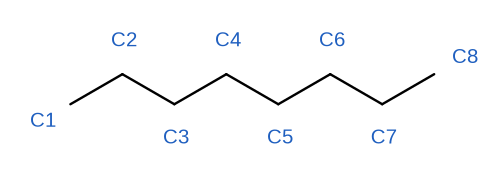
The piece you build first is the parent: the stem and the ending, the part after the last prefix. If the name ends in octane, the skeleton is eight carbons in a row, and Figure 1 is that skeleton, numbered. Everything else in the name is a decoration with an address, and the address is a number.
Two things are left to find out. How do the decorations go on when there are three of them, and how do you notice that the name you were given cannot be right?
Step 1: draw the parent and number it first
Start with the parent, the part of the name after the last prefix (octane or butanoate, say, or a ring). It tells you the number of carbons (the stem) and whether it is a chain or a ring. Draw a chain as a zigzag (a ring as a polygon) and write the numbers on the carbons, 1 to the last, before you put a single substituent on it. The numbers are the addresses, and you will be reading them off the front of the name in a moment.
For a chain it does not matter which end you call C1 when you draw it: the numbers in the name already point the right way, and a chain drawn from the other end is the same molecule turned around. Pick the left end and keep going. For a ring, put C1 where the suffix or the first substituent needs it.
Step 2: hang each prefix on its number
Now read the prefixes from the front, and put each one on the carbon its number points to. Figure 2 does this for 5-chloro-3-methyl-4-propyloctane.
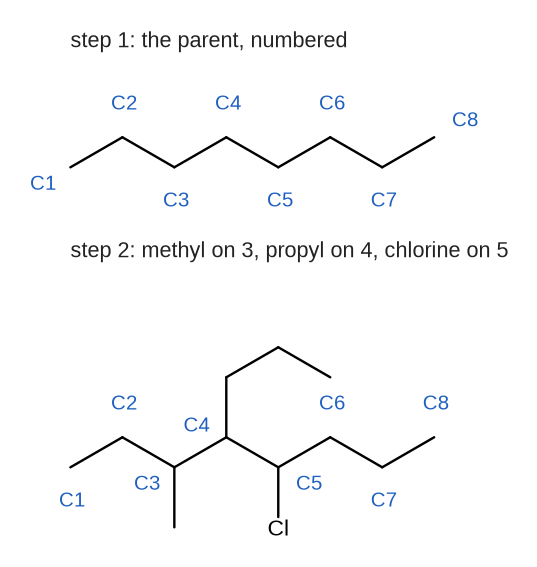
The methyl goes on C3, the propyl (three carbons in a row) on C4 and the chlorine on C5. (If you rename this molecule, two chains of eight carbons tie for longest: the one you started with, and one that runs out through the propyl. Take the one with more branches, which is the chain you started with.) The order they appear in the name is the alphabet (chloro, methyl, propyl), and it has nothing to do with the drawing: only the numbers matter. A practical tip: hang neighbouring groups on opposite sides of the chain, one up and one down, so that they do not run into each other on the paper.
A suffix group: an ester starts at the C=O
A suffix group is just another number in the name: a name ending in -2-ol puts the OH on C2, and you do not start counting at the OH. But a group that sits at the end of the chain, such as the C=O of an ester, an acid or an amide, is C1 by definition. The ester is the clearest case, because the name has two words and each one is a piece of the drawing. Figure 3 builds ethyl 2-bromo-3-methylbutanoate.
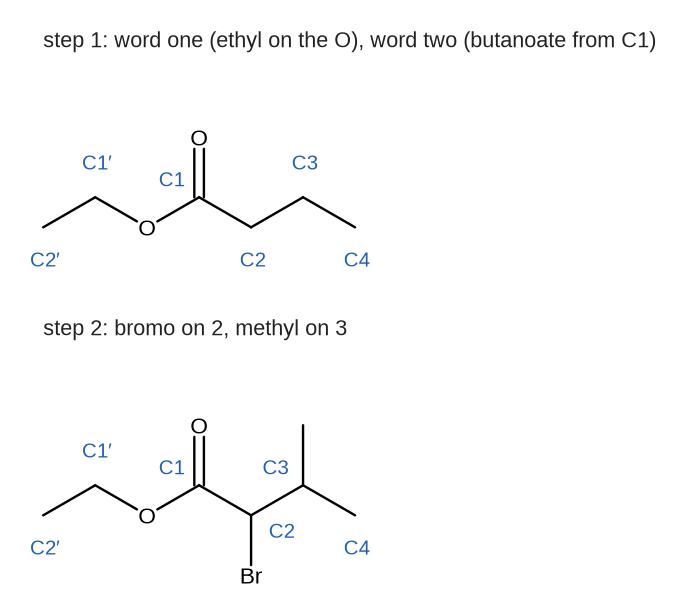
Word one, ethyl, is the group on the oxygen. Word two, butanoate, is four carbons counted from the C=O, so C1 is the carbonyl carbon and the chain runs C1 to C4. Draw both, and the skeleton is done. Then the prefixes: bromine on C2, a methyl on C3.
Rings: draw the ring first, the faces last
For a ring, draw the ring and number it so that the suffix carbon is C1. Then hang the groups on their numbers, and finally use cis or trans to set the faces. Figure 4 draws cis-3-ethylcyclohexan-1-ol.
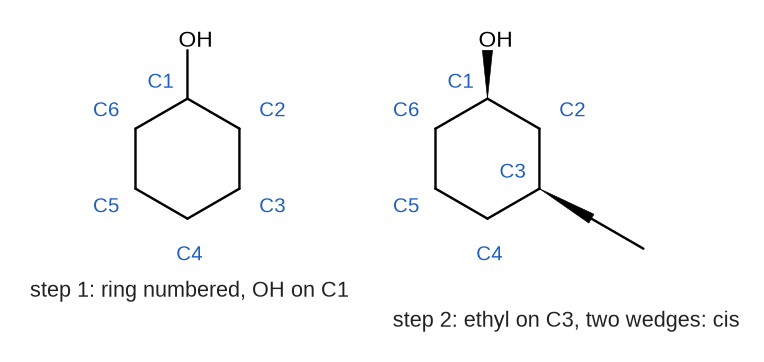
The alcohol is the suffix, so the OH goes on C1. The ethyl goes on C3, two carbons further round. Cis says that the two groups point the same way, so both bonds are wedges (or both dashed). Had the name said trans, one of them would be dashed.
The check: name your own drawing
When the drawing is done, do the exercise backwards: name what you drew, from scratch, with the same moves (parent, suffix, numbering, writing). If you get the original name back, you are done. If you do not, either your drawing has a slip or the name you were handed is not a proper one. Check the drawing against the numbers first; if it matches the name, the name is the problem.
Take the name 2-ethylbutane. Follow the steps: a chain of four carbons, and an ethyl on C2. Figure 5 draws it.
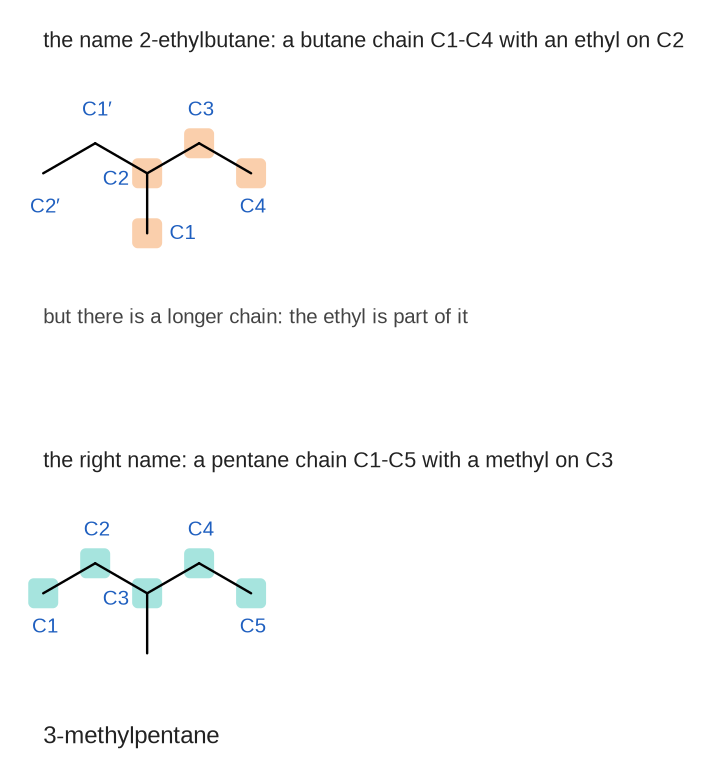
Now name your drawing. The longest chain is not the four carbons you started with: the ethyl on C2 continues the chain, so the chain can go ethyl, C2, C3, C4, which is five carbons. The parent is pentane, the carbon that was C1 is now a methyl on C3, and the molecule is 3-methylpentane. The name you were given described a molecule that already has a proper name.
That is not bad luck. An ethyl on C2 of a plain chain (no suffix group on it) is a longer chain in disguise: going on through the ethyl instead of out to C1 swaps one carbon for two. So the check by renaming catches this kind of improper name, and it costs thirty seconds.
Name to structure. Draw the parent (the stem and ending, after the prefixes) and number it. Hang each prefix on its number (the alphabet does not matter for drawing). For an ester, draw both words. For a ring, draw the faces last. Then name your drawing again: the same name means the drawing is right.
Watch out. If renaming gives a different name, first check the drawing against the numbers in the name. If it matches, the name itself may not be a proper one, as with 2-ethylbutane.
More from Structure
How to name an organic compound: the recipe in four moves
Most IUPAC names are built in four moves: parent, suffix, numbering, writing. Learn the order and even the longest names stop being scary.
How to name an ester: two words, and C1 is the C=O
An ester name is two words: the group on the oxygen, then the acid part ending in -oate. Which half goes first, and why counting starts on the C=O.
Alphabetical order in IUPAC names: why 1,1-dimethylpropyl sorts under d
In a crowded name the branches go in alphabetical order, but di, iso and tert are treated differently. Why 1,1-dimethylpropyl sorts under d and not under p.
What do cis and trans in a ring name really mean? Naming rings
Rings are named from the ring up: cyclo- plus the stem, numbers from the suffix, and cis or trans for which face each group points to.