
 PossieChem
What do cis and trans in a ring name really mean? Naming rings
Rings are named from the ring up: cyclo- plus the stem, numbers from the suffix, and cis or trans for which face each group points to.
- The recipe for naming (parent, suffix, numbering, writing)
- Wedge and dashed bonds
- Names for straight chains (meth-, eth-, prop-, but-)
Hang two groups on a ring and ask whether they are on the same side or on opposite sides. On a chain the question has no answer: every single bond turns, so the groups swap sides billions of times a second. On a ring they cannot. The ring holds them in place, and "same side" and "opposite side" are two different molecules that need two different names. Figure 1 is a ring with a name to match.
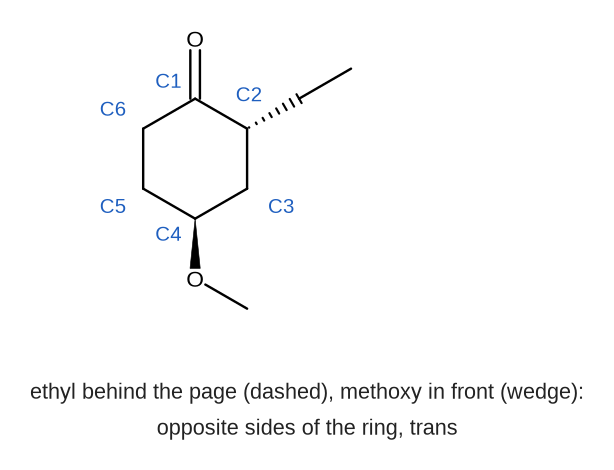
Every part of that name has a job. The ring is the parent, the ketone is the suffix and takes C1, the ethyl and the methoxy are prefixes on C2 and C4, and the word trans says that they sit on opposite faces of the ring.
How do you decide where to start counting and in which direction around the ring? And what exactly does cis promise, and where does it stop working?
The ring is the parent: cyclo- plus the stem
When the main group is on the ring, or there is no main group, the ring is the parent. Its name is cyclo- plus the stem for the number of carbons and the ending -ane, so six carbons in a ring make cyclohexane. All the carbons of a bare ring are equivalent, so there is nothing to choose between until something hangs on it.
With one substituent there is nothing to number: methylcyclohexane needs no 1, because the carbon with the methyl is C1 by definition. With two or more substituents, the usual rules apply: start on one of them, and count in the direction that gives the lowest set of numbers. Figure 2 shows both cases.
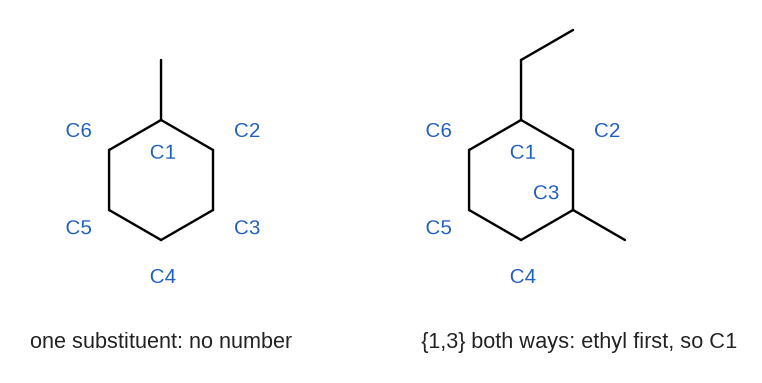
In 1-ethyl-3-methylcyclohexane the two groups are separated by one ring carbon. Start on the ethyl, go the short way round, and the methyl is on C3: {1,3}. Going the long way round would put it on C5. Start on the methyl instead and you also get {1,3}. That is a tie, and the alphabet breaks it: ethyl comes before methyl, so the ethyl takes C1.
The suffix takes C1, and the double bond comes next
If a suffix group is on the ring, its carbon is C1, and you then count in the direction that gives the double bond the lowest number. Figure 3 is a six-membered ring with a ketone and a double bond.
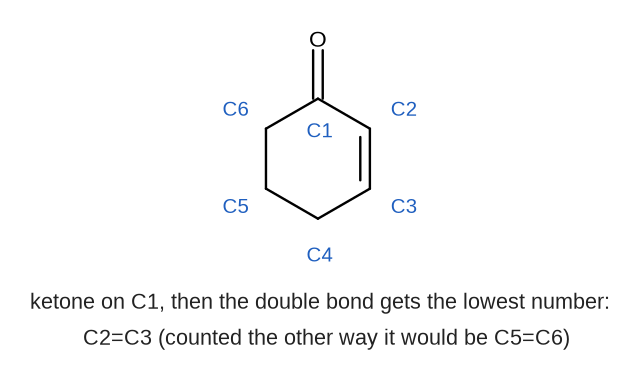
The ketone ranks above everything else here, so it is the suffix and its carbon is C1: -1-one. Then you count towards the double bond, so that it sits between C2 and C3: -2-ene. Counting the other way would put it between C5 and C6. Each locant sits in front of the part of the name it belongs to: the 2 in front of -en-, the 1 in front of -one. The name is cyclohex-2-en-1-one. (The final -e of -ane or -ene is dropped in front of a suffix that starts with a vowel: there is no e before the 1 of the -1-one.)
cis and trans: which side of the ring
On a drawing, a wedge points towards you and a dashed bond points away from you. Two groups on the same side of the ring, both on wedges or both dashed, are cis. Two groups on opposite sides, one wedge and one dash, are trans. The word goes in italics in front of the whole name, with a hyphen. Figure 4 shows a pair.
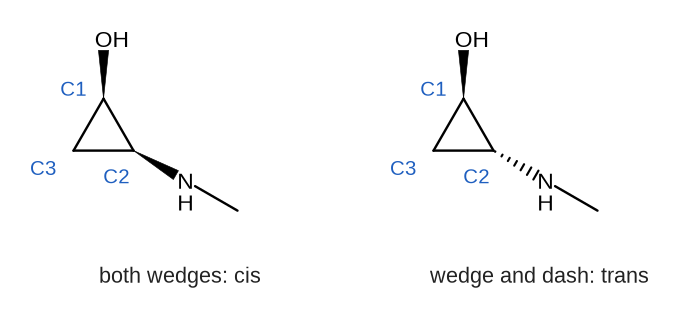
Both molecules are a three-membered ring with an OH and an NH–CH₃ group. The alcohol outranks the amine, so the OH is the suffix, on C1. The amine becomes a prefix on C2, and because the nitrogen carries a methyl, the prefix is methylamino. It is a compound prefix, so it goes in brackets: 2-(methylamino).
In the left molecule both bonds are wedges: both groups point towards you, so they are on the same face, and the name starts with cis. In the right one the OH is on a wedge and the amine on a dash, opposite faces, trans. Same atoms, same bonds, different molecules, and the one word at the front is the whole difference.
This works where the groups cannot swap sides: on a ring, and around a double bond, where simple cases also use cis and trans and the full system is called E and Z (it comes later in the course).
Putting it together, one decision at a time
Back to Figure 1, one decision at a time.
The parent is the ring, cyclohexane. The ketone has the highest rank, so it is the suffix and its carbon is C1. An ether is never a suffix, so the OCH₃ becomes the prefix methoxy. Now the direction. Counting towards the ethyl puts the ethyl on C2 and the methoxy on C4: {2,4}. Counting the other way round gives {4,6}. The first set wins.
The prefixes go in alphabetical order, so ethyl comes before methoxy. Finally the faces: the ethyl is on a dashed bond (behind the paper) and the methoxy on a wedge (in front of it), opposite sides, so trans. The name is trans-2-ethyl-4-methoxycyclohexan-1-one.
Naming a ring. The ring is the parent (cyclo- plus the stem). The suffix carbon is C1, then multiple bonds, then the prefixes get the lowest numbers. cis means both groups on the same face (two wedges or two dashes), trans means opposite faces (one wedge, one dash).
Watch out. cis and trans describe how two groups relate to each other, not a single group. A wedge on its own does not make anything cis or trans: you need a second group to compare with.
More from Structure
How to name an organic compound: the recipe in four moves
Most IUPAC names are built in four moves: parent, suffix, numbering, writing. Learn the order and even the longest names stop being scary.
How to name an ester: two words, and C1 is the C=O
An ester name is two words: the group on the oxygen, then the acid part ending in -oate. Which half goes first, and why counting starts on the C=O.
Alphabetical order in IUPAC names: why 1,1-dimethylpropyl sorts under d
In a crowded name the branches go in alphabetical order, but di, iso and tert are treated differently. Why 1,1-dimethylpropyl sorts under d and not under p.
From name to structure: how to draw a molecule from its name
Nobody sees a whole molecule in a name. Draw the parent first, number it, hang each group on its number, then name your own drawing to check it.