
 PossieChem
How many π electrons does this ring have? Hückel's rule
Count the π electrons, check the ring is flat, spot the sp³ carbon. Hückel's 4n + 2 rule, tried on seven rings and counted carbon by carbon.
- Resonance structures and curved arrows
- What sp² hybridisation means (the p orbital left over)
- Double bonds as σ plus π
Draw a ring of carbons with double bonds going round it: double, single, double, single. Some of these rings are so stable that whole industries are built on them. Others fall apart if you look at them funny, and one of them refuses to lie flat, out of pure spite. The drawing does not tell you which is which. A number does, and the number is how many π electrons the ring has.
Hückel's rule says which numbers are good. Below it is tried on seven rings, and every time the electrons are counted carbon by carbon, so you can do the same on any ring you meet.
Benzene: six electrons going round with no start and no end
Benzene has six carbons in a ring, all sp², all in one plane. Every carbon has a p orbital pointing up and down, and all six overlap in a loop, a π system without a beginning or an end. On paper there are two ways to put the three double bonds, the two Kekulé structures of Figure 1, and three curved arrows turn one into the other: every π bond slides one position round the ring.
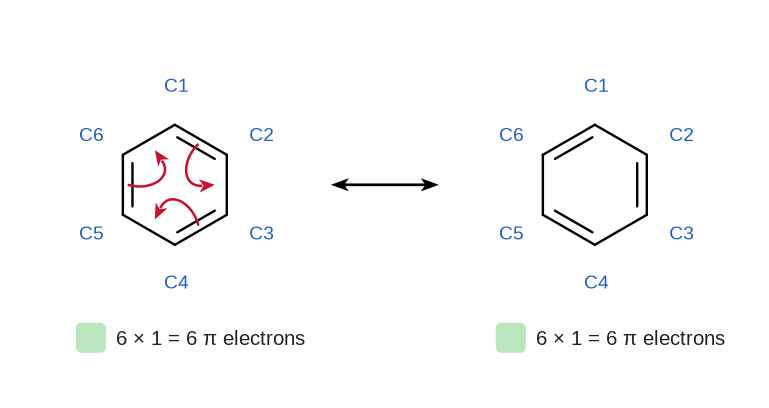
Neither structure is real. Benzene is the hybrid of the two, and you can measure it: all six C–C bonds are the same length, about 139 pm, between the 134 pm of a C=C and the 154 pm of a C–C between two sp³ carbons. Hydrogenating benzene releases about 208 kJ/mol, whereas three separate C=C bonds would release about 360 kJ/mol. Benzene is about 150 kJ/mol more stable than its Kekulé structures promise, ten times the gain of an ordinary conjugated diene. That extra stability is what aromaticity means.
Not every ring with alternating double bonds gets it. Hückel's rule says which ones do.
The four conditions
Hückel's rule. A ring is aromatic when (1) it is cyclic, (2) it is planar, (3) every ring atom has a p orbital, so the π system is continuous all the way round, and (4) the π system holds electrons, with , that is 2, 6, 10, 14, ... A planar, fully conjugated ring with electrons (4, 8, 12, ...) is antiaromatic, and unusually unstable.
Why ? The p orbitals of the ring combine into π molecular orbitals: one lowest orbital, then pairs of orbitals with the same energy. Fill them with pairs of electrons and the shells close at 2, 6, 10, 14 electrons, which is . Every bonding orbital is full and no antibonding orbital is occupied, a little like a noble-gas configuration. Think of a dance floor: at every dancer has a partner. At two electrons have no partner and stand in the corner, sulking.
So counting is the whole game. Only electrons in the p orbitals that stick out above and below the ring are counted:
- a carbon in a ring C=C puts in one electron, so a ring double bond is 2;
- a ring carbon with a lone pair (a carbanion, C⁻) has that lone pair in its p orbital: 2;
- a ring carbon with a positive charge and only three bonds (C⁺) has an empty p orbital: 0;
- an sp³ carbon has no p orbital at all, so it breaks the loop, whatever else is true.
Atoms such as N and O in a ring are counted the same way, p orbital by p orbital (a lone pair counts only if it sits in the p orbital); this page sticks to rings of carbon.
Two rings with 4n electrons
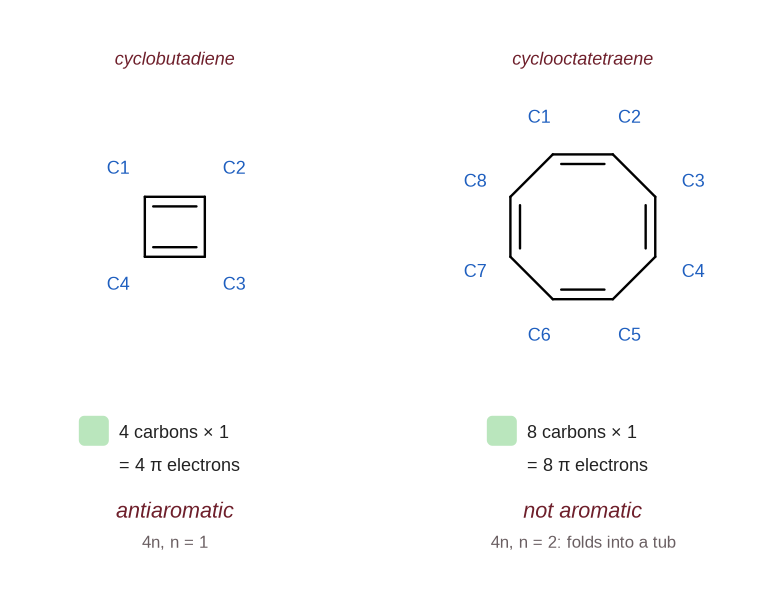
Cyclobutadiene has four carbons and two double bonds: 4 electrons, which is with . It is cyclic, planar on paper and fully conjugated, so it is antiaromatic, and the molecule knows it. It dodges as well as it can by squashing itself into a rectangle with two real double bonds and two real single bonds, and the parent molecule is still so reactive that it survives only frozen in solid argon, close to absolute zero. Let it move and it dimerises.
Cyclooctatetraene has eight carbons and four double bonds: 8 electrons, with . If it were flat it would be antiaromatic. So it is not flat. It folds into a tub, the p orbitals of neighbouring double bonds no longer line up, and condition 2 fails, so the penalty is never charged. It behaves like four ordinary C=C bonds and undergoes addition reactions like any alkene. Hückel's rule only judges flat rings, and a ring that can avoid being flat usually does.
Two rings with 4n + 2 electrons
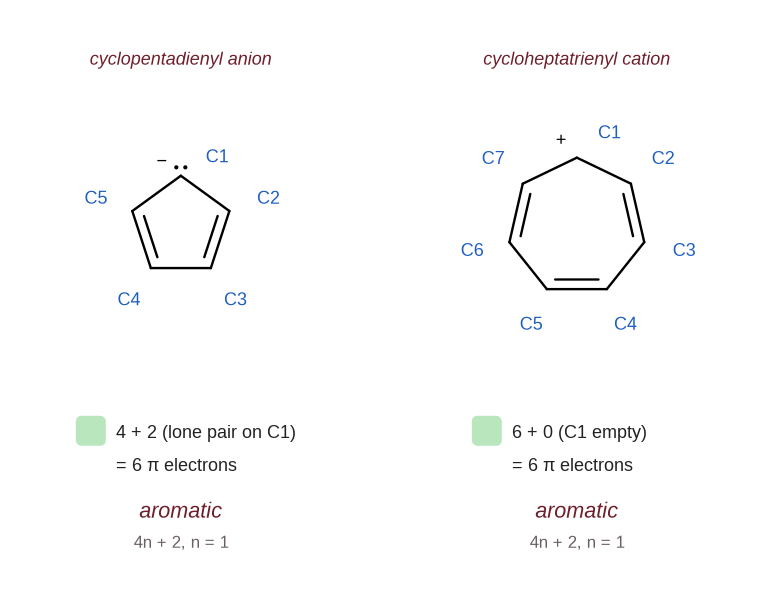
The cyclopentadienyl anion has five carbons. C2=C3 and C4=C5 give 4 electrons, and C1 carries a lone pair in its p orbital, which gives 2 more: , so with . Aromatic. A carbanion that is happy about it.
The cycloheptatrienyl cation (also called the tropylium cation) has seven carbons. Three C=C bonds give 6 electrons, and C1, with its positive charge and three bonds, has an empty p orbital: . Aromatic again, and it shows: its salts are stable enough to keep in a bottle on the shelf, which for a carbocation is a minor miracle.
One sp³ carbon spoils the ring
Counting to is only the last step. First look at the ring itself.
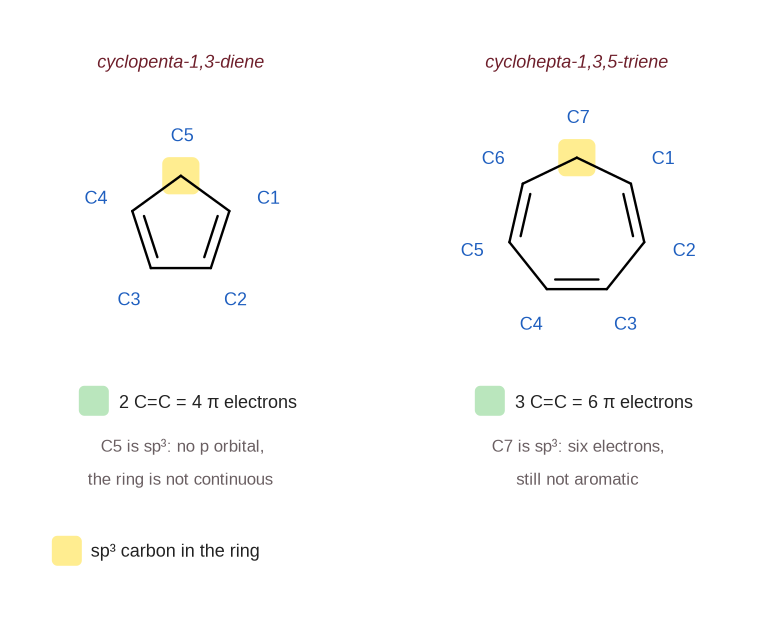
Cyclopentadiene (cyclopenta-1,3-diene) has two double bonds, so 4 electrons, but its CH₂ (C5) is sp³ and has no p orbital. Cycloheptatriene (cyclohepta-1,3,5-triene) is the instructive one: three double bonds, 6 electrons, exactly the right number, and still not aromatic, because C7 is sp³ and the loop of p orbitals has a gap in it. Six electrons in a broken ring are just six electrons.
Watch out. If one ring atom is sp³, stop: the ring is not aromatic, whatever the count. An sp³ carbon outside the ring, like the CH₃ of a methyl group hanging on it, does not affect whether the ring is aromatic.
Cyclopentadiene gives its proton away
The aromatic sextet (six π electrons in a closed shell) is not just a bookkeeping curiosity, because it changes what a molecule does. The pKa of a compound is −log of its acid dissociation constant, so a lower pKa means a stronger acid. An ordinary alkane C–H has a pKa of about 50, which is to say it does not come off. The CH₂ of cyclopentadiene is a different animal.
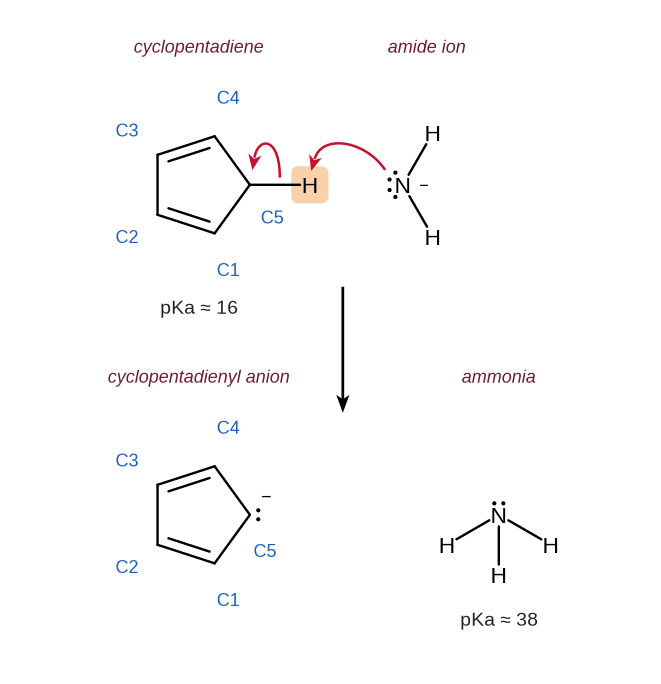
Two arrows. The lone pair on nitrogen goes to the hydrogen on C5, and the C5–H bond breaks and stays behind on C5 as a lone pair. C5 has become sp² with a p orbital holding two electrons, the ring is flat and fully conjugated with 6 electrons, and the product is the cyclopentadienyl anion. Cyclopentadiene has a pKa of about 16, ammonia of about 38, so the equilibrium constant is : the proton is gone, completely. A hydrocarbon that acts like an alcohol, because losing the proton buys it a sextet.
Where the charge goes
Take the anion and move the lone pair round (Figure 6, top). One arrow takes the lone pair on C1 to form the new bond C1=C2. A second takes the π electrons of C2=C3 onto C3 as a lone pair. The result has its charge on C3, and repeating the trick carries it on round the ring until every carbon has had it: five equivalent structures, so the negative charge is spread evenly, one fifth on each carbon, and all five C–C bonds are alike.
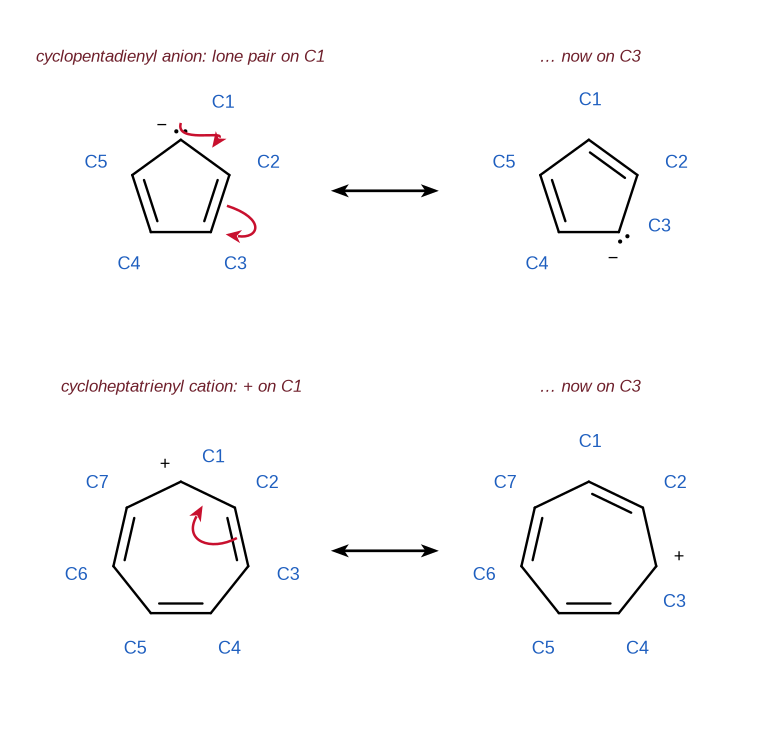
The cation does the same with a single arrow (Figure 6, bottom): the π electrons of C2=C3 slide over to make C1=C2, and the positive charge now sits on C3. Seven structures, one seventh of the charge on each carbon, and all seven carbons and all seven hydrogens of the ion are identical. That is resonance at work: other things being equal, the more equivalent resonance structures a molecule has, the more stable it is, and an aromatic ring is the extreme case.
In one table
| Ring | π electrons | Verdict |
|---|---|---|
| benzene | 6 = | aromatic |
| cyclobutadiene | 4 = | antiaromatic |
| cyclopentadienyl anion | aromatic | |
| cycloheptatrienyl cation | aromatic | |
| cyclooctatetraene | 8 = | folds into a tub |
| cycloheptatriene | 6, but C7 is sp³ | ring not continuous |
How to count. (1) Is the ring cyclic and flat, with a p orbital on every atom? One sp³ atom ends the question. (2) Count: 2 per ring double bond, 2 per lone pair in a ring p orbital, 0 for an empty p orbital. (3) means aromatic; means antiaromatic, or a ring that buckles to escape.
More from Structure
Why are conjugated dienes more stable than isolated ones?
Two double bonds can sit apart, side by side or share a carbon. Hydrogenation heats show which arrangement wins, and π orbitals show why.
How do you draw resonance structures? The rules and the curved arrows
When one Lewis structure is not enough: how to push electrons with curved arrows, which rules a resonance form must obey, and which form counts most.
Why is an amide flat? The C–N bond that will not turn
An amine nitrogen is a pyramid and spins freely. An amide nitrogen is flat and locked. One pair of curved arrows explains the difference.
Pyrrole, pyridine, imidazole: which nitrogen lone pair is aromatic?
Pyrrole and pyridine both have a nitrogen in an aromatic ring, yet one is basic and the other is not. Count which lone pair joins the π system.