
 PossieChem
Why is an amide flat? The C–N bond that will not turn
An amine nitrogen is a pyramid and spins freely. An amide nitrogen is flat and locked. One pair of curved arrows explains the difference.
- Resonance structures and curved arrows
- sp² and sp³ hybridisation
- Lone pairs on nitrogen
An amine nitrogen is a pyramid. Its lone pair points up, its three bonds splay down, and the groups on it turn freely around the C–N bond as if nothing mattered. An amide nitrogen has the same three atoms attached and, one atom further along, a C=O. Suddenly the nitrogen is flat, the C–N bond shortens, and the whole group will not spin freely at room temperature.
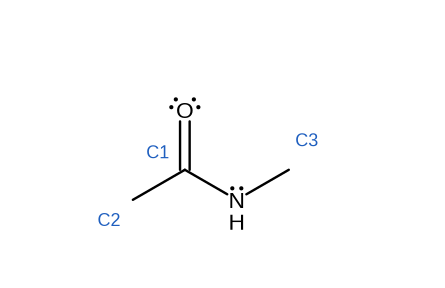
A C=O sitting next to a nitrogen is enough to change its shape. What does the carbonyl do to the nitrogen, and how can you see it?
Two electron pairs move: the resonance behind it
In N-methylacetamide the nitrogen has a lone pair and C1 has a C=O. Now push two electron pairs, with two curved arrows (Figure 2). The nitrogen lone pair moves into the C1–N bond and turns it into a double bond, and the π electrons of the C=O move onto oxygen as a lone pair. The result is structure B, the right-hand one, with O⁻ and N⁺. No atom has moved. Only electrons did.
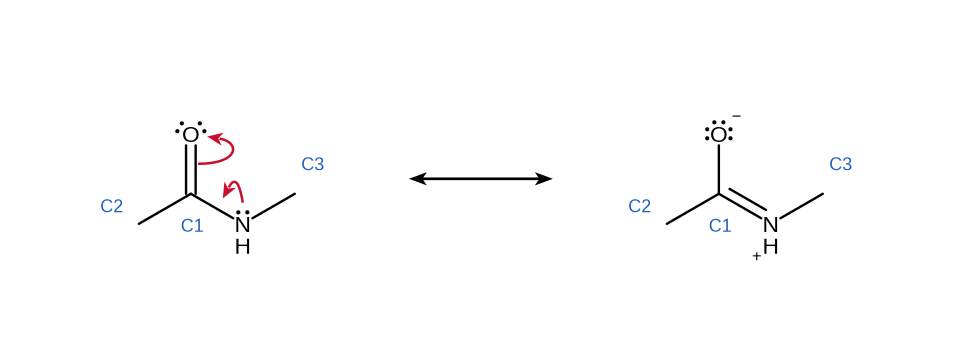
Neither A nor B exists on its own. The real molecule is a resonance hybrid of the two, written with ↔. It looks like A with a bit of B mixed in: A contributes most because it has no charges, but B contributes enough to matter. Three things you can measure show it.
Evidence 1: a short C–N bond
The C1–N bond in an amide is about 133 pm long, against about 147 pm for a C–N single bond in an amine. A bond that is partly double is shorter, and that is just what structure B predicts.
Evidence 2: a flat nitrogen
An amine nitrogen is sp³: four electron domains (three bonds and a lone pair) arranged as a pyramid. The amide nitrogen has to deliver its lone pair into a π bond with C1, and a π bond needs a p orbital lined up with its neighbour's p orbital. So the nitrogen is sp² and the lone pair sits in a p orbital, overlapping with the π bond of the C=O. Figure 3 puts the two nitrogens side by side.
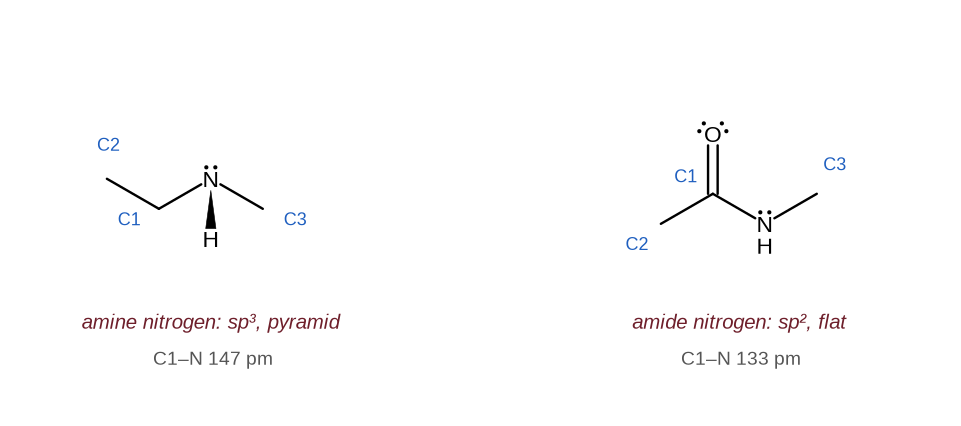
In the amide, C1, O, N, C2, C3 and the hydrogen on nitrogen all lie in one plane. That is what happens when a lone pair joins a π system: an amine nitrogen is sp³ and pyramidal, an amide nitrogen is sp² and flat.
Evidence 3: a C–N bond that will not rotate
Turning the two ends of the C1–N bond against each other would pull the p orbitals out of line and cut the partial π bond, and that costs energy: roughly 70 to 85 kJ/mol. Room temperature supplies only a small fraction of that, so at room temperature the amide group does not spin freely. N-methylacetamide has two flat arrangements, which differ by which side C3 is on (Figure 4). In the left one C2 and C3 are on opposite sides of the C1–N bond; in the right one they are on the same side. Going from one to the other means passing through a twisted shape in which the p orbitals no longer overlap.
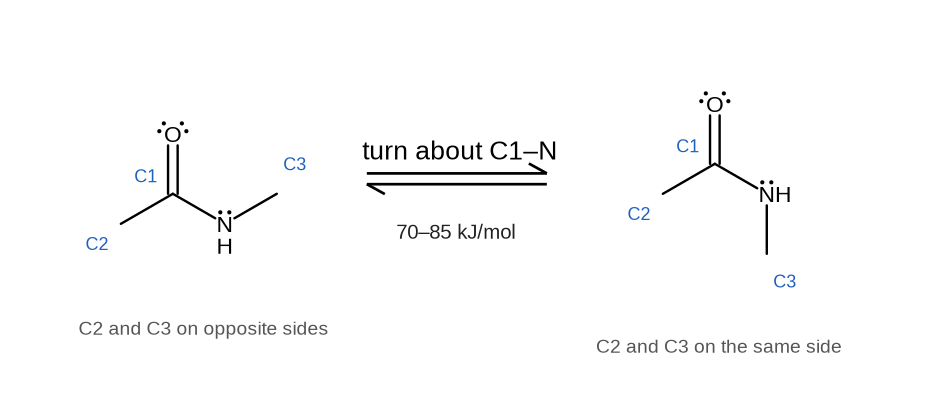
The left-hand arrangement, with C2 and C3 on opposite sides, is the more stable one, because C3 and C2 stay out of each other's way.
Why an amide is flat. The nitrogen lone pair is delocalised into the C=O: resonance structure B puts a partial C1=N double bond in the molecule. A double bond is short, flat and hard to twist. So the nitrogen is sp², C1, O, N and the atoms on them lie in one plane, and rotation about C1–N is hindered.
What this means for a chain of amides
Every peptide bond in a protein is this group, which is why a protein backbone is a string of flat tiles that can only fold at the joints between them. And a lone pair that has joined a π system is no longer available for anything else: an amide nitrogen is hardly basic at all, because the electrons it would use to pick up a proton are busy in the C1–N bond.
More from Structure
Why are conjugated dienes more stable than isolated ones?
Two double bonds can sit apart, side by side or share a carbon. Hydrogenation heats show which arrangement wins, and π orbitals show why.
How do you draw resonance structures? The rules and the curved arrows
When one Lewis structure is not enough: how to push electrons with curved arrows, which rules a resonance form must obey, and which form counts most.
How many π electrons does this ring have? Hückel's rule
Count the π electrons, check the ring is flat, spot the sp³ carbon. Hückel's 4n + 2 rule, tried on seven rings and counted carbon by carbon.
Pyrrole, pyridine, imidazole: which nitrogen lone pair is aromatic?
Pyrrole and pyridine both have a nitrogen in an aromatic ring, yet one is basic and the other is not. Count which lone pair joins the π system.