
 PossieChem
How do you draw resonance structures? The rules and the curved arrows
When one Lewis structure is not enough: how to push electrons with curved arrows, which rules a resonance form must obey, and which form counts most.
- Lewis structures and formal charge
- Lone pairs and π bonds
- Curved arrows move electron pairs
A Lewis structure puts every electron pair in one place: on one atom, or between two atoms. That is a fine model until it is not. Take the acetate ion, the ion left when a carboxylic acid of this kind loses its proton. Draw it and you must choose: one oxygen gets the C=O, the other gets the negative charge. Choose the other way round and you have drawn the same ion with the roles swapped.
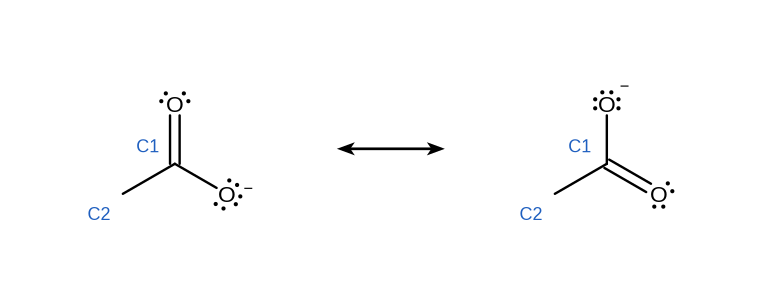
Neither drawing is right and both are right. Measure the ion and the two C–O bonds turn out the same length, somewhere between a double and a single bond. How do you draw something a Lewis structure cannot show, and what are you allowed to write down?
One ion, two drawings: what ↔ means
The two drawings are resonance structures of one ion, joined by the double-headed arrow ↔. The real ion is a resonance hybrid of them: not a mixture and not a flicker between two forms, but a single species with a charge spread over both oxygens. Figure 2 shows how the first drawing turns into the second, with two curved arrows. The lone pair of the lower oxygen moves into the C1–O bond and makes it a double bond, and the C1=O π electrons of the upper oxygen move onto that oxygen as a lone pair. No atom moved. Only electrons did.
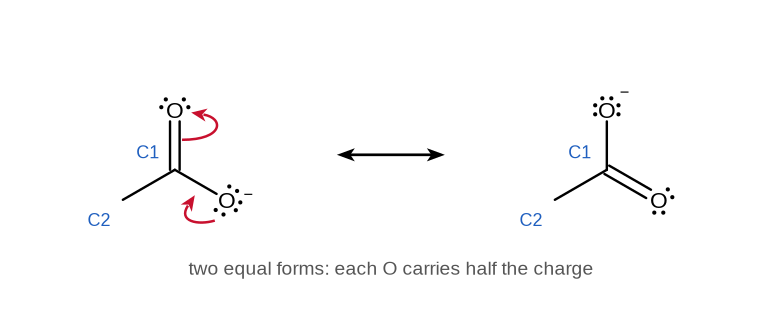
The arrow ↔ is not the equilibrium arrow ⇌. In an equilibrium two different molecules turn into each other. In resonance there is one molecule that a single Lewis structure cannot draw. A hybrid is a mule: one animal, with the traits of both parents. It is not a horse on Mondays and a donkey on Tuesdays.
The six rules, each one checked on a figure
Resonance structures are bookkeeping, so there are rules, and they are the same rules the curved arrows follow.
- Only electrons move, never atoms. Every structure has the same σ framework: the same atoms joined in the same order. A shifted hydrogen is a different molecule, not another form.
- Curved arrows start at a lone pair or at a bond, never at an atom, and end at an atom or between two atoms. In Figure 2 the first arrow starts at a lone pair and ends on the C1–O bond, the second starts on a bond and ends on an oxygen.
- The total number of electrons and the net charge stay the same. Both acetate forms carry one negative charge.
- No second-row atom (C, N, O) gets more than eight electrons. A carbon with five bonds is not a resonance form of anything.
- A form contributes more when it has more bonds, full octets, fewer charges, and any negative charge on the more electronegative atom.
- The more forms a molecule has, and the more equal they are, the more stable it is.
Rules 5 and 6 decide how the hybrid looks. Figure 3 shows rule 5 at work on the acetone enolate, the ion that forms when a ketone loses a proton from a carbon next to the C=O.
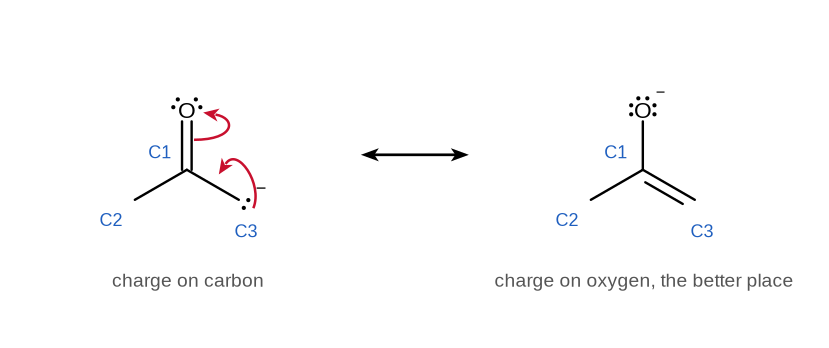
The two forms are not equal. Oxygen is more electronegative than carbon, so the form with the charge on oxygen is the better picture, and the real ion looks more like it. Both forms count, though: the hybrid has some negative charge on C3 as well, and that is why an enolate can react at carbon.
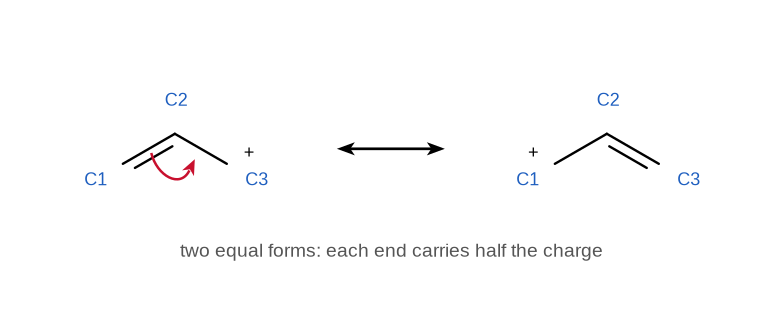
Rule 6 is the opposite case: forms that are exactly equal. Figure 4 shows the allyl cation, where the positive charge sits on one end carbon or the other, and one arrow moves the π bond along.
How to read the hybrid
Put the pieces together and a recipe appears. Draw every form the arrows allow. Throw away the ones that break rules 1 to 4. Rank the survivors with rule 5. Then picture the molecule as the weighted average, leaning toward the best form. Equal forms mean an equal split: each oxygen of acetate carries half the charge and each C–O bond is about one and a half bonds, and each end of the allyl cation carries half the positive charge. Unequal forms mean the best one dominates and the others add a small share.
And the reason to bother: a charge spread over several atoms is more stable than the same charge on one atom. That is a large part of the story behind the acidity of acids, the flatness of amides and the stability of aromatic rings, and each of them rests on the same kind of curved-arrow moves.
More from Structure
Why are conjugated dienes more stable than isolated ones?
Two double bonds can sit apart, side by side or share a carbon. Hydrogenation heats show which arrangement wins, and π orbitals show why.
Why is an amide flat? The C–N bond that will not turn
An amine nitrogen is a pyramid and spins freely. An amide nitrogen is flat and locked. One pair of curved arrows explains the difference.
How many π electrons does this ring have? Hückel's rule
Count the π electrons, check the ring is flat, spot the sp³ carbon. Hückel's 4n + 2 rule, tried on seven rings and counted carbon by carbon.
Pyrrole, pyridine, imidazole: which nitrogen lone pair is aromatic?
Pyrrole and pyridine both have a nitrogen in an aromatic ring, yet one is basic and the other is not. Count which lone pair joins the π system.