
 PossieChem
Pyrrole, pyridine, imidazole: which nitrogen lone pair is aromatic?
Pyrrole and pyridine both have a nitrogen in an aromatic ring, yet one is basic and the other is not. Count which lone pair joins the π system.
- Hückel's rule (4n + 2 π electrons)
- sp² hybridisation and the p orbital
- Resonance structures and curved arrows
Two rings, one with five atoms and one with six, both with a nitrogen inside, both aromatic. Yet pyridine takes a proton readily, as amines do (if less strongly), and pyrrole barely touches one. The nitrogen of pyrrole carries a lone pair, so why does it not behave like a base?
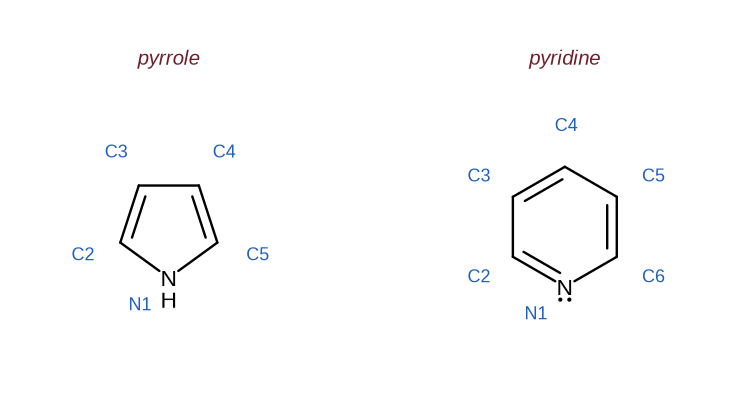
One of the two nitrogens hands its lone pair to the ring. The other keeps it for itself. Which is which, and how can you tell from the drawing?
What every ring atom puts into the π system
Count only the electrons in the p orbital perpendicular to the ring (call it pz). Each ring atom is sp² hybridised: three sp² orbitals in the plane of the ring for σ bonds (and a lone pair, if it has one in the plane), and one pz pointing up and down. Three kinds of atom cover this page:
- A carbon in a ring double bond has four valence electrons: three go into the sp² orbitals, one into pz. It counts 1.
- A pyrrole-type nitrogen, the N–H kind, has five valence electrons: one into each of three σ bonds (two ring bonds and the N–H bond), and the remaining two as a lone pair in pz. It counts 2.
- A pyridine-type nitrogen, the C=N kind, has five valence electrons: two σ bonds, one electron in pz for the C=N π bond, and its lone pair in an sp² orbital in the plane of the ring, pointing away from it. It counts 1.
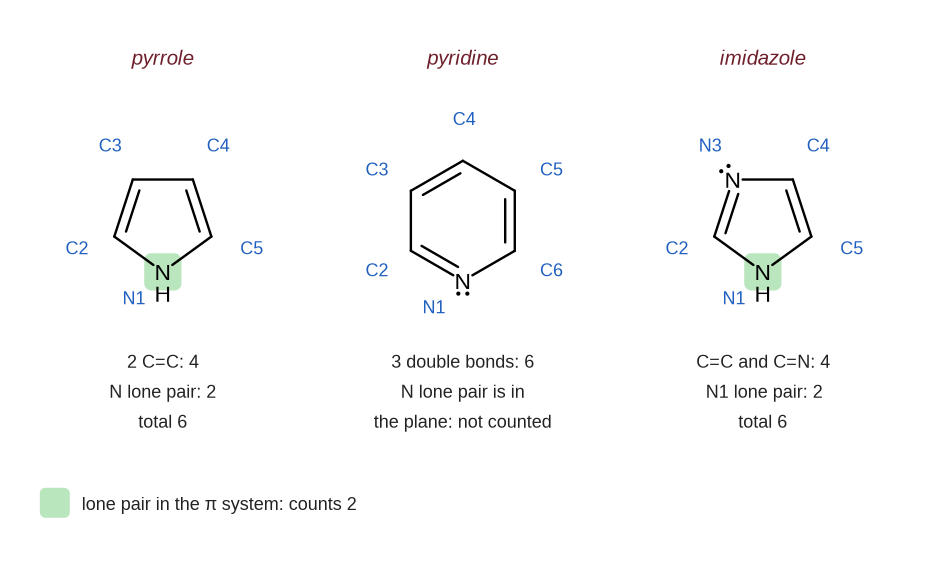
Figure 2 does the counting on pyrrole, pyridine and imidazole, and every ring comes to six.
Pyrrole: the lone pair that is part of the ring
Pyrrole has two C=C bonds (4 electrons) and the lone pair of N1 in its p orbital (2 electrons): 4 + 2 = 6, a sextet, which makes it aromatic. The lone pair is not sitting on the nitrogen, it belongs to the whole ring, and you can see that with curved arrows.
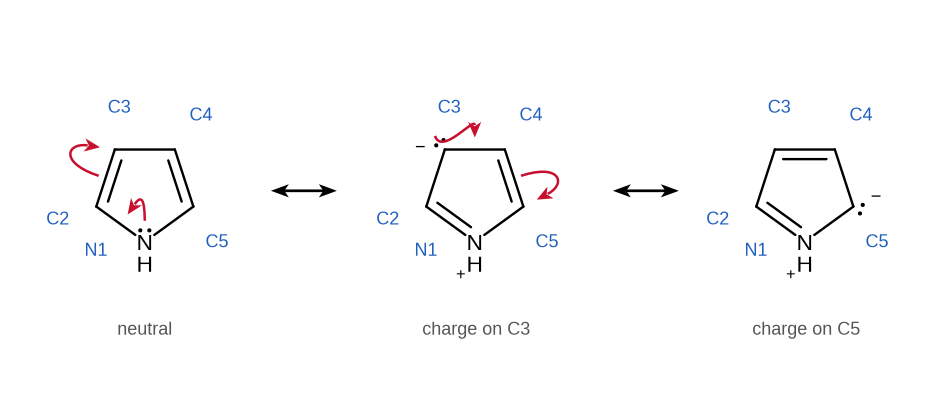
In the first step the lone pair of N1 moves into the N1–C2 bond and the C2=C3 π electrons move onto C3, which puts a negative charge on C3. In the second step the same trick moves the charge on to C5. The nitrogen is positive in every one of the charge-separated forms, and the negative charge visits C3 and C5 (and, by the same moves in the other direction, C4 and C2). The charge separation makes every one of them a minor form, but together they spread the nitrogen's electrons over the whole ring.
That is the answer to "why is pyrrole not basic?". The lone pair of N1 is needed for the aromatic sextet. A proton that took it would break the π system and give up the aromatic stabilisation, so pyrrole is a far weaker base than an amine.
Pyridine: the lone pair that was never in the ring
Pyridine has three C=C or C=N double bonds, each with two π electrons: 6 electrons, aromatic. The nitrogen lone pair is a different matter: it sits in an sp² orbital in the plane of the ring, pointing outward, at right angles to the p orbitals of the π system. It takes no part in the aromatic sextet and is available for anything else. That is why pyridine behaves as a base: it takes a proton on that in-plane lone pair and keeps its aromatic ring intact.
Imidazole: one of each, in the same ring
Imidazole is the interesting one because it has both kinds of nitrogen. N1 carries a hydrogen, the pyrrole kind; N3 is in the C2=N3 double bond, the pyridine kind. Check the conditions for aromaticity: cyclic and planar, a p orbital on every ring atom, and π electrons. Cyclic and planar: yes, a five-membered ring. Every ring atom sp²: C2, C4 and C5 are in double bonds, N3 is in the C2=N3 double bond, and N1 has a lone pair that can sit in a p orbital, so all five atoms have a p orbital. Count the electrons: C4=C5 gives 2, C2=N3 gives 2, the lone pair on N1 gives 2, total 6, which is with . Imidazole is aromatic. The lone pair on N3 lies in the plane and is not counted.
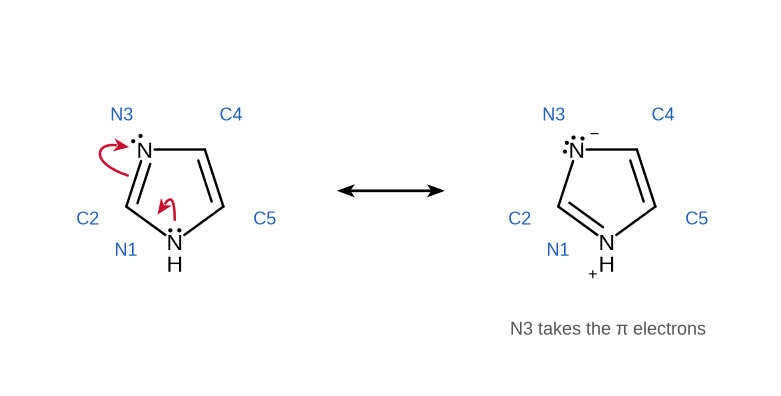
Two arrows are enough: the lone pair of N1 moves into the N1–C2 bond, and the C2=N3 π electrons move onto N3. The negative charge lands on a nitrogen, a more electronegative atom than carbon, so this form contributes more than the carbon-charged forms of pyrrole. The two nitrogens also split the work in a very different way afterwards: N3 uses its in-plane lone pair to pick up a proton, while N1's lone pair stays in the ring. That is why imidazole is a good deal more basic than pyrrole and the reason it turns up wherever chemistry needs a base that works at neutral pH.
Which lone pair is aromatic? Look at the nitrogen's bonds. If it has a hydrogen (or three single bonds) its lone pair is in the p orbital, joins the π system and counts 2. If it has a C=N double bond its lone pair is in the plane, stays free and the nitrogen counts 1 through the double bond.
More from Structure
Why are conjugated dienes more stable than isolated ones?
Two double bonds can sit apart, side by side or share a carbon. Hydrogenation heats show which arrangement wins, and π orbitals show why.
How do you draw resonance structures? The rules and the curved arrows
When one Lewis structure is not enough: how to push electrons with curved arrows, which rules a resonance form must obey, and which form counts most.
Why is an amide flat? The C–N bond that will not turn
An amine nitrogen is a pyramid and spins freely. An amide nitrogen is flat and locked. One pair of curved arrows explains the difference.
How many π electrons does this ring have? Hückel's rule
Count the π electrons, check the ring is flat, spot the sp³ carbon. Hückel's 4n + 2 rule, tried on seven rings and counted carbon by carbon.