
 PossieChem
Why are conjugated dienes more stable than isolated ones?
Two double bonds can sit apart, side by side or share a carbon. Hydrogenation heats show which arrangement wins, and π orbitals show why.
- Double bonds as σ plus π
- What sp² hybridisation means (the p orbital left over)
- Hydrogenation of a double bond adds H₂
Take a molecule with two C=C double bonds. What matters is how far apart they sit. If at least one sp³ carbon separates them, the diene is isolated. If exactly one single bond separates them, it is conjugated. If they share a carbon, it is cumulated. Repeat the conjugated pattern three times and you have a conjugated triene. The double bond at the start of every chain, C1=C2, is a terminal double bond, because it ends in a =CH₂ group; one inside the chain, like C3=C4 in the conjugated example, is internal.
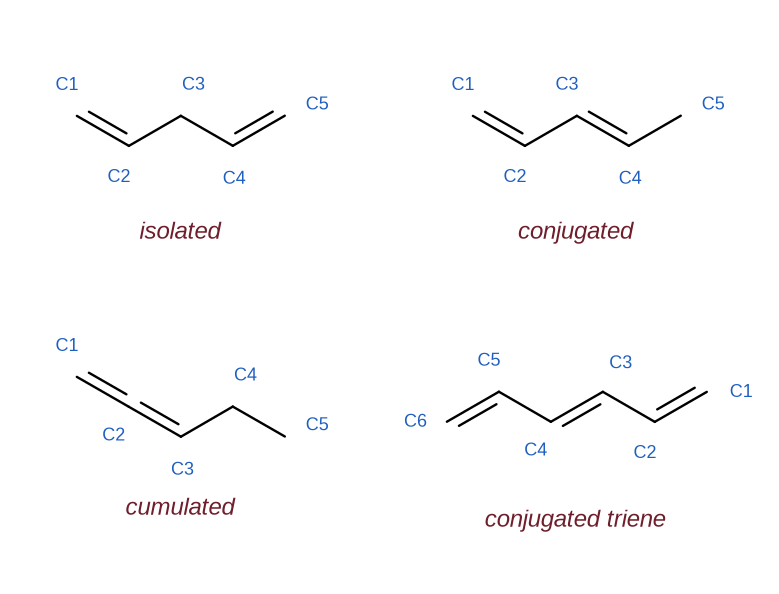
Three of these (penta-1,4-, penta-1,3- and penta-1,2-diene) have the same formula, C₅H₈, and all give the very same saturated product when you hydrogenate them. So which is more stable, the isolated or the conjugated one, and can you put a number on it?
Measuring it: the same product, 28 kJ/mol apart
Chemists weigh stability with a trick: hydrogenate two isomers to the same product and compare the heat that comes out. Both penta-1,4-diene and penta-1,3-diene take up two molecules of hydrogen over a metal catalyst and give pentane:
Hydrogen adds on the surface of the metal, which is not an electron-pushing reaction, so there are no curved arrows in Figure 2. What matters is how much energy is released, because both roads end at the same level.
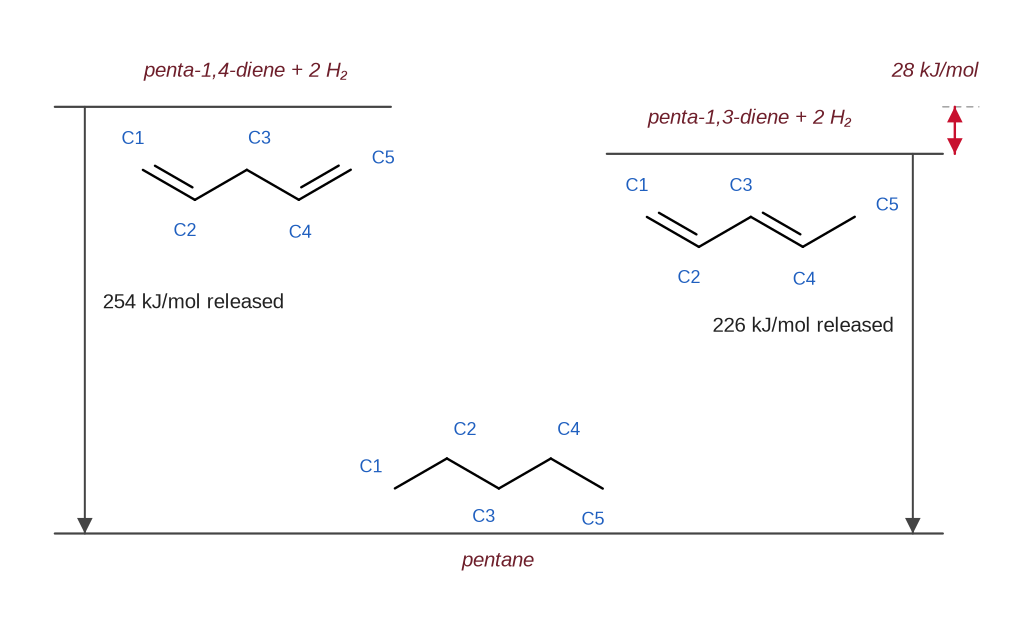
The isolated isomer releases about 254 kJ/mol and the conjugated one about 226 kJ/mol, so the conjugated diene starts out about 28 kJ/mol lower in energy. About half of that is conjugation itself: the cleaner comparison, a diene with nothing else attached against two separate double bonds, gives about 15 kJ/mol. The rest comes from the methyl group sitting on a double bond, which helps a little too.
Why: one π system spread over four carbons
The reason is orbital overlap. Every sp² carbon has one p orbital, perpendicular to the plane of its three σ bonds. In penta-1,4-diene the p orbitals of C1 and C2 overlap, and so do those of C4 and C5, but C3 is sp³ and has no p orbital to bridge the gap: two small π systems, two electrons each. In penta-1,3-diene the p orbitals of C1, C2, C3 and C4 stand in a row, and C2 and C3 overlap as well, so the four π electrons live in one π system spread over four carbons. An electron with more room has lower energy. Think of a dance floor: the same crowd, but one big floor instead of two broom cupboards.
Penta-1,2-diene is the odd one out. Its central carbon C2 is sp hybridised and linear, and it uses two different p orbitals, one for each double bond, at right angles to each other. The two π bonds cannot overlap, so a cumulated diene is not conjugated. The same right angle twists the two ends of the molecule 90° relative to each other.
Conjugation does not need two C=C bonds. A C=C next to a C=O, next to an aromatic ring or next to an atom with a lone pair is conjugated too, as soon as the p orbitals line up in a row.
The middle bond: shorter, and s-trans or s-cis
A side effect of that overlap: the C2–C3 bond of the simplest conjugated diene, buta-1,3-diene, is about 147 pm long, shorter than the 154 pm of a C–C bond between two sp³ carbons. Partly that is because sp² carbons carry more s character, partly because C2 and C3 now share some π overlap.
Overlap needs the p orbitals parallel, so the four carbons of a conjugated diene lie in one plane. With C1=C2 and C3=C4 in a plane, there are two ways to hold the C2–C3 single bond flat (Figure 3): the two double bonds on opposite sides of it (s-trans) or on the same side (s-cis). The s stands for single bond: the prefix describes the arrangement around the single bond, the way cis and trans do around a double bond.
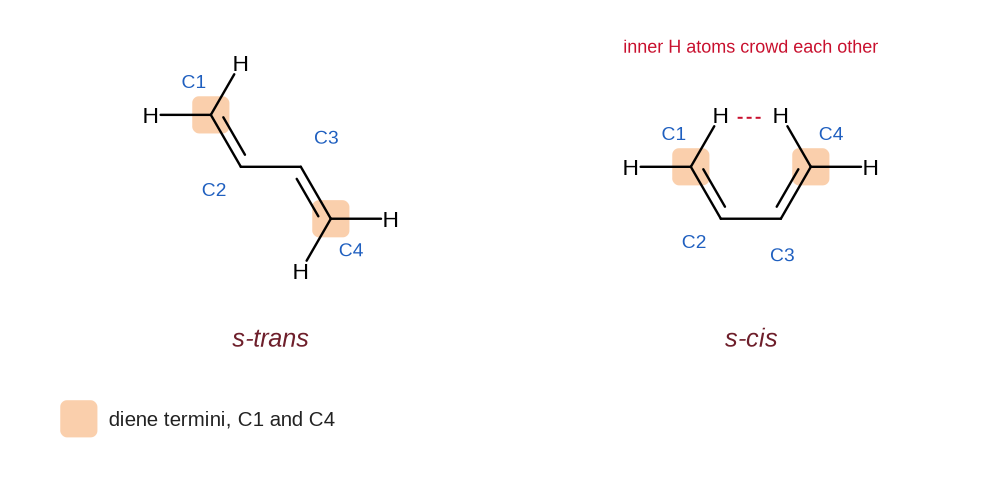
The s-trans form is the more stable one, because in s-cis the two inner hydrogens, on C1 and C4, crowd each other. The two forms interconvert by turning around C2–C3. That bond has only a little double-bond character, so the barrier is low, a few tens of kJ/mol, and the turning happens easily at room temperature. Many reactions of dienes work only through the s-cis shape, so the small fraction of molecules in it matters more than its size suggests.
The electrons' view: why the gain is only about 15 kJ/mol
Resonance gives the same story with curved arrows. Figure 4 pushes two electron pairs in buta-1,3-diene: the C1=C2 π bond slides into the C2–C3 bond, and the C3=C4 π bond becomes a lone pair on C4. The result is a form with a positive C1 and a negative C4. No atom has moved, only electrons.
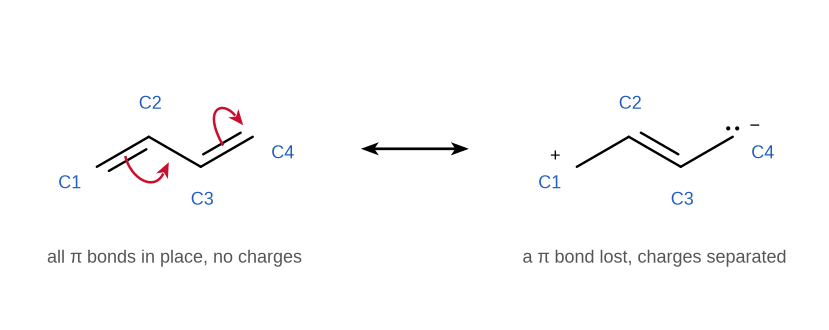
That form costs a π bond and separates two charges, so it contributes very little. The real molecule looks almost entirely like the neutral drawing, with a hint of the charged one mixed in, and that hint is the whole of the conjugation energy: about 15 kJ/mol. Where every form is neutral and the forms are equally good, as in some rings of alternating double bonds, the gain is about ten times bigger, and that is what aromaticity is about.
More from Structure
How do you draw resonance structures? The rules and the curved arrows
When one Lewis structure is not enough: how to push electrons with curved arrows, which rules a resonance form must obey, and which form counts most.
Why is an amide flat? The C–N bond that will not turn
An amine nitrogen is a pyramid and spins freely. An amide nitrogen is flat and locked. One pair of curved arrows explains the difference.
How many π electrons does this ring have? Hückel's rule
Count the π electrons, check the ring is flat, spot the sp³ carbon. Hückel's 4n + 2 rule, tried on seven rings and counted carbon by carbon.
Pyrrole, pyridine, imidazole: which nitrogen lone pair is aromatic?
Pyrrole and pyridine both have a nitrogen in an aromatic ring, yet one is basic and the other is not. Count which lone pair joins the π system.