
 PossieChem
Nitrogen inversion: why amine N is not a stereocentre but sulfoxide S is
Three different groups and a lone pair look like a stereocentre, yet nobody sells an amine as a single enantiomer on the strength of its nitrogen. The umbrella flips, and a number decides.
- Stereocentres and enantiomers
- R and S, with the lone pair as the lowest priority
- sp3 and sp2 hybridisation of nitrogen
A nitrogen with three different groups looks like a stereocentre. Count: three groups and a lone pair make four different things pointing to the corners of a pyramid. Draw the mirror image and it does not fit on the original. By the four-different-groups rule, every such amine should come as a pair of enantiomers, and chemists should be selling the left-handed and right-handed ones in separate bottles.
They are not. Nobody sells a single enantiomer of an amine whose only stereocentre is its nitrogen, because nobody can keep one. The nitrogen turns itself inside out like an umbrella in a gale, hundreds of millions of times a second, and the molecule is its own mirror image before you can blink. Sulfur, which looks almost the same on paper, does not do that at room temperature.
What is the difference, and how do you put a number on it?
The umbrella flips
An amine nitrogen is sp³-hybridised and pyramidal, with the lone pair at the fourth corner. The nitrogen can flip through the plane of its three substituents and come out on the other side, taking the lone pair with it. This is nitrogen inversion. In the middle of the flip the nitrogen is flat and sp²-hybridised, with the lone pair in a p orbital, and that flat arrangement is the transition state. Figure 1 shows it for ethylmethylamine, whose nitrogen carries an ethyl group, a methyl group, a hydrogen and a lone pair.
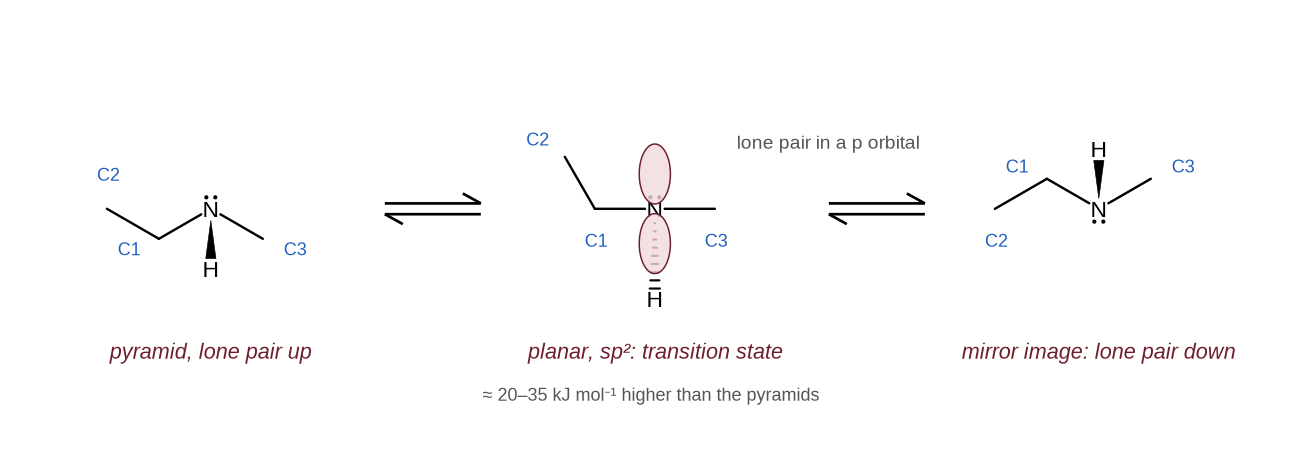
There are no curved arrows in this picture, because no bond breaks and no electron pair moves to a new atom. It is the nucleus that moves: the nitrogen goes through the plane of its three neighbours, the way an umbrella goes inside out. The two pyramids have the same energy because they are mirror images, and the flat state in the middle is the top of the hill between them.
How big is the hill?
The barrier for an amine of this type is small, roughly 20 to 35 kJ mol⁻¹. How fast that is follows from the Eyring equation:
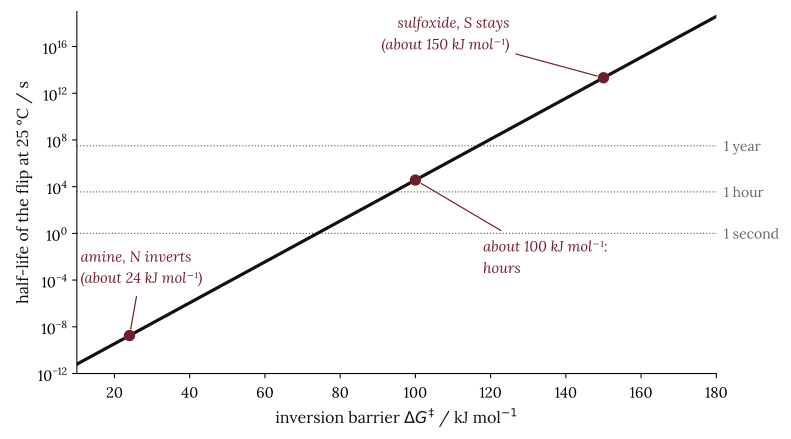
Here k is the rate constant (s⁻¹), the Boltzmann constant, h Planck's constant, T the temperature, R the gas constant and the barrier. At 298 K the prefactor is about 6.2 × 10¹² s⁻¹. For = 24 kJ mol⁻¹ the exponent is 24 000 / (8.314 × 298) = 9.7, so and k ≈ 4 × 10⁸ s⁻¹. A few hundred million flips per second. The time for half the molecules to have flipped, , is about 2 nanoseconds.
Figure 2 draws that half-life of the flip against the barrier for 25 °C, and the table lists the values worth remembering.
| Barrier ΔG‡ / kJ mol⁻¹ | Half-life of the flip at 25 °C | What it means |
|---|---|---|
| 24 | about 2 ns | an amine: no separate enantiomers, ever |
| 60 | about 4 ms | still hopeless |
| 80 | about 12 s | too fast to isolate |
| 100 | about 10 h | borderline: you can handle it in the cold, quickly |
| 120 | about 4 years | a stable stereocentre for practical purposes |
| 150 | about 700 000 years | a stable stereocentre for ever |
A rough rule follows: below about 90 kJ mol⁻¹ you cannot isolate the two forms at room temperature, above about 110 kJ mol⁻¹ you can bottle them. For a nitrogen that is locked at the bridgehead of a cage, so that it cannot flatten at all, the picture changes: the transition state is out of reach, and the nitrogen can be a stable stereocentre.
Sulfur does not play
A sulfoxide has sulfur with three substituents (the oxygen and two carbon groups) and a lone pair: the same picture as the amine. The S=O bond is better written S⁺–O⁻, but whichever way you draw it, the sulfur is pyramidal with a lone pair. Its inversion barrier is not 24 kJ mol⁻¹ but about 150 kJ mol⁻¹ or more, and the Eyring equation turns that into hundreds of thousands of years. Figure 3 shows the two enantiomers of methyl phenyl sulfoxide.
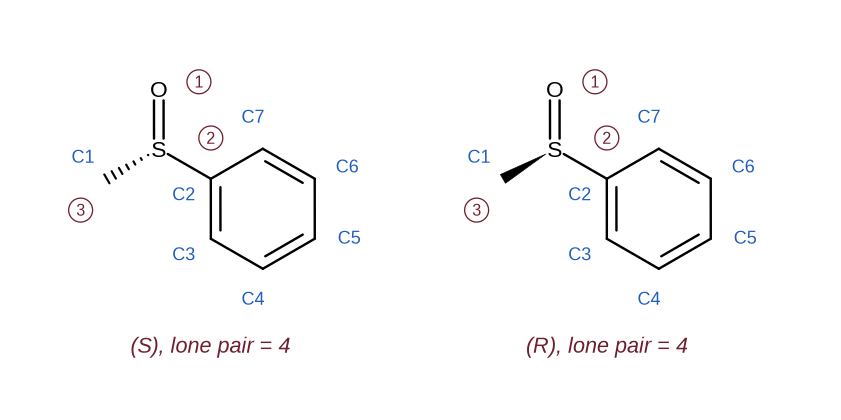
In the CIP (Cahn–Ingold–Prelog) rules a lone pair counts as an "atom" with atomic number zero, so it is always the lowest priority, 4, even below a hydrogen. Here the oxygen is 1, the phenyl carbon 2 and the methyl carbon 3. The two enantiomers do not racemise at room temperature, and chiral sulfoxides are bought and used as single enantiomers.
Carbon, and the C=N bond
A carbon does not invert at all. It has four bonds and no lone pair; to flip it would have to pass through a flat four-bonded carbon, which costs far more energy than a C–C bond is worth, so the molecule falls apart long before. A tetrahedral stereocentre stays as it is until a bond actually breaks.
The nitrogen of an imine, C=N, behaves differently from the nitrogen of an amine. It is sp² with its lone pair in the plane, and to invert it has to pass through a linear, sp-hybridised arrangement, which costs much more than the flat state of an amine. At room temperature the groups on a C=N therefore mostly stay on their side, and, just as on a C=C, the two arrangements can be told apart as E and Z.
| Centre | Pathway | Barrier | Consequence |
|---|---|---|---|
| N in an amine | flat sp² transition state | about 20–35 kJ mol⁻¹ | inverts fast, racemic at room temperature |
| S in a sulfoxide | flat transition state | about 150 kJ mol⁻¹ or more | stable stereocentre |
| sp³ carbon | none without breaking a bond | not applicable | stable stereocentre |
More from Structure
What makes a molecule chiral? Stereocentres and mirror images
Your hands are identical and still do not fit on top of each other. Molecules can do the same trick: four different groups on one carbon, and a mirror.
How do you assign R and S? The CIP rules step by step
Rank the four groups, put the lowest at the back, read 1, 2, 3. The CIP rules for R and S, worked out on three real molecules.
What is enantiomeric excess? Optical rotation and what the numbers mean
A bottle says 98 % ee, a polarimeter says −36.6 degrees. How the two are linked, how to get one from the other, and why the sign has nothing to do with R and S.
How do you read a Fischer projection? Turn it and get R or S
A cross with a rule: horizontal bonds come towards you, vertical ones go away. How to read a Fischer projection, which moves keep the molecule and which flip it, and why D and L are not R and S.