
 PossieChem
Chloromethane boils 138 °C above methane: dipole–dipole forces
Swap one hydrogen of methane for chlorine and the boiling point jumps 138 °C. Part of that is size. The rest is a polar bond, and it is a smaller share than you may expect.
- What a polar bond is (electronegativity, δ+ and δ−)
- London forces between non-polar molecules
- Reading a line drawing (carbons at the corners)
Take methane, the lightest alkane. It boils at −162 °C. Now swap one hydrogen for a chlorine atom. You get chloromethane, and it boils at −24 °C: 138 °C higher, from changing one atom out of five.
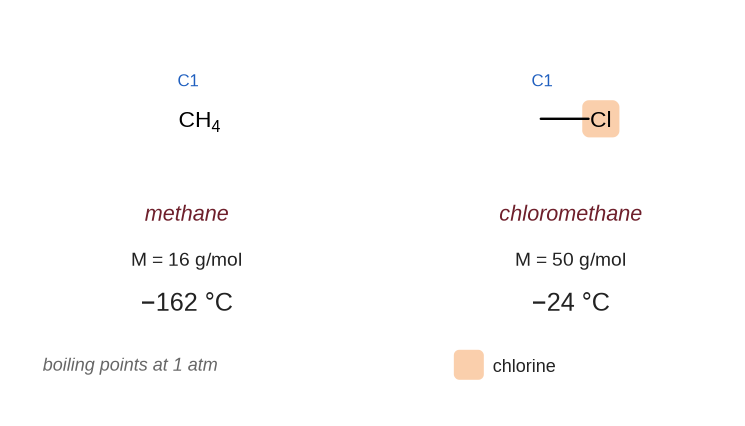
Part of that jump is simply size: a chlorine atom has 17 electrons, and a molecule with more electrons sticks harder to its neighbours. But chlorine is also more electronegative than carbon, which makes the C–Cl bond polar, and polar molecules have an extra way of attracting each other.
So how much of the 138 °C is "chlorine is big" and how much is "the bond is polar"? The answer is less dramatic than you might expect.
Why the C–Cl bond is polar: the electrons lean towards Cl
In the C1–Cl bond the two atoms share a pair of electrons, but not equally. Chlorine pulls harder: its electronegativity is 3.16 on the Pauling scale, against 2.55 for carbon. The bonding electrons spend more time near the chlorine, which becomes slightly negative (δ−) and leaves C1 slightly positive (δ+). The bond is polar, and we draw its dipole as an arrow with a crossed tail on the δ+ end and the head on the δ− end (Figure 2).
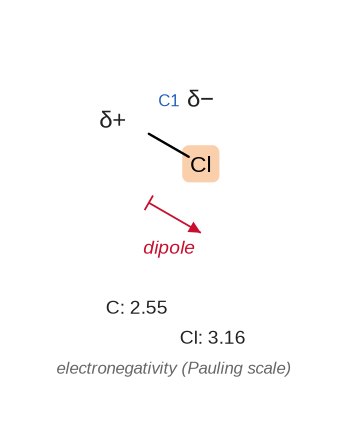
Compare a C–H bond: hydrogen is 2.20, only 0.35 away from carbon, so C–H is hardly polar at all. That is why methane has no dipole and chloromethane does. The dipole of the whole molecule is about 1.9 D (debye, the unit for dipoles), and since there is only one polar bond, nothing cancels it.
How two polar molecules attract: the dipole–dipole force
A polar molecule has a δ+ end and a δ− end all the time, not just for an instant. Two of them line up with δ+ facing δ− (Figure 3), and they attract: the dipole–dipole force.
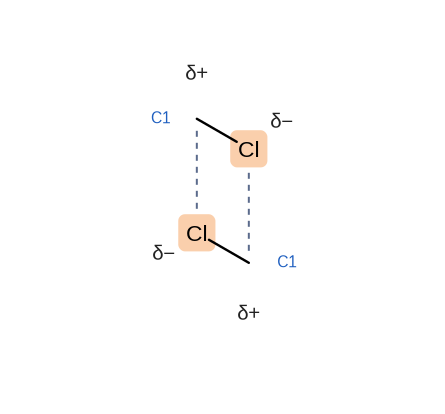
This force comes on top of the London forces, never instead of them. Thermal motion keeps shaking the molecules out of their ideal alignment, so the dipole–dipole force is a modest bonus rather than a bond.
Take size away: same electrons, polar or not
To separate the two effects, compare molecules with the same number of electrons, so that their London forces are about equal. Ethane and fluoromethane both have 18 electrons; propane, dimethyl ether and chloromethane all have 26 (Figure 4).
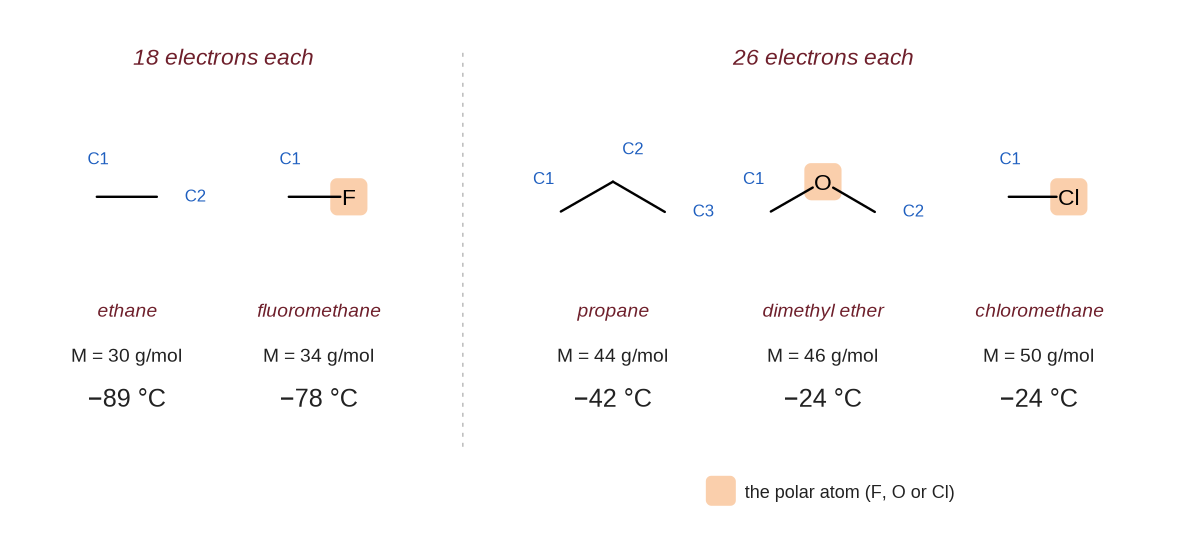
Figure 5 puts the boiling points side by side.
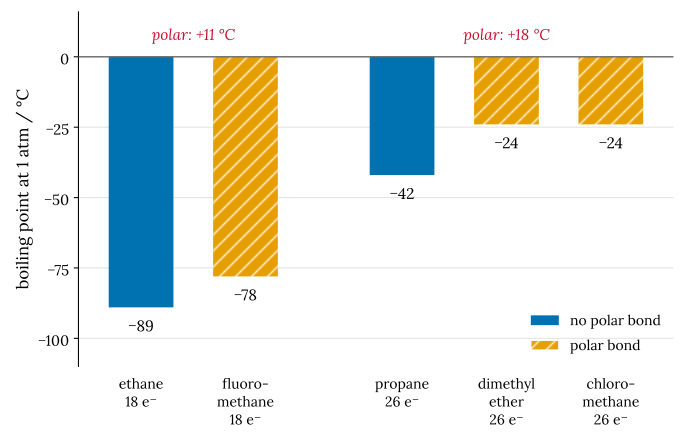
The polar bond is worth roughly 10 to 20 °C at this size. Now redo the arithmetic for the jump of Figure 1. Chloromethane has the same 26 electrons as propane, and going from methane (−162 °C) to propane (−42 °C) is a rise of 120 °C that is all London force, because both are non-polar. The remaining 18 °C, from propane (−42 °C) to chloromethane (−24 °C), is the polar bond. So of the 138 °C, about 120 °C is size and about 18 °C is polarity.
Counting electrons is only a rough yardstick: chloromethane is about as easy to polarise as ethane and less so than propane, so its London forces may be somewhat smaller than propane's, and the dipole may then be worth a bit more than 18 °C. Take 120 and 18 as the shape of the answer, not as exact figures.
The rise shrinks as the molecule grows
Figure 6 shows the same swap, H for Cl, on the next two alkanes, and Figure 7 charts the three pairs.
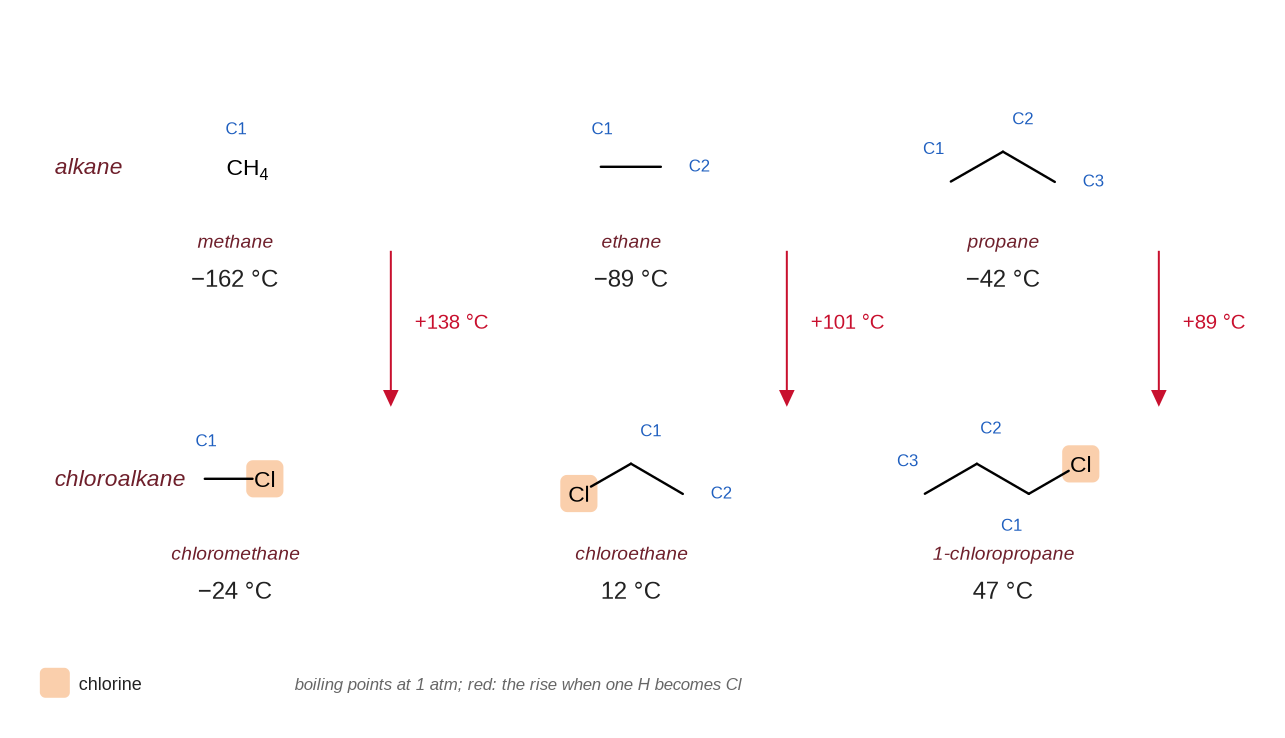
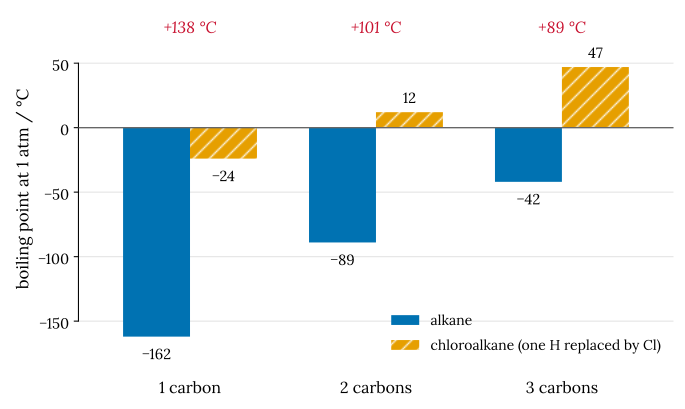
The rise is 138 °C, 101 °C and 89 °C: it shrinks as the molecule grows. The boiling-point curve of the alkanes flattens as they get bigger (each extra carbon buys fewer degrees), so the same swap, 16 extra electrons plus a polar bond, buys fewer degrees on a bigger molecule. Every chloroalkane still boils higher than its alkane, because each has the polar C1–Cl bond and each has the extra electrons.
Fluorine, the exception
The rule "more electronegative, higher boiling point" fails for fluorine. Fluoromethane boils at −78 °C, 54 °C below chloromethane at −24 °C (Figure 4), even though C–F is the more polar bond: the electronegativity of fluorine is 3.98. But the whole molecule ends up with about the same dipole as chloromethane, roughly 1.9 D. With the dipole about equal, the difference is all London force: fluoromethane has 18 electrons against 26 for chloromethane, and fluorine's are held tightly, so its London forces are the smaller ones.
Polar molecules boil higher than non-polar ones of the same size. A polar bond gives δ+ and δ− ends, and neighbouring molecules line up δ+ against δ−. This dipole–dipole force is added to the London forces. At the size of chloromethane it is worth roughly 10 to 20 °C by a fair comparison; the rest of the difference with a smaller alkane is size.
Common mistake: "a molecule with polar bonds is a polar molecule." It is the dipole of the whole molecule that counts. If a molecule has several polar bonds pointing in different directions, their dipoles add up like arrows and can cancel completely; then there is no dipole–dipole force at all. And never forget that London forces are always there as well.
What this means for the next boiling point you compare
Ask three questions in order: how many electrons, so how big the London forces are; is there a polar bond whose dipole does not cancel; is there an O–H or N–H that can form hydrogen bonds. The first usually gives you the bulk, the second a few tens of degrees at most, and the third is the one that can add a hundred.
More from Structure
Why do bigger alkanes boil higher? London forces, explained
Alkanes have no charge, no OH, no polar bond, yet octane boils 288 °C above methane. London forces explain the climb, and the shape of the molecule.
Why does ethanol boil about 100 °C above dimethyl ether?
Ethanol and dimethyl ether are built from the same atoms and weigh the same, yet one boils at 78 °C and the other at −24 °C. One hydrogen explains the 100 °C.
Like dissolves like: why ethanol mixes with water and hexane does not
Ethanol vanishes into water in any ratio, hexane floats on it for ever. Like dissolves like, explained with the three forces between molecules, and where it stops working.
Why are conjugated dienes more stable than isolated ones?
Two double bonds can sit apart, side by side or share a carbon. Hydrogenation heats show which arrangement wins, and π orbitals show why.