
 PossieChem
Like dissolves like: why ethanol mixes with water and hexane does not
Ethanol vanishes into water in any ratio, hexane floats on it for ever. Like dissolves like, explained with the three forces between molecules, and where it stops working.
- London forces, dipole–dipole forces and hydrogen bonds
- What a polar bond is (electronegativity, δ+ and δ−)
- Reading a line drawing (carbons at the corners)
Pour ethanol into water and stir. Within a second there is nothing left to see: one clear liquid, and you can add more ethanol, or more water, in any ratio, and it stays one clear liquid. Pour hexane into water and stir, and it goes cloudy for a moment before it floats back to the top as its own layer. Leave it a week and nothing has changed.
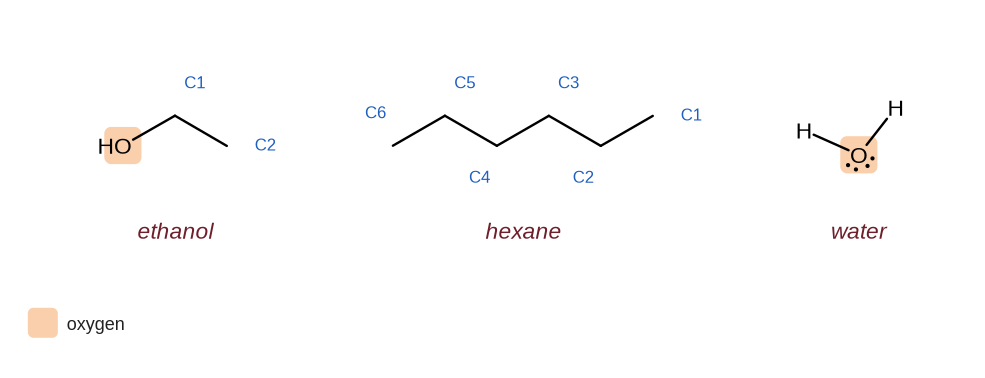
Chemists summarise it as "like dissolves like", which sounds like a saying from a fortune cookie. It is more than that: it is a statement about which attractions between molecules survive when you mix them, and it can be checked with the forces you already know.
So what does "like" mean, and where does it stop working?
Dissolving is a swap of attractions
To dissolve one liquid in another you have to pull its molecules apart from each other, and the same happens to the other liquid, to make room. That costs the attractions that held each liquid together. In return the molecules of the two kinds now sit next to each other and attract each other, and that pays something back.
The mixture forms easily when what you get back is about as good as what you gave up. It does not when the new attractions are much weaker than the old ones. Molecules that attract each other in the same way, which is what "like" means here, are the ones that make an even swap.
Ethanol in water: every attraction survives
Water molecules hold each other with hydrogen bonds: each O–H gives a hydrogen to a lone pair of the next molecule. Ethanol molecules hold each other the same way, with the O–H on C1. Put them together and the same two kinds of hydrogen bond still work (Figure 2). The O–H of ethanol can give a hydrogen to the oxygen of a water molecule, and the O–H of a water molecule can give a hydrogen to the oxygen of ethanol.
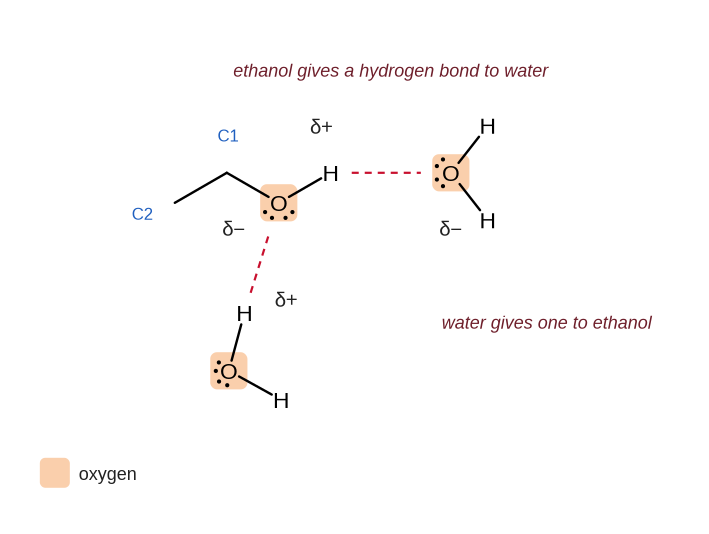
Each hydrogen bond lost between two ethanol molecules, or between two water molecules, is replaced by one of about the same strength between ethanol and water. The swap is even, and ethanol and water mix in every ratio. Chemists call liquids that do this miscible.
Hexane in water: a bad swap
Now try hexane. A hexane molecule has only C–H and C–C bonds: no polar bond, no O–H to give, no lone pair to take. Its only attraction to anything is the London force. To make room for it, water molecules have to rearrange around it, and hexane gives almost nothing back: next to a water molecule it can offer only a feeble London attraction (Figure 3).
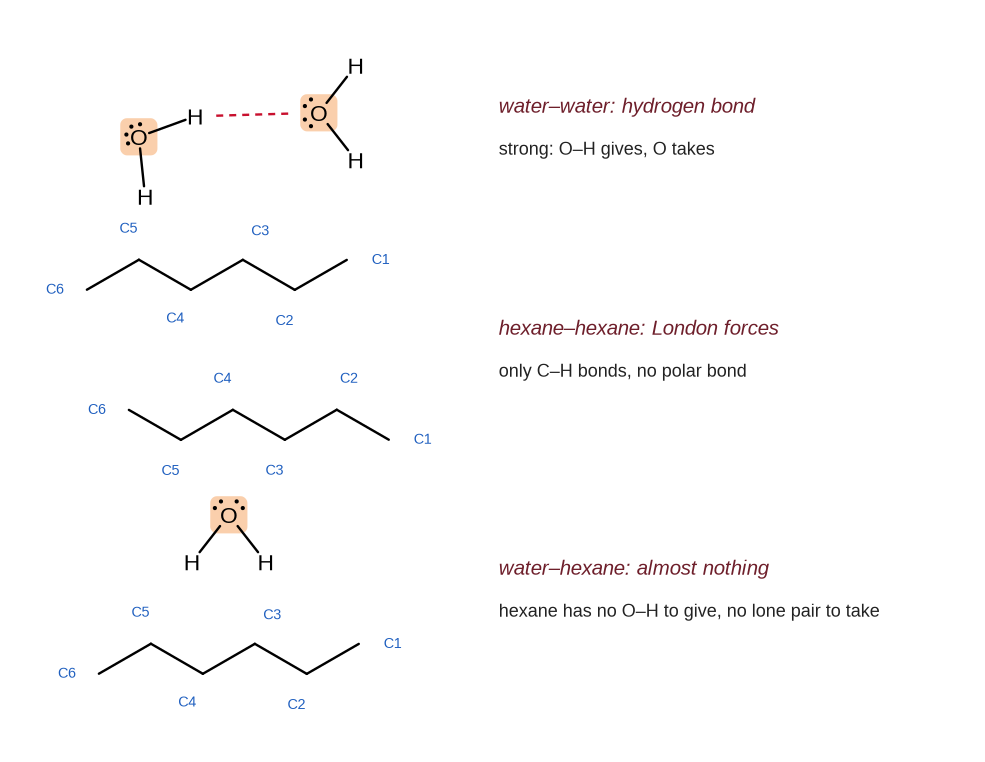
The result is that hexane dissolves in water only to about 10 mg per litre, and the two liquids stay apart. Hexane floats because it is less dense (0.66 g/mL against 1.00 g/mL). It is not that water and hexane repel each other: water molecules simply attract each other far more strongly than they attract hexane, so they keep to themselves and push the hexane out. (There is a second reason, and at room temperature it is the bigger one: water molecules packed around a hydrocarbon lose freedom to move, which is called the hydrophobic effect. The bookkeeping of attractions gets the direction right, but this loss of freedom does much of the work.)
Longer alcohols: the tail wins in the end
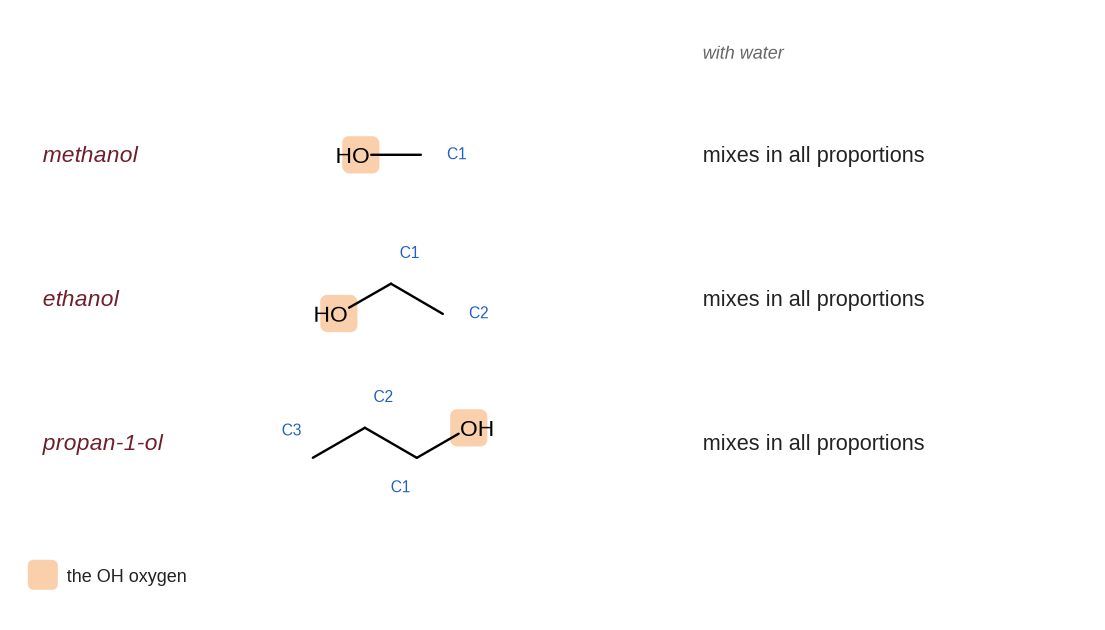
Methanol, ethanol and propan-1-ol (Figure 4) all mix with water in every ratio. Look at what they have in common: a small carbon chain and an OH group that can form hydrogen bonds with water.
Now lengthen the chain. An alcohol is two things stuck together: an OH head that likes water, and a carbon tail that behaves like hexane. From four carbons on, the tail starts to win (Figure 5).
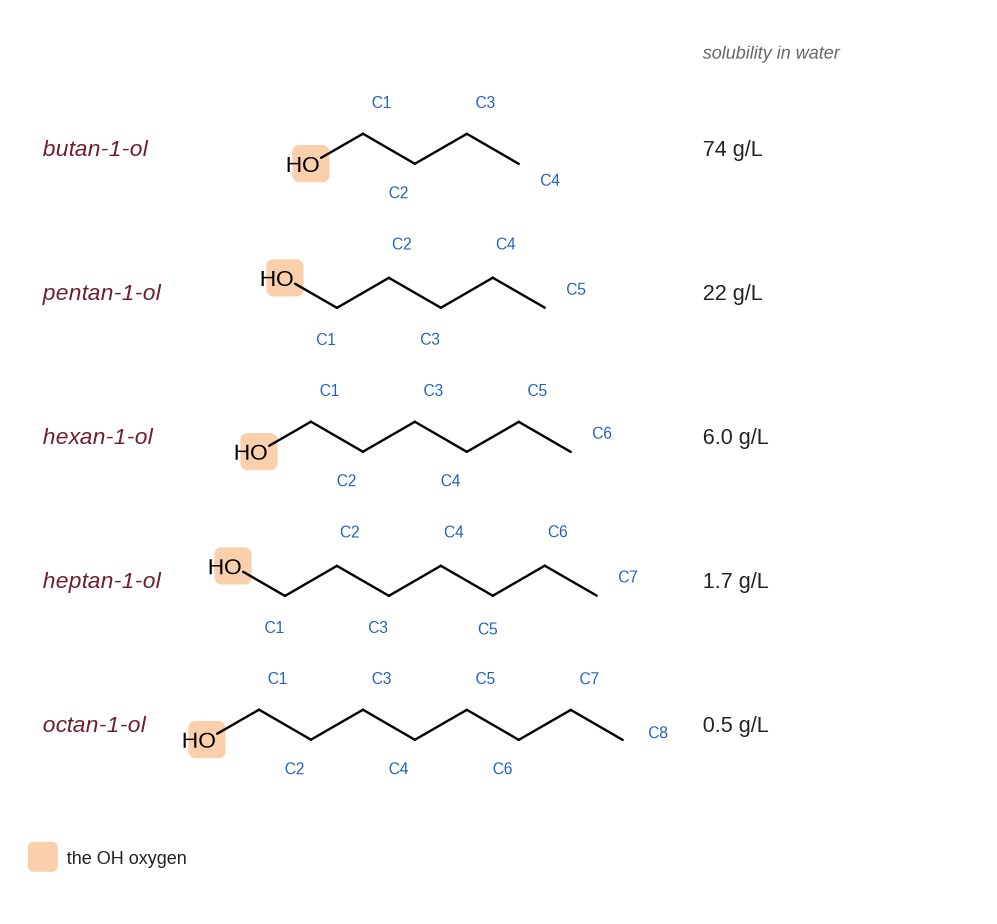
Figure 6 plots the same numbers on a logarithmic scale.
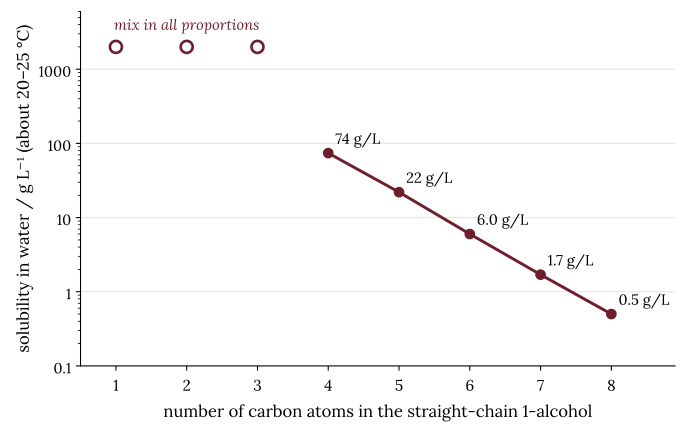
On a log scale the points fall on a straight line: each extra CH₂ in the tail divides the solubility by roughly 3 to 4. Butan-1-ol still dissolves to about 74 g/L, around one mole per litre, but octan-1-ol manages only 0.5 g/L. The OH group on C1 is the same in all five. What changed is the tail: each CH₂ adds a bit more hydrocarbon that water has to make room for and cannot hold on to.
Like dissolves like. Dissolving swaps the attractions inside each liquid for attractions between the two. Polar molecules, and above all those that form hydrogen bonds, mix with polar ones such as water. Non-polar molecules mix with non-polar ones. A molecule with both a polar head and a non-polar tail dissolves in water only as long as the head is big enough compared with the tail.
Common mistake: "oil and water do not mix because they repel each other." There is no repulsion. Water molecules attract each other so strongly that they keep to themselves and squeeze non-polar molecules such as hexane out of the way. Likewise, "like dissolves like" is a rule of thumb, not a law: the changeover from soluble to insoluble is gradual, as the alcohols of Figure 5 show.
The check to run next time
Before predicting whether A dissolves in B, ask which of the three forces holds A together and which holds B together. Is there an OH or NH on either that can give a hydrogen bond, and an O or N that can take one? If the same kinds of attraction exist on both sides, they usually mix. If one side has hydrogen bonds and the other only London forces, the one with the hydrogen bonds will mostly keep to itself. And for a molecule that has both, compare the size of the polar head with the size of the carbon tail.
More from Structure
Why do bigger alkanes boil higher? London forces, explained
Alkanes have no charge, no OH, no polar bond, yet octane boils 288 °C above methane. London forces explain the climb, and the shape of the molecule.
Chloromethane boils 138 °C above methane: dipole–dipole forces
Swap one hydrogen of methane for chlorine and the boiling point jumps 138 °C. Part of that is size. The rest is a polar bond, and it is a smaller share than you may expect.
Why does ethanol boil about 100 °C above dimethyl ether?
Ethanol and dimethyl ether are built from the same atoms and weigh the same, yet one boils at 78 °C and the other at −24 °C. One hydrogen explains the 100 °C.
Why are conjugated dienes more stable than isolated ones?
Two double bonds can sit apart, side by side or share a carbon. Hydrogenation heats show which arrangement wins, and π orbitals show why.