
 PossieChem
Why does ethanol boil about 100 °C above dimethyl ether?
Ethanol and dimethyl ether are built from the same atoms and weigh the same, yet one boils at 78 °C and the other at −24 °C. One hydrogen explains the 100 °C.
- What a polar bond is (electronegativity, δ+ and δ−)
- What a lone pair on oxygen is
- Reading a line drawing (carbons at the corners)
Take two molecules built from exactly the same atoms: two carbons, six hydrogens, one oxygen, . Same formula, same molar mass ( = 46 g/mol). Pour one into a glass and it stays a liquid until you heat it to 78 °C. That is ethanol. The other one is a gas at room temperature, because it already boils at −24 °C, so it has to be kept in a can under pressure, as a liquid. That is dimethyl ether.
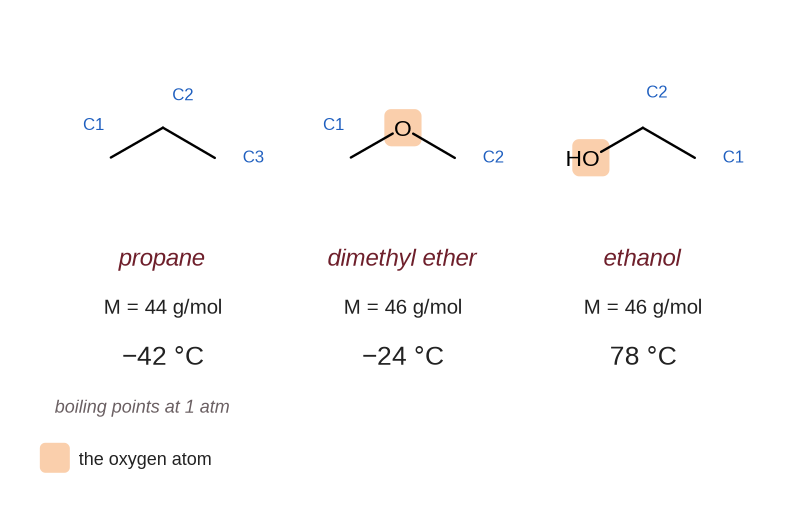
The atoms are the same. Only the order in which they are connected differs, and that order is worth 100 °C. The short version: ethanol molecules hold hands, and dimethyl ether molecules keep their hands in their pockets. The long version is below, and it works for any pair of molecules of similar size.
What boiling pulls apart
To boil a liquid you pull its molecules away from each other. The atoms inside each molecule stay exactly where they are: no covalent bond breaks. So the boiling point measures one thing, how hard the molecules cling to their neighbours. The harder they cling, the more heat it takes to get them apart.
Molecules cling in three ways. For molecules of similar size the order of strength is: London forces, dipole–dipole forces, hydrogen bonds. The easiest way to see what each one is worth is to take three molecules of about the same size, the ones of Figure 1, and give them the forces one by one.
Propane: London forces and nothing else
Propane has only carbon and hydrogen, and a C–H bond is hardly polar. Still, the electrons of a molecule never sit perfectly still: for a moment they bunch up on one side, the molecule has a tiny dipole, and that tilts the electrons of its neighbour the opposite way. The two attract. These London forces exist between every pair of molecules and grow with size. Propane, 44 g/mol, has no other trick, and it boils at −42 °C.
Dimethyl ether: polarity buys about 18 °C
Now put an oxygen between C1 and C2. Oxygen is more electronegative than carbon, so in each C–O bond the electrons sit closer to the oxygen. The oxygen is slightly negative (δ−), the carbons slightly positive (δ+), and because the two bonds point in a V, they do not cancel: the molecule has a dipole. Polar molecules line up δ+ against δ−, and this extra pull, the dipole–dipole force, comes on top of the London forces.
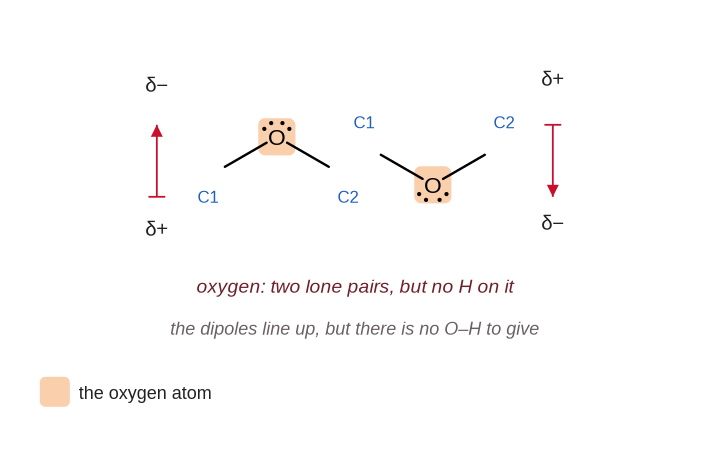
The result: dimethyl ether boils at −24 °C, 18 °C above propane. That is a fair gain, but not a spectacular one, and a sliver of it is only the extra 2 g/mol of mass.
Look at the oxygen in Figure 2. It carries two lone pairs, so another molecule's hydrogen could sit against it. But the only hydrogens in dimethyl ether are on carbon, and a C–H hydrogen is only barely δ+, far too little to act as a hydrogen-bond donor. The molecule can receive a hydrogen bond. It has nothing to give, so two of them together cannot make one.
Ethanol: one hydrogen changes everything
In ethanol the oxygen is bonded to C2 and also to a hydrogen. That O–H bond is very polar: the oxygen pulls the electrons, and the hydrogen is left almost bare, because a hydrogen atom has no inner electrons to hide behind. Its δ+ charge can come very close to a lone pair on the oxygen of the next ethanol molecule (Figure 3), and the two attract much more strongly than any dipole–dipole pair of that size could.
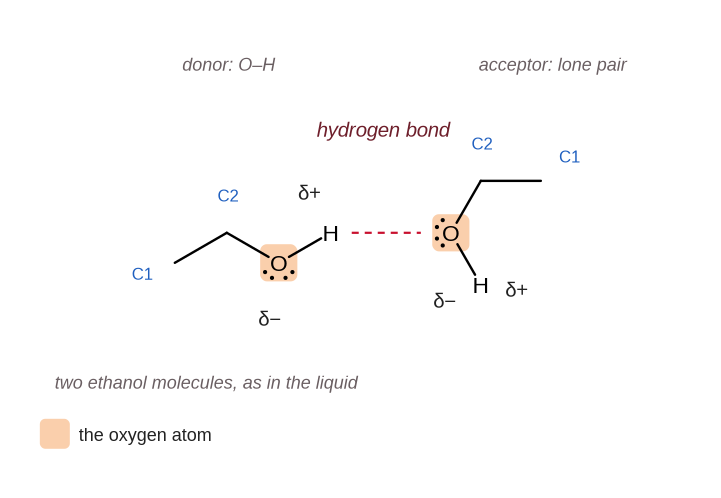
This is a hydrogen bond, written O–H···O. It needs two partners: a hydrogen on a very electronegative atom as the donor, and a lone pair on a very electronegative atom as the acceptor. Ethanol has both in one molecule. Its O–H gives one hydrogen bond, and its two lone pairs can receive up to two, so ethanol molecules link up into chains and rings, each one holding on to its neighbours. A hydrogen bond is still far weaker than a covalent bond (roughly 20 kJ/mol, against about 440 kJ/mol for the O–H bond itself), but it is several times stronger than the other two forces between molecules of this size.
You can see the cost in the heat needed to evaporate one mole of each liquid at its own boiling point: about 19 kJ for propane, 22 kJ for dimethyl ether and 39 kJ for ethanol. The extra 17 kJ or so is roughly the price of pulling one hydrogen bond apart per molecule, on average.
All three on one chart
Figure 4 puts the three numbers side by side.
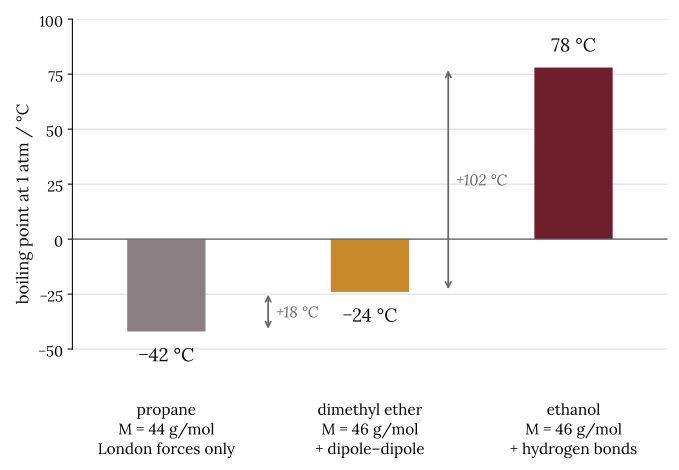
Same size, so the London forces are about equal. The polar C–O bonds add about 18 °C. The O–H group adds another 102 °C or so. That is the whole difference between a liquid you can keep in a glass and a gas you have to keep in a can.
Comparing boiling points of molecules of similar size: first look for polar bonds (each adds a little), then for hydrogen bonds. A hydrogen bond needs a hydrogen on N, O or F (O–H, N–H, H–F) as the donor and a lone pair on N, O or F as the acceptor. A hydrogen on an ordinary alkyl carbon does not count.
Common mistake: "when ethanol boils, the O–H bond breaks." It does not. Boiling only separates the molecules from each other, and the covalent bonds inside each molecule stay intact. What does let go is the hydrogen bond between molecules. And an oxygen without an O–H, as in dimethyl ether, can accept a hydrogen bond from another molecule but cannot form one with its own kind.
The check to run next time
When two molecules have about the same mass, ask three questions in this order. Does either have a polar bond? Does either have an O–H or N–H, so that it can donate a hydrogen bond? Which one therefore has more ways to hold on to its neighbours? The one that does usually boils higher. Do not start with the mass: here it was equal, and the 100 °C came from one hydrogen.
More from Structure
Why do bigger alkanes boil higher? London forces, explained
Alkanes have no charge, no OH, no polar bond, yet octane boils 288 °C above methane. London forces explain the climb, and the shape of the molecule.
Chloromethane boils 138 °C above methane: dipole–dipole forces
Swap one hydrogen of methane for chlorine and the boiling point jumps 138 °C. Part of that is size. The rest is a polar bond, and it is a smaller share than you may expect.
Like dissolves like: why ethanol mixes with water and hexane does not
Ethanol vanishes into water in any ratio, hexane floats on it for ever. Like dissolves like, explained with the three forces between molecules, and where it stops working.
Why are conjugated dienes more stable than isolated ones?
Two double bonds can sit apart, side by side or share a carbon. Hydrogenation heats show which arrangement wins, and π orbitals show why.