
 PossieChem
Why do bigger alkanes boil higher? London forces, explained
Alkanes have no charge, no OH, no polar bond, yet octane boils 288 °C above methane. London forces explain the climb, and the shape of the molecule.
- What a polar bond is (electronegativity, δ+ and δ−)
- Reading a line drawing (carbons at the corners)
- What boiling means (molecules pulled apart from each other)
Methane, ethane and propane are the dullest molecules in organic chemistry. Carbon and hydrogen, nothing else. The C–H bonds are barely polar, there is no lone pair, no OH, no charge anywhere. If any molecules had a reason to ignore each other, it would be these.
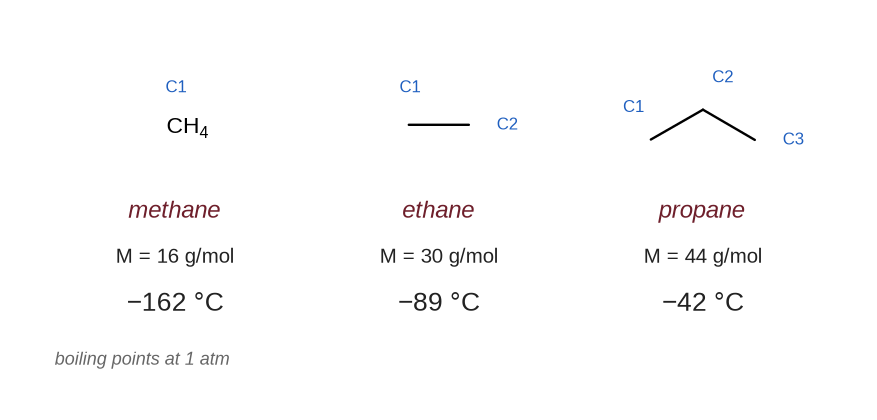
And yet they do not ignore each other. Methane boils at −162 °C, ethane at −89 °C, propane at −42 °C: every carbon you add, the liquid survives a little more warmth. Keep going and at five carbons you have a liquid on your bench, and at eight carbons it needs 126 °C before it boils. Something is holding these molecules together, and it holds harder the bigger the molecule gets.
So what is the glue between two molecules that carry no charge at all, and why does more carbon mean more glue?
Electrons never sit still: the instantaneous dipole
The electrons of a molecule are not frozen in place. They move all the time, and at any one instant they are a little more on one side of the molecule than on the other. For that instant the molecule has a tiny dipole: one end slightly negative (δ−), the other slightly positive (δ+).
Now put a second molecule next to it (Figure 2, left). The δ− end of the first pushes the electrons of its neighbour away, so the neighbour's nearest end turns δ+. Opposite charges face each other, and they attract. A moment later the electrons of the first molecule have sloshed to the other end, the neighbour's electrons follow, and the charges are reversed (Figure 2, right). The dipoles flip, but they flip together, so the two molecules are attracted at every instant. Averaged over time the attraction never cancels.
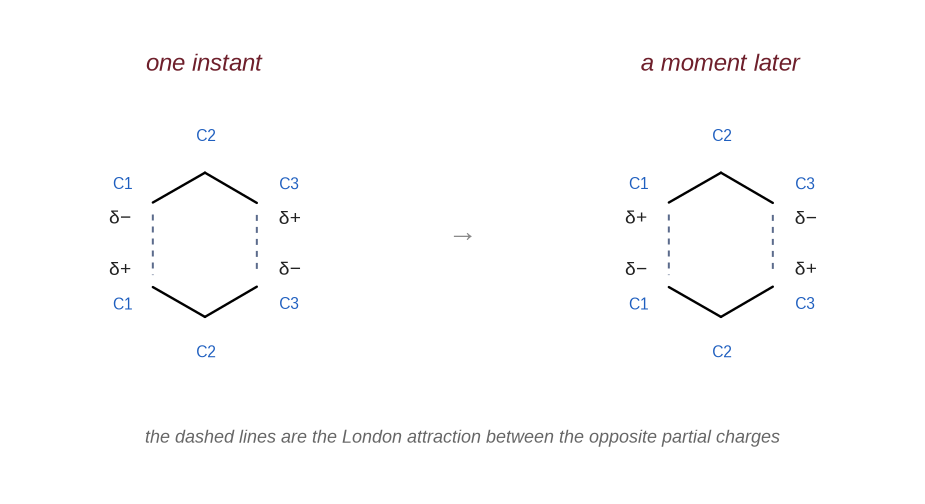
This attraction is the London force (also called dispersion force or instantaneous-dipole–induced-dipole force). It exists between every pair of molecules, polar or not, which is why even methane can be liquefied. The general name for these weak attractions between neutral molecules (London, dipole–dipole and similar) is van der Waals forces. No bond inside the molecules changes when this happens, and nothing breaks when the liquid boils: boiling only pulls molecules away from their neighbours.
Why bigger means stickier
Two things grow with the size of the molecule.
First, a bigger molecule has more electrons, spread over a larger volume, so its electron cloud is easier to push around. Chemists say it is more polarisable: a stronger instantaneous dipole, and a stronger induced one next door. Second, a longer molecule lies along its neighbour over a longer stretch, so there are more places where the two attract at the same time. Every CH₂ you add contributes another bit of contact, and the bits add up.
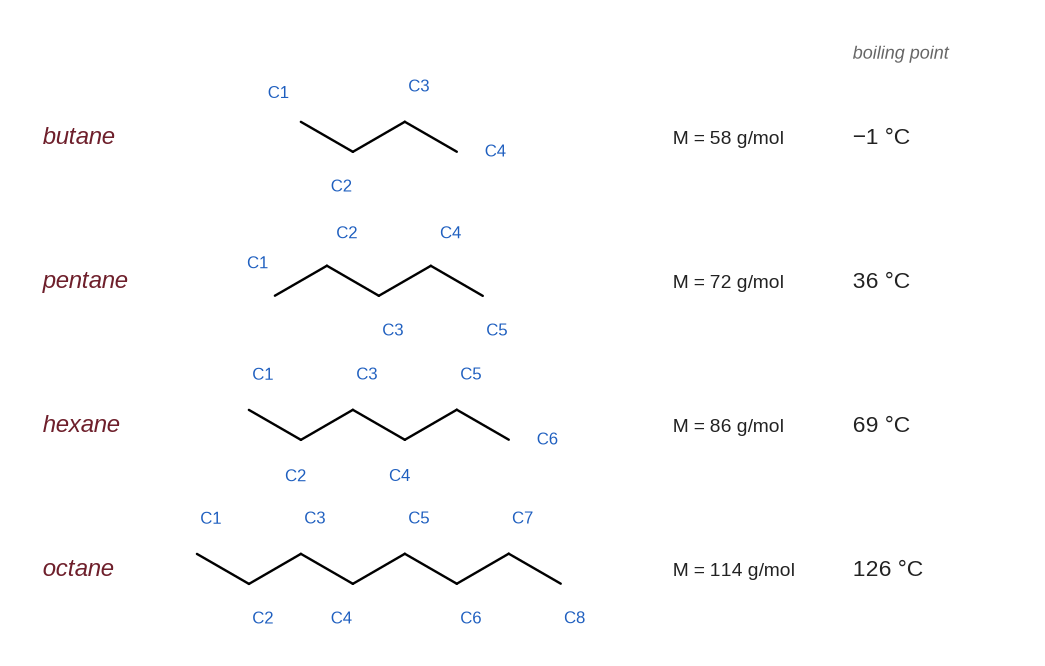
You can see the size in the heat needed to evaporate one mole of each liquid at its boiling point: about 26 kJ/mol for pentane, 29 kJ/mol for hexane and 34 kJ/mol for octane. Each extra CH₂ costs roughly 3 kJ/mol more.
How the boiling point climbs, and why it flattens
Figure 4 plots the boiling point against the number of carbons, from methane to an alkane of eight carbons.
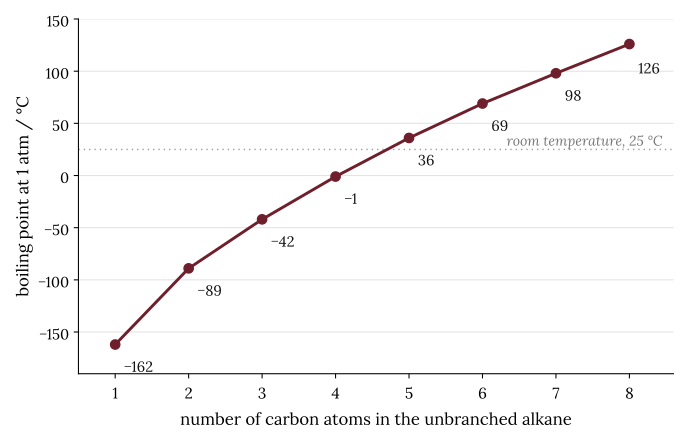
The first carbons add the most: 73 °C from one carbon to two, 47 from two to three, then 41, 37, 33, 29 and 28. The curve keeps rising but flattens. Butane (−1 °C) is a gas that you only liquefy in a lighter by squeezing it, pentane (36 °C) is a liquid that evaporates in your hand, and if you keep adding carbons the liquids thicken into oils and then into waxes.
Same atoms, different shape: three isomers of C₅H₁₂
Size is not the only thing. Take the three alkanes of formula (Figure 5). All three have = 72 g/mol and the same number of electrons, so the first reason for stickiness is the same for all of them.
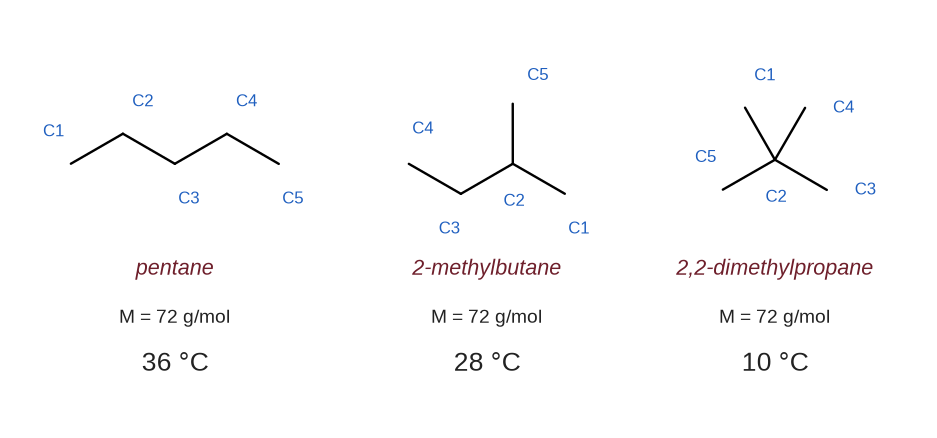
The boiling points are 36 °C, 28 °C and 10 °C. The more the molecule curls up into a ball, the less of its surface can touch a neighbour. Pentane lies along the next pentane like a pencil against a pencil. 2,2-dimethylpropane is almost a sphere, and spheres touch at a point (Figure 6).
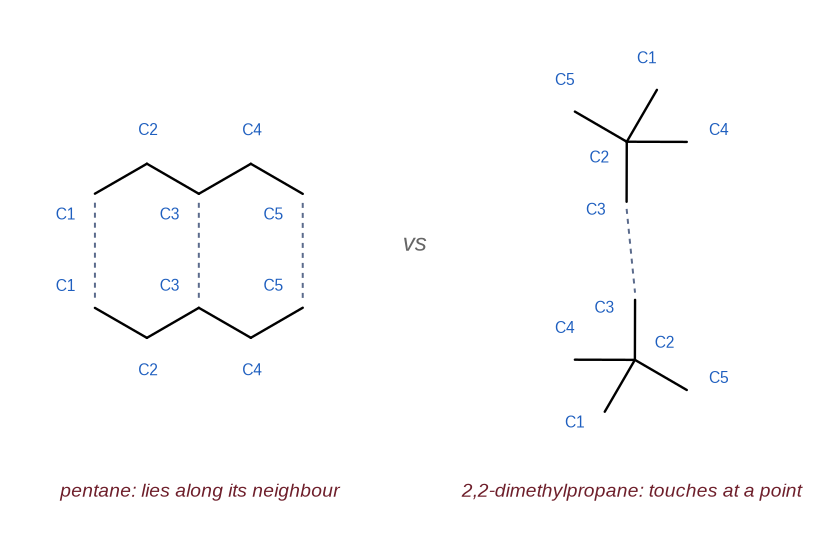
Comparing alkanes: more carbons means a higher boiling point, because the molecule is more polarisable and has more contact with its neighbours. With the same number of carbons, the less branched one boils higher, because it touches its neighbours over a longer stretch.
Common mistake: "London forces only exist in non-polar molecules." Every molecule has them. A polar molecule has dipole–dipole forces on top of them, never instead of them, and in a big molecule the London forces can easily be the larger share.
The questions to ask before comparing boiling points
Whenever you compare two boiling points, ask about size first, then shape. If the molecules have about the same number of electrons and the same shape, London forces are about equal, and something else, polar bonds or hydrogen bonds, must explain the difference. Each of those is a force added on top of what you saw here.
More from Structure
Chloromethane boils 138 °C above methane: dipole–dipole forces
Swap one hydrogen of methane for chlorine and the boiling point jumps 138 °C. Part of that is size. The rest is a polar bond, and it is a smaller share than you may expect.
Why does ethanol boil about 100 °C above dimethyl ether?
Ethanol and dimethyl ether are built from the same atoms and weigh the same, yet one boils at 78 °C and the other at −24 °C. One hydrogen explains the 100 °C.
Like dissolves like: why ethanol mixes with water and hexane does not
Ethanol vanishes into water in any ratio, hexane floats on it for ever. Like dissolves like, explained with the three forces between molecules, and where it stops working.
Why are conjugated dienes more stable than isolated ones?
Two double bonds can sit apart, side by side or share a carbon. Hydrogenation heats show which arrangement wins, and π orbitals show why.