
 PossieChem
What are sp³, sp² and sp hybridisation? Why carbon makes four equal bonds
Carbon has two unpaired electrons and still makes four identical bonds. Promotion, orbital mixing and what sp³, sp² and sp really mean, orbital by orbital.
- Electron configurations (2s² 2p²)
- σ and π bonds (head-on and side-by-side overlap)
Carbon's electron configuration is 1s² 2s² 2p². Only two of its four valence electrons are unpaired, so you would expect carbon to make only two bonds. Yet carbon makes four, and in methane all four bonds are identical, 109.5° apart. That is two puzzles in one: why four bonds, and why four equal ones, when an atom that has one round s orbital and three dumbbell-shaped p orbitals at 90° to each other cannot possibly aim four equal bonds at the corners of a tetrahedron.
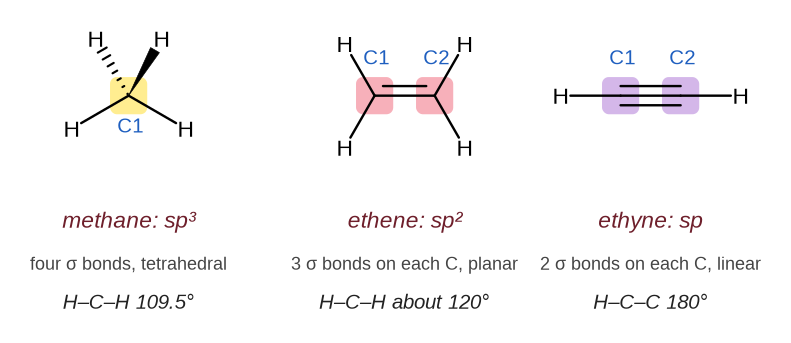
Figure 1 shows the three kinds of carbon you meet in organic chemistry: the carbon of methane, whose four bonds point to the corners of a tetrahedron; the two carbons of ethene, each with three bonds in a plane; and the two carbons of ethyne, each with two bonds in a line. One atom, three different geometries.
The answer is a two-step bit of bookkeeping, promotion and mixing, and it ends in one rule you can use on any atom.
Puzzle 1: two unpaired electrons, four bonds (promotion)
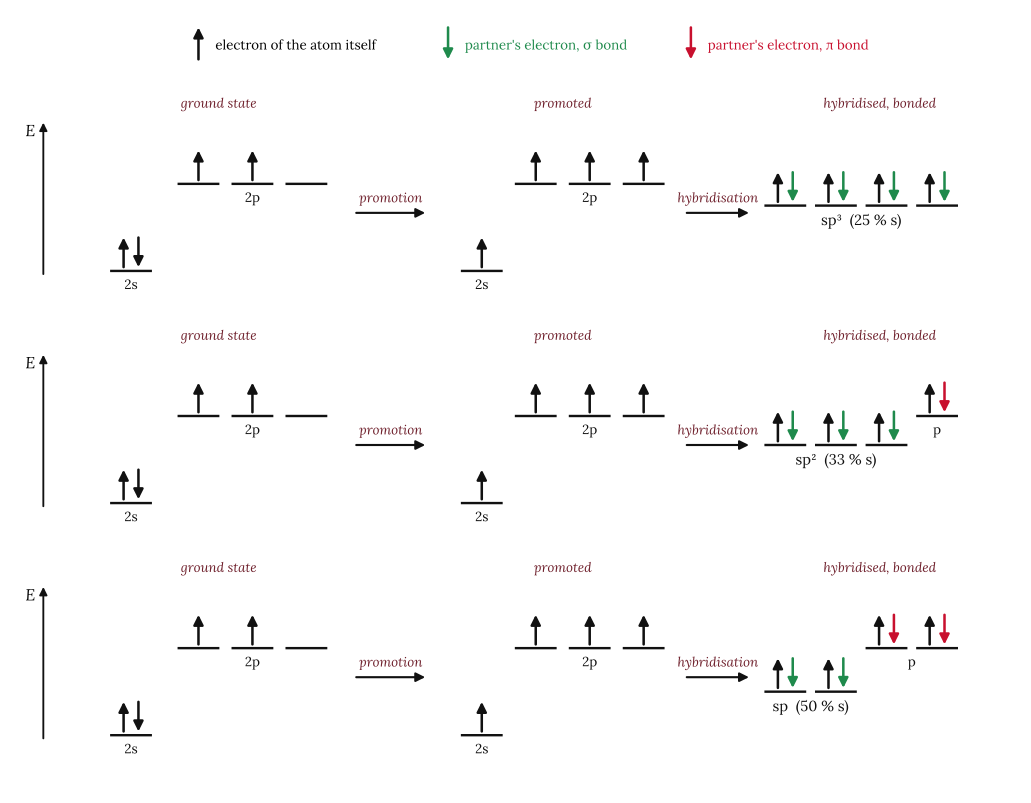
In the ground state the two 2p electrons of carbon sit in separate 2p orbitals (the third 2p orbital is empty), and the 2s orbital holds a pair. Only the two unpaired electrons can make bonds. The fix is to promote one 2s electron into the empty 2p orbital. Now carbon is 2s¹ 2p³, with four unpaired electrons and four bonds on offer. Figure 2 follows the electrons: the first two columns of every row.
Promotion costs energy, about 400 kJ/mol, but each new bond returns about as much (a C–H bond is worth roughly 410 kJ/mol), so the two extra bonds return about 820 kJ/mol, roughly twice the cost. (Nothing literally hops in an isolated carbon atom while it waits for hydrogens to arrive. Promotion is bookkeeping: a way to count electrons and energy.)
Puzzle 2: four equal bonds (mixing)
After promotion we have one s orbital and three p orbitals. They are different, so bonds made from them should differ too: one short round s bond and three p bonds at 90°. That is not what methane looks like. All four C–H bonds are the same length and the angles are all 109.5°.
The way out is to mix the orbitals: blend the 2s and the 2p orbitals into new orbitals that are all identical. Mix one s with three p and you get four new orbitals, each one quarter s and three quarters p, called sp³ orbitals. (Mixing never changes the number of orbitals: you put four in, you get four out.) Each is a big lobe pointing one way and a tiny lobe on the other side, and the four big lobes point at the corners of a tetrahedron, 109.5° apart. The big lobe overlaps with a hydrogen better than a bare s or p orbital would, which makes a stronger bond.
sp²: keep one p orbital out of the mix
Mix the s orbital with only two of the three p orbitals and you get three sp² orbitals, each one third s and two thirds p, lying in one plane 120° apart. The third p orbital is not part of the mix and stays as it was, a dumbbell standing at right angles to that plane. The three sp² orbitals make three σ bonds (the planar skeleton of ethene); the left-over p orbital makes the π bond. In Figure 2 it is the p orbital with the red arrow in the middle row.
sp: keep two p orbitals out of the mix
Mix the s orbital with just one p orbital and you get two sp orbitals, each half s and half p, pointing in opposite directions, 180° apart. Two p orbitals are left over, at right angles to each other and to the sp axis. The two sp orbitals make two σ bonds in a straight line (ethyne is H–C1≡C2–H); the two left-over p orbitals make the two π bonds. That is the bottom row of Figure 2.
Reading the diagram
Check the electrons in Figure 2 row by row. In these neutral, bonded carbons there are four valence electrons in four orbitals, one electron per orbital, and each of those electrons pairs up with an electron from a bonding partner. What changes is how the four orbitals are split into hybrids (σ bonds) and p orbitals (π bonds). The more s character a hybrid has, the closer it sits to the low-lying 2s level, which is why the sp hybrids sit lowest and the sp³ hybrids highest. The table collects the result.
| Hybridisation | Orbitals mixed | Hybrids made | p orbitals left | s character | Shape (angle) | Example |
|---|---|---|---|---|---|---|
| sp³ | s + 3 p | 4 | 0 | 25 % | tetrahedral (109.5°) | methane |
| sp² | s + 2 p | 3 | 1 | 33 % | trigonal planar (120°) | ethene |
| sp | s + 1 p | 2 | 2 | 50 % | linear (180°) | ethyne |
So the number of hybrids is also the number of σ bonds (or lone pairs) that the atom has, and the number of p orbitals that are left is the number of π bonds it can make (a left-over p orbital can also stay empty, as on C2 in Figure 3). Every row adds up to four.
Hybridisation in motion: ethene and HBr
An atom's hybridisation is not fixed for life: it follows the number of groups around it, and that changes during a reaction. Figure 3 runs ethene (carbons C1 and C2) through the addition of hydrogen bromide (HBr) and colours each carbon by its hybridisation.
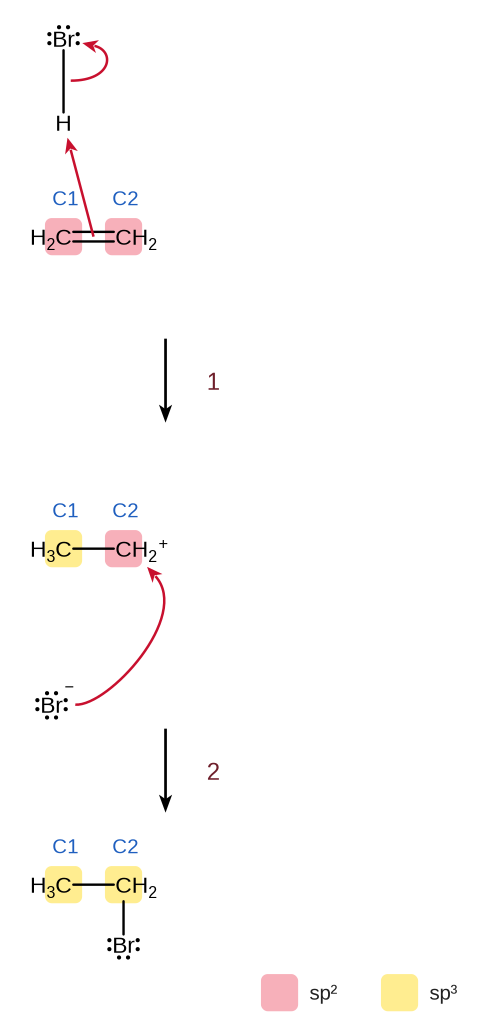
In ethene both carbons are sp². Step 1: the π pair, which lives in the left-over p orbitals, goes to the hydrogen of HBr and becomes a new C1–H σ bond (first arrow); the second arrow takes the H–Br bond to bromine, which leaves as a bromide ion. C1 now has four σ bonds: it has turned sp³. C2 has lost its share of the π electrons: it has three σ bonds, no lone pair and an empty p orbital, so it is still sp², and in the ethyl cation that empty p orbital is the hole. Step 2: a lone pair of bromide fills that hole, making a C2–Br σ bond (the arrow), and C2 now has four σ bonds: sp³. The product is bromoethane, with two sp³ carbons.
Mix the orbitals you need for σ bonds and lone pairs, keep the rest as p orbitals for π bonds. s + 3 p gives four sp³ hybrids (109.5°, no π bond). s + 2 p gives three sp² hybrids (120°, one p left, one π bond). s + 1 p gives two sp hybrids (180°, two p left, two π bonds). The hybrids make the σ bonds; the p orbitals that were not mixed make the π bonds.
Watch out. The 25 %, 33 % and 50 % are the ideal values for the model. Real molecules deviate a little: the H–C–H angle in ethene is about 117°, not 120°. Hybridisation is a model that explains shapes and bonding well, not a measurement of the atom.
More from Structure
What are σ and π bonds? What a double bond is really made of
A double bond is not two single bonds glued together. It is one σ bond with a weaker π bond on top, and the π bond is the one that reacts.
Why is water bent? (and ammonia a pyramid)
Two hydrogens on an oxygen should sit in a straight line, yet water is bent. Count the groups, find the lone pairs, and the shape explains itself.
How to find the hybridisation of an atom: count the groups
No orbital drawings needed. Count σ bonds plus lone pairs, read off sp, sp² or sp³. Worked on a carbon chain, then on nitrogen and oxygen.
Alkane, alkene, alkyne or arene? The four hydrocarbon families
Four families, made of nothing but carbon and hydrogen. One count, the hydrogens, tells saturated from unsaturated, and the double bond shows why it matters.