
 PossieChem
How to find the hybridisation of an atom: count the groups
No orbital drawings needed. Count σ bonds plus lone pairs, read off sp, sp² or sp³. Worked on a carbon chain, then on nitrogen and oxygen.
- σ and π bonds
- Lewis structures with lone pairs
You never need to draw an orbital to find a hybridisation. You need a pencil and a single number, and the number comes from counting.
Take the molecule of Figure 1: eight carbons, one triple bond, one double bond, and a branch. Which carbons are sp, which are sp², which are sp³? There is a count that settles every one of them in a few seconds, and the same count works on nitrogen and oxygen, where the lone pairs make things more interesting.
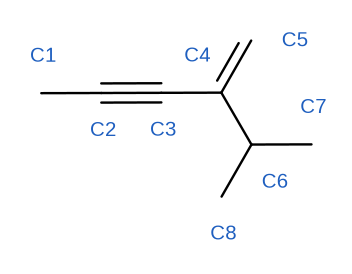
Eight atoms, three possible answers, and one rule that decides each.
The rule: σ bonds plus lone pairs make the groups
Three steps, for any atom:
- Draw every bond, hydrogens included. The hydrogens that a line drawing leaves out are still σ bonds on the atom.
- Count the groups around the atom: the number of σ bonds plus the number of lone pairs. A double bond counts as one group (its σ bond) and so does a triple bond. π bonds are never counted.
- Read off the hybridisation: 4 groups is sp³, 3 groups is sp², 2 groups is sp.
The reason is in the explanation of sp³, sp² and sp hybridisation: every group, whether a σ bond or a lone pair, needs one hybrid orbital, and the hybrid orbitals are the ones that get mixed. The π bonds are made from the p orbitals that were left out. So the number of groups is the number of hybrids, and that tells you the mix.
| Groups | Hybridisation | Geometry of the groups | Angle |
|---|---|---|---|
| 4 | sp³ | tetrahedral | 109.5° |
| 3 | sp² | trigonal planar | 120° |
| 2 | sp | linear | 180° |
Worked example: all eight carbons
Count, for each carbon of Figure 1, the σ bonds (to carbon and to hydrogen) and the π bonds. Figure 2 colours each carbon by the answer.
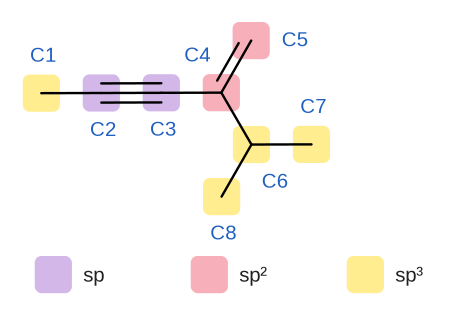
| Carbon | σ bonds | π bonds | Groups | Hybridisation |
|---|---|---|---|---|
| C1 | 4 (C2 and 3 H) | 0 | 4 | sp³ |
| C2 | 2 (C1, C3) | 2 | 2 | sp |
| C3 | 2 (C2, C4) | 2 | 2 | sp |
| C4 | 3 (C3, C5, C6) | 1 | 3 | sp² |
| C5 | 3 (C4 and 2 H) | 1 | 3 | sp² |
| C6 | 4 (C4, C7, C8 and H) | 0 | 4 | sp³ |
| C7 | 4 (C6 and 3 H) | 0 | 4 | sp³ |
| C8 | 4 (C6 and 3 H) | 0 | 4 | sp³ |
For a neutral carbon with four bonds there is a shortcut that skips the table: a triple bond (or two double bonds on the same carbon) makes it sp, one double bond makes it sp², and four single bonds make it sp³.
A cheap check on the count: a molecule without rings has one σ bond fewer than it has atoms. C₈H₁₂ has 20 atoms, so it should have 19 σ bonds: seven C–C bonds and twelve C–H bonds make 19. Its three π bonds (two in the triple bond, one in the double bond) match the formula's degree of unsaturation (the number of π bonds plus rings, here 0 rings), (2 × 8 + 2 − 12) / 2 = 3.
Nitrogen and oxygen: lone pairs count as groups
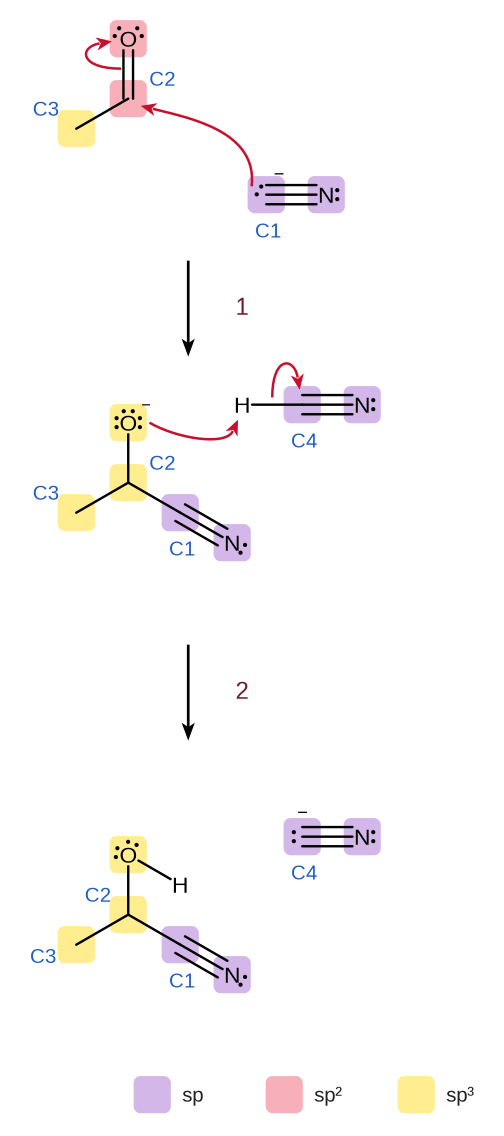
On nitrogen and oxygen you have to count the lone pairs too, and for that you need the full Lewis structure. A good place to watch it happen is a reaction: cyanide adds to ethanal and, after a proton transfer, gives 2-hydroxypropanenitrile. Figure 3 shows every arrow. The numbers follow the atoms of the reaction: C1 and N belong to the cyanide ion, C2 and C3 to ethanal (C2 is the carbonyl carbon), and C4 is the carbon of a second molecule, hydrogen cyanide, that supplies the proton.
Count the groups before and after:
| Atom | Where | σ bonds | Lone pairs | Groups | Hybridisation |
|---|---|---|---|---|---|
| C1 | cyanide ion | 1 (N) | 1 | 2 | sp |
| N | cyanide ion | 1 (C1) | 1 | 2 | sp |
| C2 | ethanal | 3 (C3, H, O) | 0 | 3 | sp² |
| C3 | ethanal | 4 (C2 and 3 H) | 0 | 4 | sp³ |
| O | ethanal | 1 (C2) | 2 | 3 | sp² |
| C2 | alkoxide | 4 (C1, C3, H, O) | 0 | 4 | sp³ |
| O | alkoxide | 1 (C2) | 3 | 4 | sp³ |
| O | 2-hydroxypropanenitrile | 2 (C2, H) | 2 | 4 | sp³ |
| C1 | alkoxide and 2-hydroxypropanenitrile | 2 (C2, N) | 0 | 2 | sp |
| N | alkoxide and 2-hydroxypropanenitrile | 1 (C1) | 1 | 2 | sp |
Step 1. The lone pair on C1 of cyanide attacks the carbonyl carbon C2 (first arrow), and the C=O π bond moves onto oxygen as a lone pair (second arrow). C2 goes from three σ bonds to four, so sp² becomes sp³. The oxygen goes from one σ bond plus two lone pairs to one σ bond plus three lone pairs: three groups become four, sp² becomes sp³ as well. Notice that the carbonyl oxygen has only one atom attached and is nevertheless sp²: its two lone pairs count. And C1 and N do not change at all: the C1 that was a lone pair plus one σ bond (2 groups) is now two σ bonds (2 groups), so the nitrile stays sp, linear, before and after.
Step 2. A lone pair on the alkoxide oxygen takes the hydrogen of H–C4≡N (first arrow), and the H–C4 bond becomes a lone pair on C4 (second arrow). The oxygen now has two σ bonds (C2 and H) and two lone pairs: still 4 groups, still sp³. C4 goes from two σ bonds to one σ bond plus one lone pair: 2 groups both times, so it is sp throughout, and the cyanide ion that comes out is the one that goes round again. Cyanide is a catalyst here.
When the count needs care
Watch out. The count assumes every lone pair is an ordinary one. A lone pair that can join a neighbouring π bond (the classic case is the nitrogen of an amide) goes into a p orbital and the atom behaves as sp², even though the count says 4 groups. And a carbocation carbon, with three σ bonds and no lone pair, is sp² with an empty p orbital; a carbanion carbon, with three σ bonds and a lone pair, is sp³.
Hybridisation = number of groups = σ bonds + lone pairs. 4 groups is sp³, 3 groups is sp², 2 groups is sp. Count hydrogens, count each double or triple bond once, never count π bonds, and always count lone pairs on nitrogen and oxygen (except a lone pair that is delocalised into a π system). The count follows the atom through a reaction: when its groups change, so does its hybridisation.
More from Structure
What are σ and π bonds? What a double bond is really made of
A double bond is not two single bonds glued together. It is one σ bond with a weaker π bond on top, and the π bond is the one that reacts.
Why is water bent? (and ammonia a pyramid)
Two hydrogens on an oxygen should sit in a straight line, yet water is bent. Count the groups, find the lone pairs, and the shape explains itself.
What are sp³, sp² and sp hybridisation? Why carbon makes four equal bonds
Carbon has two unpaired electrons and still makes four identical bonds. Promotion, orbital mixing and what sp³, sp² and sp really mean, orbital by orbital.
Alkane, alkene, alkyne or arene? The four hydrocarbon families
Four families, made of nothing but carbon and hydrogen. One count, the hydrogens, tells saturated from unsaturated, and the double bond shows why it matters.