
 PossieChem
What are σ and π bonds? What a double bond is really made of
A double bond is not two single bonds glued together. It is one σ bond with a weaker π bond on top, and the π bond is the one that reacts.
- Atomic orbitals (s and p)
- Lewis structures
Carbon–carbon bonds come in three sizes. In ethane two carbons share one pair of electrons, in ethene they share two pairs and in ethyne three. The obvious guess is that a double bond is simply two single bonds side by side, twice as strong and twice as stubborn. The tables of average bond energies say otherwise: breaking a C–C bond takes about 350 kJ/mol, a C=C bond about 610 kJ/mol and a C≡C bond about 840 kJ/mol. The second bond added only about 260 kJ/mol, and the third only about 230 kJ/mol.
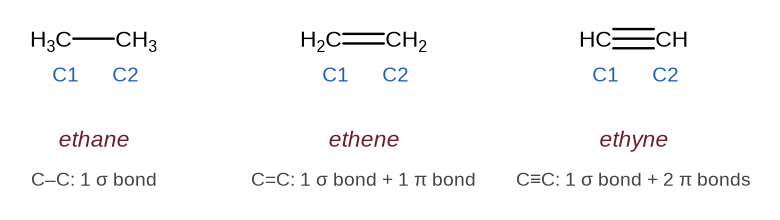
So the second bond is not a copy of the first. It is a different kind of bond, made in a different way and sitting in a different place. The first bond between two atoms is always a σ bond; any bond that comes on top of it is a π bond. Figure 1 shows the three molecules and how many of each they hold between C1 and C2.
What is the π bond made of, why is it the weak one, and why is it the part of a molecule that everything attacks?
σ bonds: orbitals that meet head-on
Every bond between two atoms starts out as a σ bond. Two orbitals, one from each atom, point at each other and overlap head-on, along the line between the two nuclei. That is the best overlap two orbitals can get, so the electron pair sits right between the nuclei, holding them together. A single bond is one σ bond and nothing else.
A σ bond has no preferred side. Seen from the end, it looks like a circle, so you can turn one end of the bond around its axis and the overlap does not change at all. That is why the two CH₃ groups in ethane turn freely (the cost is only about 12 kJ/mol, which room temperature pays without noticing).
Count the σ bonds in ethane: one C1–C2 bond and six C–H bonds, so seven σ bonds and nothing else.
π bonds: p orbitals that meet side by side
Now ethene. Each carbon makes three σ bonds: one to the other carbon and two to hydrogens. That framework (C1, C2 and the four hydrogens) lies flat in one plane, with all the angles about 120°. Each carbon still has one p orbital that it has not used for a σ bond (the explanation on sp³, sp² and sp hybridisation shows where it comes from), and it points straight up out of that plane, perpendicular to the framework.
The two p orbitals sit parallel, side by side, one on C1 and one on C2. They overlap sideways, and the result is a π bond: a cloud of electron density in two halves, one above the plane and one below it, with a node (a place where the electrons are never found) in the plane itself. Figure 2 shows it.
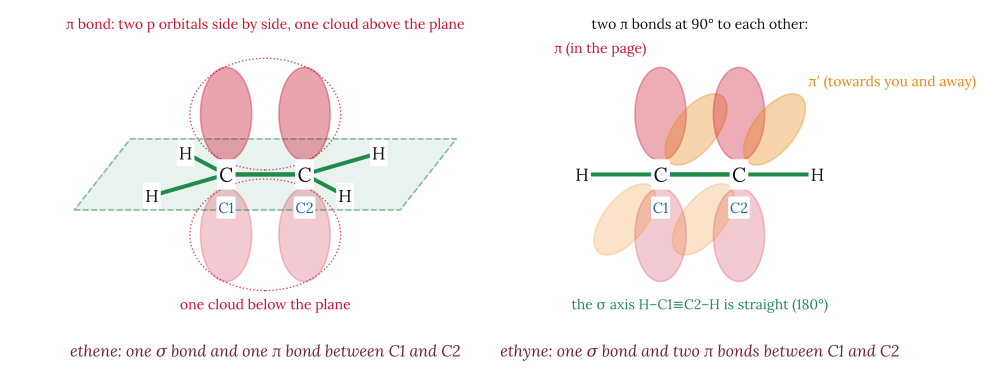
Two things follow, and both explain the 260 kJ/mol. Sideways overlap is poorer than head-on overlap, so the π bond is weaker than the σ bond underneath it. And the π electrons are not tucked away on the line between the nuclei: they are spread above and below the molecule, out in the open, where a passing positive charge can reach them.
Ethyne: a σ bond with a collar of two π bonds
In ethyne each carbon makes only two σ bonds (one to the other carbon, one to a hydrogen), so the σ framework H–C1–C2–H is a straight line, 180°. That leaves each carbon with two unused p orbitals, at right angles to each other and to the axis. They overlap in pairs: one π bond lies in the plane of the page, the other in the plane at right angles to it (the red and orange clouds of Figure 2). Together they form a collar of electron density all the way round the σ axis. Seen from the end, a triple bond looks cylindrical, like a σ bond, just much fatter.
Counting, and what it costs
You can now count σ and π bonds in any molecule: every single bond is one σ, every double bond is one σ plus one π, every triple bond is one σ plus two π. Do not forget the C–H bonds; they are σ bonds too. The structures and the numbers are in the table.
| Molecule | σ bonds | π bonds | C–C bond length | Average C–C bond energy |
|---|---|---|---|---|
| ethane (C1–C2) | 7 (1 C–C, 6 C–H) | 0 | 153 pm | 350 kJ/mol |
| ethene (C1=C2) | 5 (1 C–C, 4 C–H) | 1 | 134 pm | 610 kJ/mol |
| ethyne (C1≡C2) | 3 (1 C–C, 2 C–H) | 2 | 120 pm | 840 kJ/mol |
Each extra π bond pulls the carbons closer together and adds less energy than the one before it, which is what you would expect from a bond that overlaps less well.
The π bond has one more consequence. To turn one CH₂ group of ethene by 90° around the C=C axis, the two p orbitals would end up at right angles and stop overlapping, so the π bond would have to break. That costs about 260 kJ/mol, the size of the π bond itself (the σ bond of ethane asks for only 12 kJ/mol). Nothing at room temperature can pay that, so a double bond does not rotate, and whatever sits on its two ends stays on its side. That is why cis and trans isomers of alkenes can exist at all (each carbon of the double bond also needs two different groups).
Proof that the π bond is the one that reacts
If the π electrons really are the exposed ones, ethene should react through the π bond and leave the σ framework alone. Add hydrogen bromide, HBr, and watch the arrows in Figure 3. The carbons are numbered as in Figure 1.
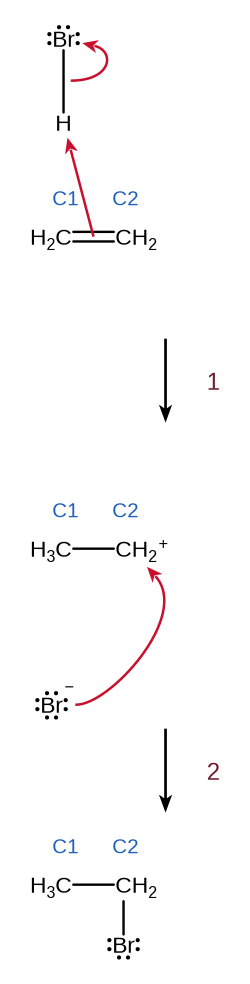
Step 1: the π bond reaches for the proton. The first arrow starts in the middle of the C1=C2 double bond (the π bond, not the σ bond) and ends at the hydrogen of HBr: the π pair becomes the new C1–H σ bond. The second arrow starts in the H–Br bond and ends on bromine, which leaves as a bromide ion with a full octet and a negative charge. The result is the ethyl cation: C1 is now a CH₃ group, and C2 has only three bonds, six electrons and a positive charge.
Step 2: bromide closes the gap. The bromide ion has plenty of electrons and C2 has a hole. One arrow from a lone pair of bromine to C2 makes a new C2–Br σ bond. The product is bromoethane.
Look at what happened to the carbon–carbon bond. It started as σ plus π and ended as σ alone: the σ bond between C1 and C2 was never touched. In the balance, one π bond and one H–Br bond are traded for a C–H σ bond and a C–Br σ bond. With average bond energies (π about 260, H–Br 366, C–H 413 and C–Br 285 kJ/mol) that is about 626 kJ/mol broken and 698 kJ/mol made, so the reaction runs downhill. The weak, exposed π bond is the part of ethene that gets spent.
One σ bond between any two bonded atoms; every extra bond is a π bond. A σ bond is a head-on overlap on the line between the nuclei: strong, cylindrical, free to rotate. A π bond is a side-by-side overlap of two p orbitals above and below that line: weaker, exposed, and the reason a double bond does not rotate and is the part that reacts. So a double bond is 1 σ + 1 π and a triple bond is 1 σ + 2 π.
Watch out. A double bond is not "two σ bonds". When you count σ bonds in a molecule, count every C–H bond, and count each double or triple bond once, as a single σ; the rest of it goes in the π column.
More from Structure
Why is water bent? (and ammonia a pyramid)
Two hydrogens on an oxygen should sit in a straight line, yet water is bent. Count the groups, find the lone pairs, and the shape explains itself.
What are sp³, sp² and sp hybridisation? Why carbon makes four equal bonds
Carbon has two unpaired electrons and still makes four identical bonds. Promotion, orbital mixing and what sp³, sp² and sp really mean, orbital by orbital.
How to find the hybridisation of an atom: count the groups
No orbital drawings needed. Count σ bonds plus lone pairs, read off sp, sp² or sp³. Worked on a carbon chain, then on nitrogen and oxygen.
Alkane, alkene, alkyne or arene? The four hydrocarbon families
Four families, made of nothing but carbon and hydrogen. One count, the hydrogens, tells saturated from unsaturated, and the double bond shows why it matters.