
 PossieChem
Why is water bent? (and ammonia a pyramid)
Two hydrogens on an oxygen should sit in a straight line, yet water is bent. Count the groups, find the lone pairs, and the shape explains itself.
- Valence electrons and lone pairs
- What sp³ means (one s and three p orbitals mixed into four equal hybrids)
Water has three atoms: one oxygen, two hydrogens. If you wanted the two hydrogens as far apart as possible, you would put them on opposite sides of the oxygen, in a straight line, 180°. A straight line is the laziest arrangement, and plenty of three-atom molecules take it. Water does not. It sits there with its two hydrogens leaning towards each other like two people sharing one menu, at an angle of about 104.5°.
Ammonia has the same kind of problem. Three hydrogens around a nitrogen would be happiest lying flat in a triangle with the nitrogen at the centre, 120° apart. Ammonia is a little pyramid instead, with an angle of about 107°.
Something invisible shapes these molecules, and it is not an atom. Here is what it is, in three moves. (The method is called VSEPR, valence shell electron pair repulsion, and you are about to do it by hand.)
Move 1: count the groups, not the atoms
Around a central atom, count the σ bonds (the head-on bond between two atoms; a double bond is one σ plus one π) plus the lone pairs. (A lone pair that is delocalised into a π system, as on the nitrogen of an amide, is the usual exception.) That number is the number of groups, and it is also the number of hybrid orbitals the atom makes: four groups give four sp³ orbitals (one s and three p orbitals mixed into four equal hybrids), which point to the four corners of a tetrahedron, about 109.5° apart. (π bonds do not count; they are made from the p orbitals that are left over.)
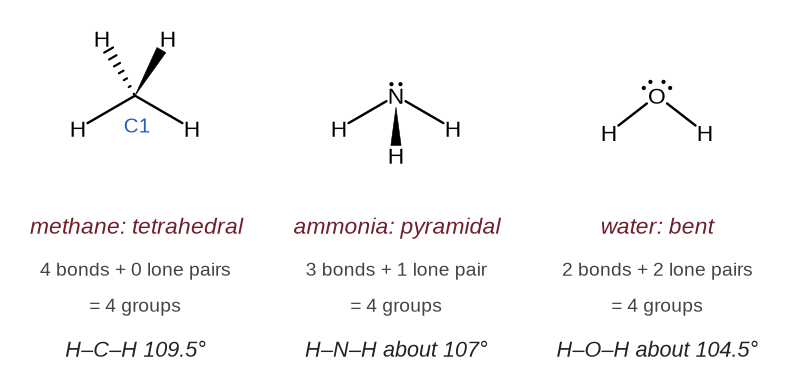
Figure 1 shows the three molecules. Count the groups on each:
- Methane. Carbon C1 makes four σ bonds and has no lone pair: 4 groups.
- Ammonia. Nitrogen has five valence electrons. Three go into bonds with hydrogen and two stay behind as a lone pair: 3 + 1 = 4 groups.
- Water. Oxygen has six valence electrons. Two go into bonds and four stay behind as two lone pairs: 2 + 2 = 4 groups.
All three central atoms are sp³: four orbitals pointing, roughly, at the four corners of a tetrahedron. (Move 3 looks at the "roughly".)
Watch out. Hybridisation counts groups of electrons, not neighbouring atoms. The oxygen in water has only two atoms attached and is still sp³, because its two lone pairs count too.
Move 2: only the atoms count for the shape
When we say "bent" or "pyramidal", we are describing where the atoms are. A lone pair is not an atom. It is real electron density and it occupies a corner of the tetrahedron, but nobody photographs it.
In methane all four corners hold a hydrogen, so you see the whole tetrahedron. In ammonia one corner holds a lone pair, so the three hydrogens form a pyramid with the nitrogen at its tip. In water two corners are taken, and the two hydrogens that remain make a bent shape.
Picture a table set for four where, in water, two of the guests are ghosts. You only see the two who are made of atoms, and they sit at an angle to each other, not across the table.
So the straight line was never on offer. Four groups arrange themselves in a tetrahedron, and two atoms bonded to the centre of a tetrahedral arrangement are always at an angle to each other.
Move 3: why 104.5° and not 109.5°
If the story ended there, water would be 109.5° and ammonia too. They are not: 104.5° and 107°, a little under the tetrahedral value. The reason is that the four groups are not equal.
A bonding pair is shared between two nuclei, so it is pulled into the space between them. A lone pair belongs to one nucleus only, so it spreads out more and takes up more room. A fat group pushes harder than a thin one. The repulsion between a lone pair and a bonding pair is therefore stronger than between two bonding pairs, and the lone pairs squeeze the bonds closer together.
| Molecule | Bonds | Lone pairs | Shape of the atoms | Angle |
|---|---|---|---|---|
| methane | 4 | 0 | tetrahedral | 109.5° |
| ammonia | 3 | 1 | trigonal pyramidal | about 107° |
| water | 2 | 2 | bent | about 104.5° |
Read down the columns. In this series, each extra lone pair closes the angle a little more: none gives the full 109.5°, one gives about 107°, two give about 104.5°. Water has two lone pairs, so it is squeezed the most.
Proof: take the lone pair away
A good explanation should predict something. If the lone pair is what squeezes ammonia, then turning that lone pair into an ordinary bond should let the angle open back up to 109.5°.
Do it: add a proton, H⁺, to ammonia.
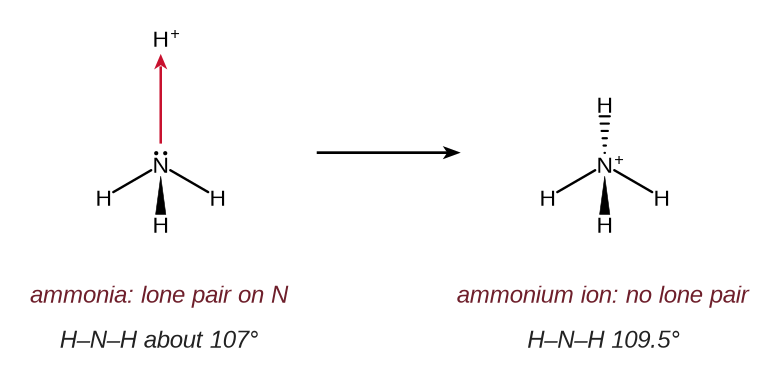
The lone pair of ammonia is the electron pair that makes the new N–H bond, so one curved arrow does the whole job: from the lone pair to the proton. Nitrogen now has four N–H bonds and no lone pair. Its formal charge is the 5 valence electrons of a free nitrogen atom minus the 4 electrons it is assigned here (half of the 8 bonding electrons, and no lone-pair electrons), which is +1: the ammonium ion.
All four groups around the nitrogen of the ammonium ion are now identical N–H bonding pairs, so nothing pushes harder than anything else. It is a perfect tetrahedron, and the H–N–H angle is 109.5°, exactly like methane. The squeeze was the lone pair all along.
Count the groups, then look at the atoms. σ bonds plus lone pairs give the number of groups: four means sp³ and a tetrahedral arrangement. The shape is named after the atoms only, so each lone pair removes a corner: tetrahedral, pyramidal, bent. Lone pairs push harder than bonding pairs, so, for four groups around a central atom, the more lone pairs, the smaller the angle: 109.5°, about 107°, about 104.5°.
More from Structure
What are σ and π bonds? What a double bond is really made of
A double bond is not two single bonds glued together. It is one σ bond with a weaker π bond on top, and the π bond is the one that reacts.
What are sp³, sp² and sp hybridisation? Why carbon makes four equal bonds
Carbon has two unpaired electrons and still makes four identical bonds. Promotion, orbital mixing and what sp³, sp² and sp really mean, orbital by orbital.
How to find the hybridisation of an atom: count the groups
No orbital drawings needed. Count σ bonds plus lone pairs, read off sp, sp² or sp³. Worked on a carbon chain, then on nitrogen and oxygen.
Alkane, alkene, alkyne or arene? The four hydrocarbon families
Four families, made of nothing but carbon and hydrogen. One count, the hydrogens, tells saturated from unsaturated, and the double bond shows why it matters.