
 PossieChem
How do you draw a Newman projection? Newman and sawhorse, side by side
Natta, sawhorse and Newman are three drawings of the same bond. Learn to jump between them without thinking, using 2,2-dimethylbutane and butane as the worked examples.
- What a conformation is (rotation around a single bond)
- Wedge and dash bonds
- The zigzag (skeletal) drawing
To show what a molecule looks like around one bond, organic chemistry has three standard drawings. They are the same bond seen from three places, and the whole skill is to jump from one to the next without thinking. Anyone who cannot do it gets stuck on every conformation problem, and the reason is almost always the same: they never worked out which carbon is in front.
The three drawings are the Natta projection (the zigzag you already know, with wedges and dashes), the sawhorse (the bond seen from the side and a bit from above) and the Newman projection (the bond seen from the end, dead on). Each one hides something the others show.
So which one do you use when, and how do you get from the zigzag to the Newman projection without turning anything the wrong way round?
One bond, three drawings
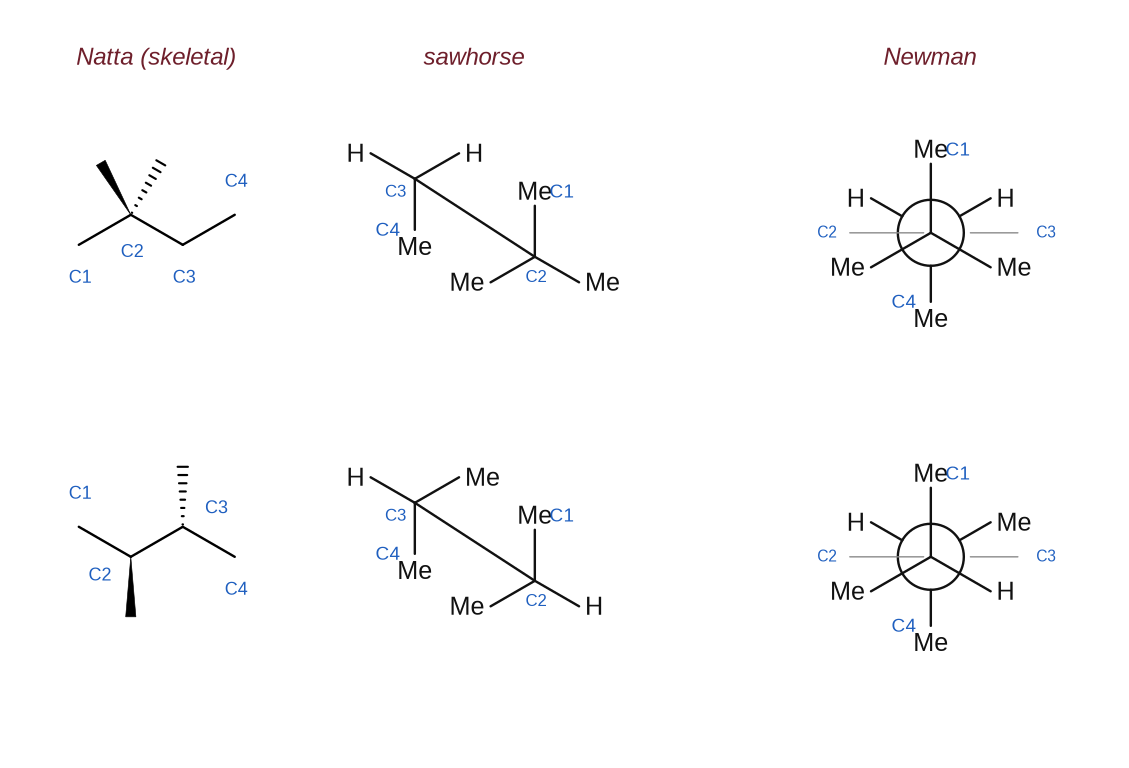
Figure 1 draws two molecules in all three ways, always along the C2–C3 bond. The top row is 2,2-dimethylbutane, the bottom row is 2,3-dimethylbutane.
The Natta projection: the zigzag with wedges
C1, C2, C3 and C4 lie in the plane of the paper. Whatever leaves the plane gets a wedge (towards you) or a hash (away from you). For 2,2-dimethylbutane that is the two methyls on C2, one wedged and one hashed, which is all the zigzag has to say about how they sit.
The Natta projection is the best drawing for which atoms are bonded to which. It is a poor drawing for how far apart two groups are, because the zigzag shows one flat arrangement whatever the bond is doing.
The sawhorse: the bond seen from the side
The sawhorse looks at the C2–C3 bond from the side and a little from above. The long line is the bond you are looking along, with the front carbon (C2) at the lower right and the back carbon (C3) at the upper left. Each carbon then gets its three other groups: for 2,2-dimethylbutane, C2 holds C1 and the two methyls, and C3 holds two H and C4.
In a sawhorse you see the bond, so you see which carbon is in front. What you do not see clearly is the angle between a front group and a back group.
The Newman projection: the bond seen from the end
The Newman projection looks straight down the bond. The front carbon is the point in the middle where three bonds meet, and the back carbon is the circle behind it, whose three bonds start at the edge of the circle. A Newman projection is a sawhorse seen from the end.
Now the angles are the point. In the top Newman projection every back group sits in the gap between two front groups, 60° from each: a staggered arrangement. In the bottom one it is the same, and every front group has a back partner exactly opposite, 180° away, which is the anti arrangement.
How to go from a sawhorse to a Newman projection
Follow the sawhorse in the same order each time, so you never turn it the wrong way round.
- Find the bond you are looking along, and decide which carbon is in front. In Figure 1 it is C2, the one at the lower right.
- Draw the front carbon as the dot in the middle, with its three groups at 90°, 210° and 330° (angles measured counter-clockwise from the horizontal on the right): one straight up, two down-left and down-right. Keep the groups in the same order, clockwise.
- Draw the circle for the back carbon C3 and put its three groups at 30°, 150° and 270°, between the front ones.
- Label every group, and write the carbon numbers next to the groups they belong to, so you can check later that nothing swapped.
Figure 2 does exactly this for one conformation of butane, with C1 and C4 coloured so you can follow them from the sawhorse into the Newman projection.
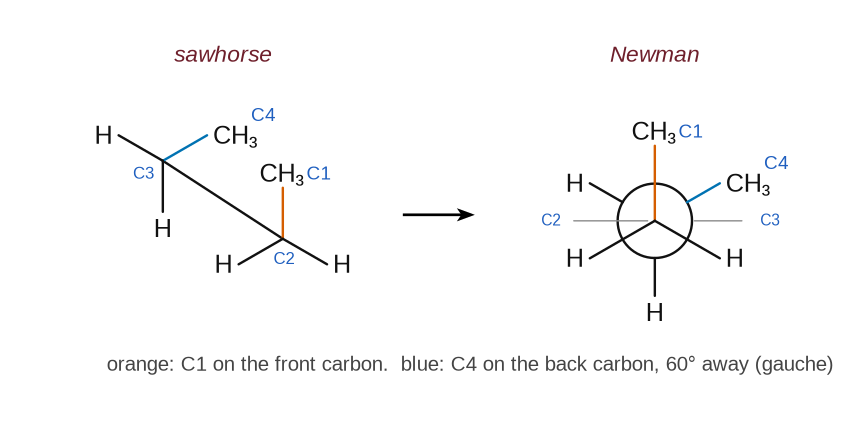
In the sawhorse, C1 is on the carbon in front and C4 on the carbon behind. In the Newman projection, C1 is a front bond and C4 a back bond. The two coloured bonds are 60° apart, which is gauche. Had C4 stood straight down, opposite C1, the conformation would be anti.
Staggered or eclipsed, at a glance
Every conformation sits somewhere between two extremes. In a staggered conformation each back group sits in the gap between two front groups, as in all the Newman projections above. In an eclipsed conformation each back group stands straight behind a front group. To show the back bonds at all, an eclipsed Newman projection is drawn with them turned a little, because otherwise they would hide behind the front bonds.
Staggered is the comfortable arrangement, because the groups are as far apart as they can get. Eclipsed is the uncomfortable one. The next page, on rotation around a single bond, follows the energy as the bond turns.
The three views. Natta: which atoms are bonded. Sawhorse: the bond from the side, front carbon at the lower right. Newman: the bond end-on, front carbon the dot in the middle, back carbon the circle. Angles are easiest to read in the Newman projection.
Watch out. A Newman projection says nothing without the information along which bond. Always write which carbon is in front and which behind, and check the numbering again after you have drawn it. Look from the other end and you get another correct Newman projection of the same molecule, with front and back swapped and the groups running round the circle the other way. Both are fine, but never mix the two in one drawing.
More from Structure
What is the difference between configuration and conformation?
Two words that look like twins and are not. One test tells configuration and conformation apart: do you have to break a bond to get from one arrangement to the other?
What are staggered, eclipsed, gauche and anti? Rotation around a single bond
Turn one single bond and the energy goes up and down like a wave. Staggered, eclipsed, gauche and anti explained with ethane, butane and 2,2-dimethylbutane.
Why is tert-butyl always equatorial? A-values explained
Cyclohexane flips between two chairs, and a tert-butyl group will spend almost all its time in one of them. Axial against equatorial, the A-value, and why size is not the whole story.
How do you draw the cyclohexane chair? Axial and equatorial, step by step
Why a ring of six sp³ carbons is never flat, how to draw the chair with the right parallel lines, and how to tell axial from equatorial on every carbon.