
 PossieChem
What is the difference between configuration and conformation?
Two words that look like twins and are not. One test tells configuration and conformation apart: do you have to break a bond to get from one arrangement to the other?
- Single and double bonds, sigma and pi
- The sp³ carbon: four bonds, tetrahedral
Two words that look like twins and are not. Configuration and conformation both describe how the atoms of a molecule sit in space. Both are kinds of stereoisomerism. Students swap them about as often as they swap a left shoe and a right shoe, and they are about as confusing to walk on.
What you see on the page does not tell them apart. What tells them apart is the road between two arrangements. On one road you simply turn a bond, nothing breaks, and it happens billions of times a second without anybody noticing. On the other road a bond has to break, and at room temperature it usually does not.
So the question the rest of this page answers is a very practical one: which road is it, how can you tell by looking at a molecule, and what does a double bond have to do with it?
The test: do you have to break a bond?
Two arrangements of the atoms of one molecule are conformations of each other when you can get from one to the other by rotation around single bonds. No bond breaks, so it costs little energy: for the usual single bond between sp³ carbons, somewhere between about 12 and 25 kJ/mol. The typical thermal energy at room temperature is only about 2.5 kJ/mol, but at any moment enough molecules have that much energy and more, so the arrangements turn into each other billions of times a second, and you cannot put one conformation in one bottle and another in a second bottle.
Two arrangements are configurations of each other when getting from one to the other means breaking and remaking bonds. That costs a great deal, so each configuration is a separate compound: it sits in its own bottle, with its own boiling point and its own spectrum. Cis and trans, and the R and S of stereocentres: these are configurations.
Conformations: butane turning around C2–C3
Take butane, four carbons in a row, and look along the bond between C2 and C3 (Figure 1). The Newman projection on the right-hand side of the zigzag is that view: C2 is the dot in the middle where three bonds meet, C3 is the circle behind it.
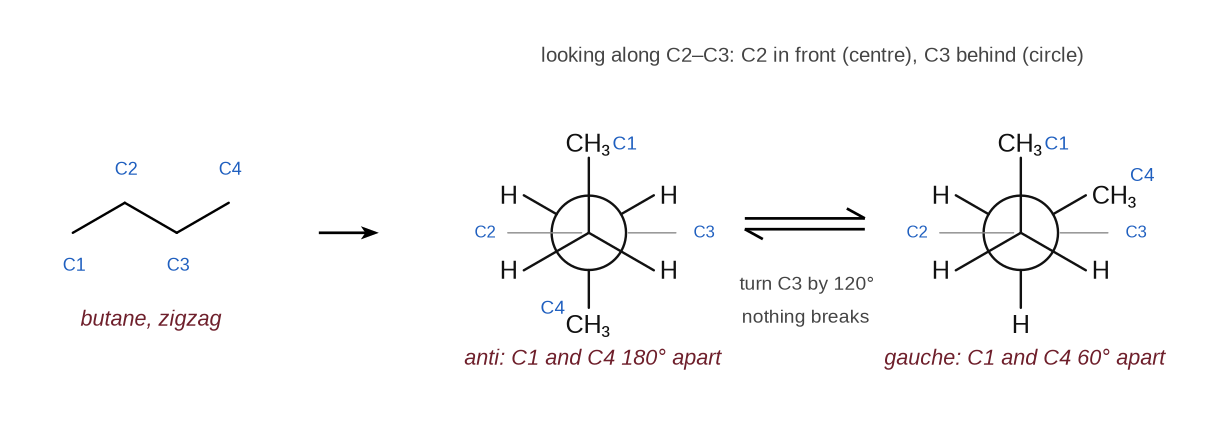
In the left Newman projection the CH₃ on the back carbon (C4) points straight down, exactly opposite the CH₃ on the front carbon (C1). The angle between them, seen along the bond, is 180°, and that arrangement is called anti. Hold C2 still and turn C3 by 120°, and C4 swings round to the upper right, only 60° from C1. That is gauche.
Same atoms, same bonds, same molecule. The only thing that changed is an angle, the dihedral angle C1–C2–C3–C4 (the angle between the C1–C2 bond and the C3–C4 bond, seen along C2–C3). The anti form of butane is a little more comfortable than the gauche form, by about 4 kJ/mol, because in the gauche form the two methyls are closer together. But that is a difference of populations, not of compounds: at room temperature roughly 70 % of the butane molecules are anti and 30 % gauche, and every molecule goes back and forth between them billions of times a second.
Configurations: why cis and trans stay put
Now put a double bond in the middle. Figure 2 shows but-2-ene, which is butane with a C=C between C2 and C3, in its two forms.
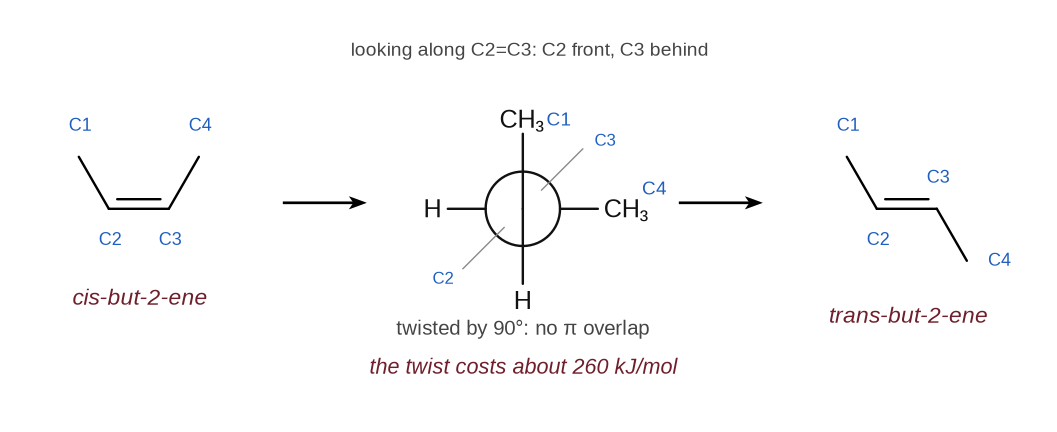
A double bond is a σ bond plus a π bond, and the π bond is made of two p orbitals lying side by side, parallel to each other. That only works while the two ends of the double bond stay in one plane. Rotate C3 around the C2=C3 bond and the p orbitals turn away from each other. At 90° (the middle of Figure 2) they do not overlap at all and the π bond is gone. Getting there costs about 260 kJ/mol, roughly a hundred times the thermal energy of a molecule at room temperature, which is about 2.5 kJ/mol.
So cis-but-2-ene and trans-but-2-ene do not turn into each other by themselves. They are two compounds, two configurations, and they even boil at different temperatures (about 3.7 °C for cis and 0.9 °C for trans). Rings work the same way. The ring holds two groups on the same face or on opposite faces and stops them swapping, so cis and trans on a ring are configurations too.
The test. Can you get from one arrangement to the other by rotating around single bonds? Then they are conformations of one molecule. Do bonds have to break (a π bond, or a bond to a stereocentre)? Then they are configurations: separate compounds.
Watch out. A single bond is almost always free to turn, not always. If both ends of a single bond carry big groups, rotation can become so slow that the conformations can be separated as different compounds. That is a special case with its own name (atropisomerism). For simple molecules, a single bond means conformations, double bond or ring means configurations.
More from Structure
How do you draw a Newman projection? Newman and sawhorse, side by side
Natta, sawhorse and Newman are three drawings of the same bond. Learn to jump between them without thinking, using 2,2-dimethylbutane and butane as the worked examples.
What are staggered, eclipsed, gauche and anti? Rotation around a single bond
Turn one single bond and the energy goes up and down like a wave. Staggered, eclipsed, gauche and anti explained with ethane, butane and 2,2-dimethylbutane.
Why is tert-butyl always equatorial? A-values explained
Cyclohexane flips between two chairs, and a tert-butyl group will spend almost all its time in one of them. Axial against equatorial, the A-value, and why size is not the whole story.
How do you draw the cyclohexane chair? Axial and equatorial, step by step
Why a ring of six sp³ carbons is never flat, how to draw the chair with the right parallel lines, and how to tell axial from equatorial on every carbon.