
 PossieChem
What are staggered, eclipsed, gauche and anti? Rotation around a single bond
Turn one single bond and the energy goes up and down like a wave. Staggered, eclipsed, gauche and anti explained with ethane, butane and 2,2-dimethylbutane.
- Newman projections (front carbon, back carbon)
- What a conformation is
A single bond between two sp³ carbons turns. Hold one end still, twist the other, and the molecule passes through a series of shapes. They are not equally comfortable: plot the energy against the angle of the twist and you get a wave, with comfortable valleys and uncomfortable hills.
The shape of that wave is the whole story of open-chain conformations. Staggered, eclipsed, gauche and anti are just the names of the valleys and the hills. And the height of the hills decides a question that sounds philosophical and is not: can you ever catch one conformation of a molecule and keep it in a bottle?
So how high is the hill, what makes it a hill, and why does the molecule in the example below go over three identical hills in one turn?
The simplest wave: ethane
Take ethane and look along the C1–C2 bond (Figure 1). Each carbon holds three hydrogens. In the staggered conformation each back H sits in the gap between two front H atoms. In the eclipsed conformation each back H stands straight behind a front H.
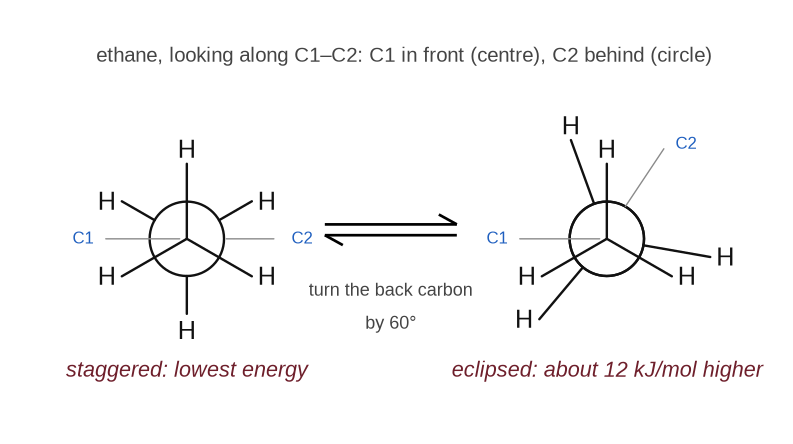
Turn the back carbon by 60° and one becomes the other. The staggered form is the lowest in energy, because the C–H bonds of the two carbons are as far from each other as they can get. The eclipsed form is the top of the hill, about 12 kJ/mol higher. Three pairs of eclipsing C–H bonds share that bill, so each pair adds about 4 kJ/mol. This torsional strain (the price of eclipsed bonds) comes back every 120°, since after 120° the molecule looks exactly as it did before.
Twelve kJ/mol is small. At room temperature the thermal energy scale, RT (the gas constant times the temperature), is about 2.5 kJ/mol, yet enough molecules have 12 kJ/mol or more at any moment that the hill is climbed many billions of times per second. So a single bond counts as freely rotating, and you can never isolate one conformation of ethane.
2,2-dimethylbutane: three equal hills
Now give the two carbons more to carry. In 2,2-dimethylbutane the front carbon C2 holds three identical groups (C1 and the two methyls) and the back carbon C3 holds C4 and two H. Figure 2 follows C4 as it makes one full turn about C2–C3, in steps of 60°.
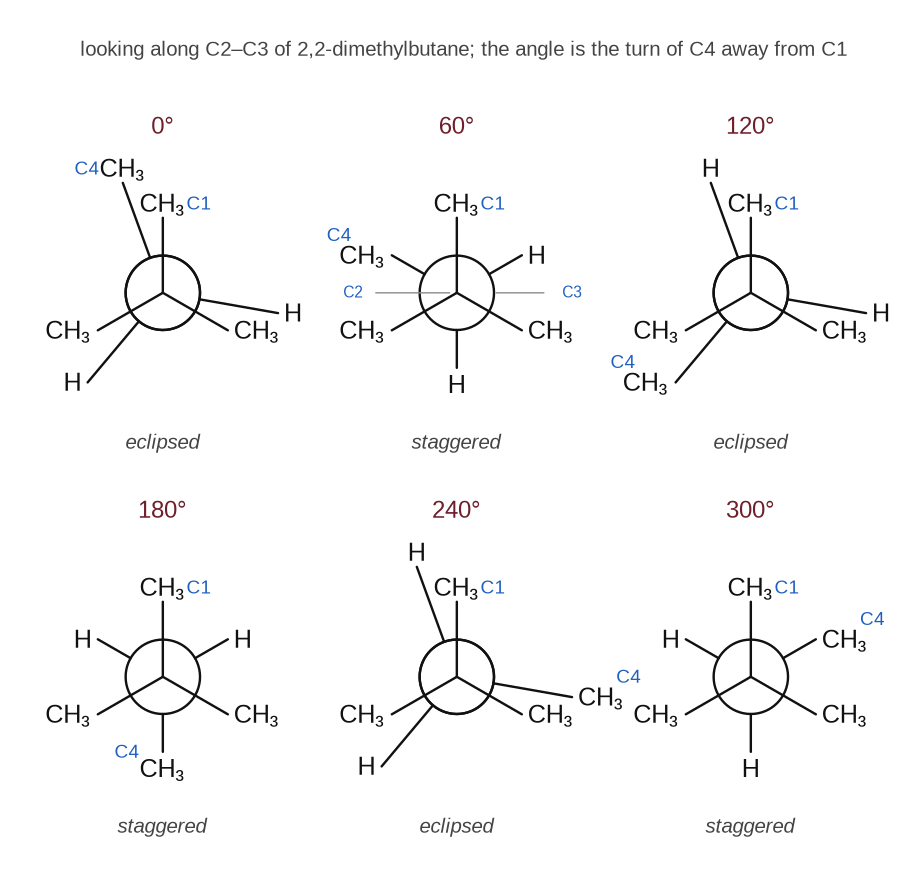
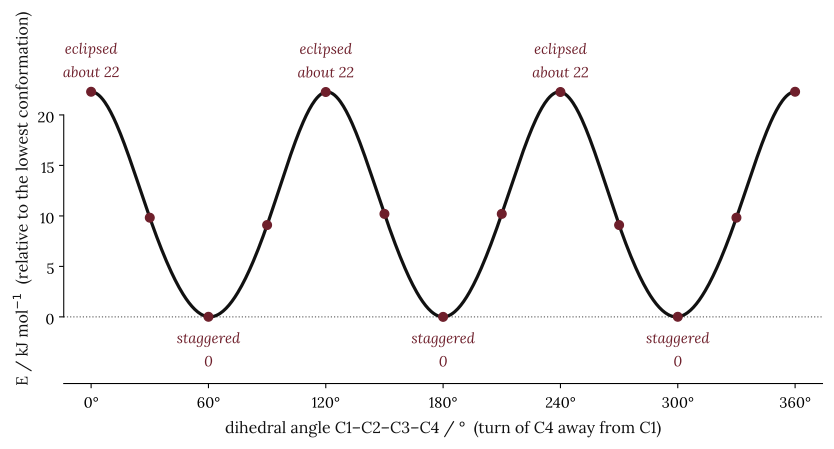
Because the front carbon holds three identical groups, the molecule looks the same after every 120°. So the energy profile has three equal maxima and three equal minima (Figure 3). The numbers come from a molecular-mechanics calculation: the eclipsed form is about 22 kJ/mol above the staggered one, a taller hill than ethane's because a methyl is being pushed onto a methyl.
Butane: gauche, anti, and two kinds of eclipsed
Give the back carbon different groups and the three valleys stop being equal. Butane, with C1 and C4 as its two methyls, shows it best (Figure 4). The words you need are two angles: two groups 60° apart are gauche, two groups 180° apart are anti.
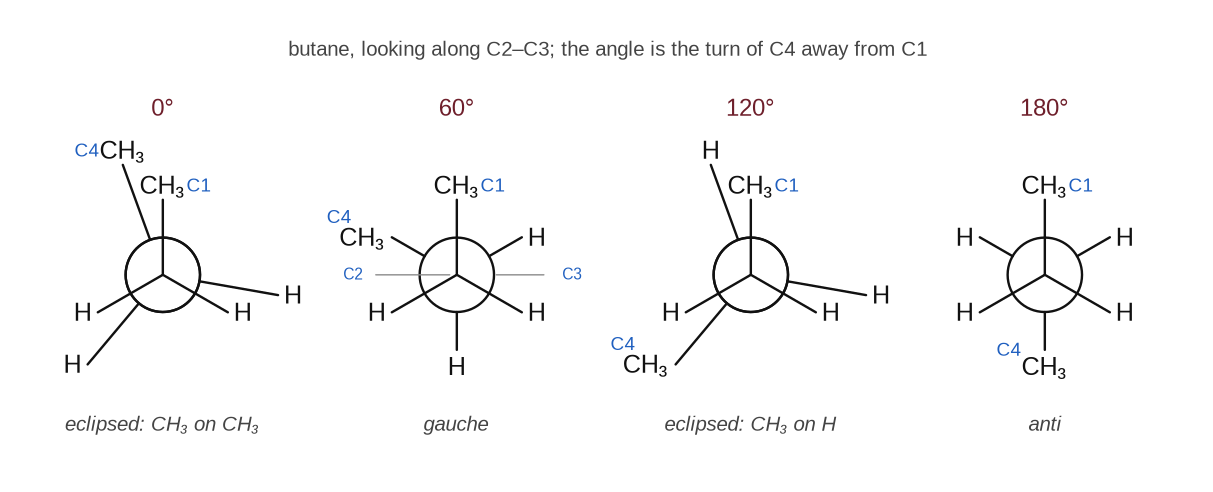
Four conformations matter. At 180° the two methyls are anti and as far apart as possible: this is the lowest-energy conformation. At 60° they are gauche, close enough to push against each other, so it sits about 4 kJ/mol higher. At 120° the methyl on C4 eclipses an H on C2 and the energy is about 16 kJ/mol. At 0° the two methyls eclipse each other and the energy peaks at about 19 kJ/mol. Figure 5 puts it together.
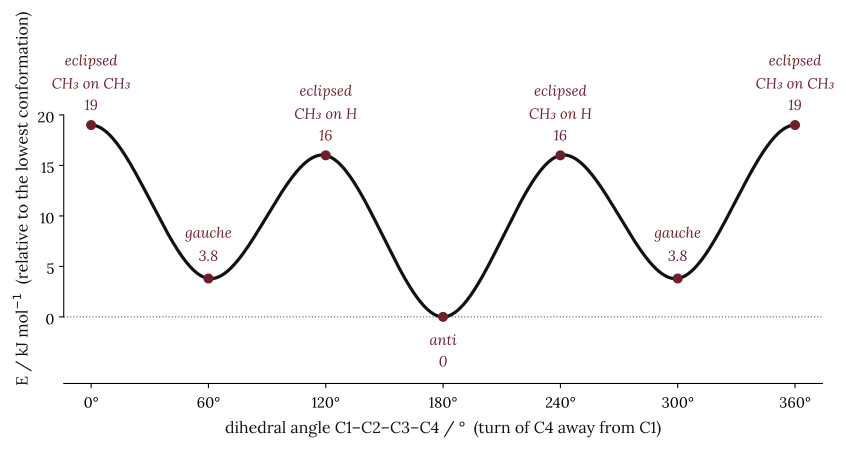
Two valleys of different depth and two hills of different height: that is the signature of butane. The 4 kJ/mol between anti and gauche is a difference in population, not a difference in compounds: at room temperature about 70 % of butane molecules are anti and 30 % gauche, and each molecule moves between them many billions of times per second.
What makes a conformation high in energy
Two things add up. Torsional strain is the cost of eclipsed bonds, as in ethane. Steric strain is the cost of two big groups getting too close, as in gauche butane and, much more, in the CH₃-on-CH₃ eclipsed form. The more crowded the groups on the two carbons, the higher the hills. Because the staggered forms are the valleys, every drawing of a chain in its best shape is a staggered one, and the zigzag of a long alkane is just all its C–C bonds in the anti arrangement.
Remember. Staggered is the valley, eclipsed is the hill. Gauche: 60° apart. Anti: 180° apart. Bigger groups make taller hills and make anti more favoured than gauche. The hills of ordinary single bonds are roughly 12 to 25 kJ/mol, so rotation is fast and the conformations cannot be separated.
Watch out. The energy minimum is staggered, but it is not the only conformation that exists. In butane about 30 % of the molecules are gauche at any moment. A "preferred" conformation is a majority, not the only one.
More from Structure
What is the difference between configuration and conformation?
Two words that look like twins and are not. One test tells configuration and conformation apart: do you have to break a bond to get from one arrangement to the other?
How do you draw a Newman projection? Newman and sawhorse, side by side
Natta, sawhorse and Newman are three drawings of the same bond. Learn to jump between them without thinking, using 2,2-dimethylbutane and butane as the worked examples.
Why is tert-butyl always equatorial? A-values explained
Cyclohexane flips between two chairs, and a tert-butyl group will spend almost all its time in one of them. Axial against equatorial, the A-value, and why size is not the whole story.
How do you draw the cyclohexane chair? Axial and equatorial, step by step
Why a ring of six sp³ carbons is never flat, how to draw the chair with the right parallel lines, and how to tell axial from equatorial on every carbon.