
 PossieChem
Why is tert-butyl always equatorial? A-values explained
Cyclohexane flips between two chairs, and a tert-butyl group will spend almost all its time in one of them. Axial against equatorial, the A-value, and why size is not the whole story.
- What a chair looks like (cyclohexane as a puckered ring, not a flat hexagon)
- What an sp³ carbon is (four bonds, about 109.5° apart)
Cyclohexane is a ring that cannot sit still. It flips between two chairs about a hundred thousand times per second, and if you hang a methyl group on it, that methyl is carried back and forth between two very different seats. Hang a tert-butyl group on it instead and something odd happens: the flipping carries on, but the molecule spends practically all of its time in one chair, the one where the tert-butyl sits out in the open. Roughly one molecule in three thousand is in the other chair.
Why one chair, and why is tert-butyl so extreme about it? It is a story of two seats, one of which is a middle seat in the back row of a very small car.
Two seats on every carbon
A flat hexagon would force every C–C–C angle to 120°, where an sp³ carbon wants about 109.5°, and every neighbouring pair of C–H bonds would be eclipsed. So the ring puckers into a chair: all angles close to 109.5° and every bond staggered.
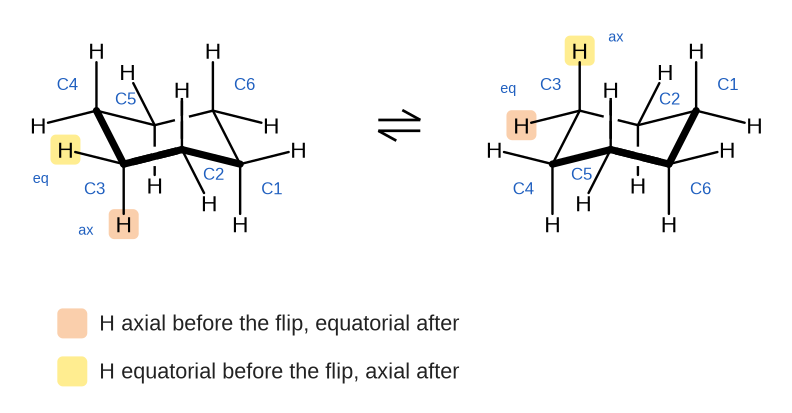
On a chair every carbon has two positions for a substituent. The six axial bonds are vertical, parallel to the axis of the ring, and they point up and down alternately from carbon to carbon. The six equatorial bonds point outward around the ring's equator, a little up or a little down; in the drawing each one is parallel to two of the ring bonds.
The chair can also turn itself inside out. This is the ring flip of Figure 1, and it is the process this whole page is about. Every axial bond becomes equatorial and every equatorial bond becomes axial. Up stays up and down stays down, so a group that was up stays up; the only thing that changes is how it sits. On the way the ring passes through a half-chair, the top of the energy hill, about 45 kJ/mol above the chair, and that is low enough for the flip to happen about 10⁵ times per second at room temperature.
In cyclohexane itself the two chairs are identical, so the flip changes nothing you could measure. Put a substituent on the ring and the two chairs stop being equal.
The axial seat is crowded
Look at the right-hand chair in Figure 2. The axial bond on C1 points straight up, and so do the axial bonds on C3 and C5, two carbons away on either side. Three parallel bonds on the same face of the ring, and the axial hydrogens on them sit only about 2.5 Å from one another. An axial hydrogen on C1 does not mind: hydrogens are tiny. An axial methyl minds a lot. Its hydrogens end up almost on top of the axial hydrogens on C3 and C5, closer than the atoms like to be. This is called a 1,3-diaxial interaction, and it is just ordinary steric repulsion: two atoms that want the same bit of space.
An equatorial methyl points away from the ring into open space and has nobody to bump into.
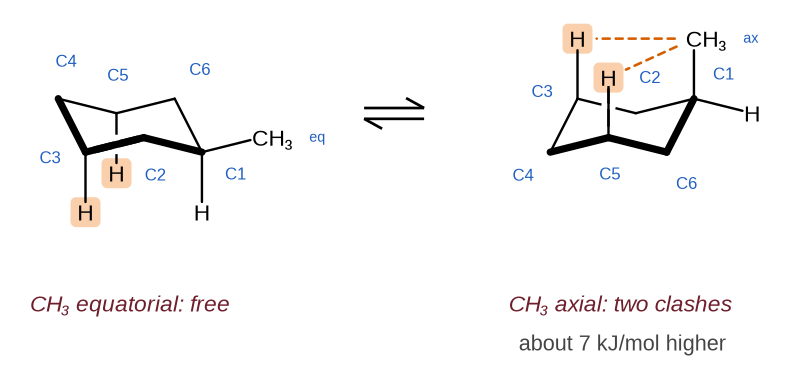
Each of those two meetings costs about 3.5 to 4 kJ/mol, the same price as a gauche arrangement, two groups on neighbouring carbons sitting 60° apart (here the CH₃ and a ring carbon). Two of them make about 7 kJ/mol. That number has a name. The A-value of a group is how much higher the chair with that group axial sits than the chair with it equatorial:
where is the free energy of the chair. For methyl it is about 7 kJ/mol.
What 7 kJ/mol means for the two chairs
The two chairs are in equilibrium, and the ratio follows from the energy difference:
Here is the gas constant and the temperature in kelvin; at 298 K, kJ/mol. For methyl, : about 17 molecules in the equatorial chair for every one in the axial chair, roughly 94 % equatorial. A comfortable majority, but the minority chair is still well populated.
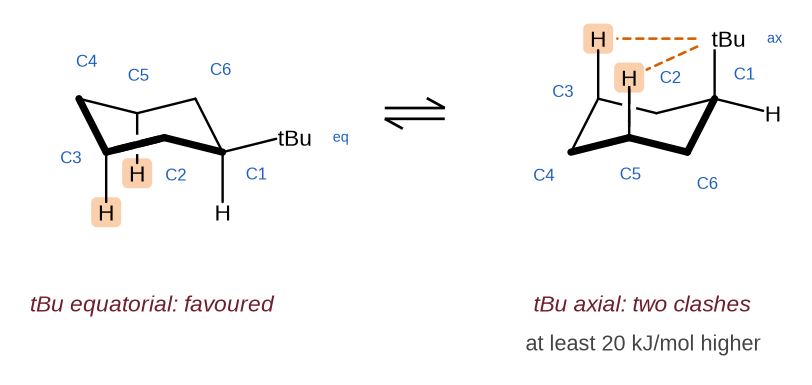
Now the same sum for tert-butyl. Its A-value is at least 20 kJ/mol, so or more. One molecule in the axial chair for every three thousand in the equatorial one.
Why tert-butyl is so much worse than methyl
The easy answer is "it is bigger", and that is true, but it is only half the story. A methyl group is a small cone with three hydrogens. However it turns about its bond to the ring, one of those hydrogens ends up pointing over the ring, at the axial hydrogens on C3 and C5, and a hydrogen is tiny. A tert-butyl group is a carbon carrying three methyl groups, C(CH₃)₃. In every staggered arrangement of those three methyls, one whole CH₃ group ends up pointing over the ring, straight at them. No amount of fidgeting gets rid of it.
That is why the whole axial chair is so expensive: not just the energy of two bumps, but of an entire methyl group squeezed into a space made for a hydrogen.
The A-value ladder
Figure 4 puts six groups on the same chair, each axial on C1, with a bar for the size of their A-value. Chlorine and bromine are about 2 kJ/mol, hydroxyl about 4, methyl about 7, phenyl about 12, and tert-butyl 20 or more.
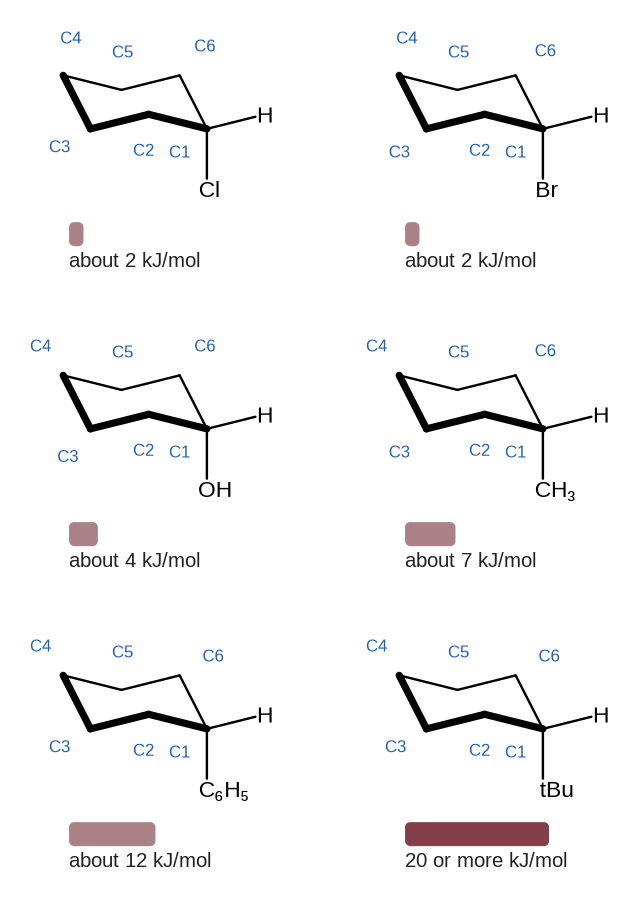
Two things in that ladder are surprising, and they say the same thing: the A-value is not a measure of size alone. Bromine is a big atom, about as bulky as a methyl group, yet its A-value is only a third of methyl's. The reason is the C–Br bond, which at about 1.94 Å is far longer than a C–C bond (about 1.54 Å): the big atom sits so far from the ring that it barely reaches the axial hydrogens. Phenyl runs the other way. It has a flat face and can turn edge-on to the crowd, so it is cheaper than a group of its weight would be. tert-Butyl is the group that is big and round and sitting right next to the ring, with no flat side to hide.
An A-value is the price of a group sitting axial, and it depends on how far the bulk starts from the ring and what shape it can make.
What chemists do with it
Because the axial chair of a tert-butyl group is so rare, the ring is practically locked in one chair. Chemists use this as a trick: put a tert-butyl on the ring as an anchor, and every other group on that ring has to take whichever position this chair gives it. The ring can still flip, but it almost never sits in the other chair, so the anchor decides which chair is the real one.
Nearly every group on a chair prefers the equatorial seat, because the axial seat puts it next to the axial hydrogens on the carbons two steps away. The A-value is the energy cost of the axial chair: about 7 kJ/mol for methyl, which still leaves about 6 % of the molecules axial at 25 °C, and 20 kJ/mol or more for tert-butyl, which leaves at most about one molecule in three thousand.
Watch out. Up and down say which face of the ring a group is on, and a ring flip never changes that. Axial and equatorial say how the group sits on one particular chair, and the ring flip swaps them. A group that is up and axial before the flip is up and equatorial after it.
More from Structure
What is the difference between configuration and conformation?
Two words that look like twins and are not. One test tells configuration and conformation apart: do you have to break a bond to get from one arrangement to the other?
How do you draw a Newman projection? Newman and sawhorse, side by side
Natta, sawhorse and Newman are three drawings of the same bond. Learn to jump between them without thinking, using 2,2-dimethylbutane and butane as the worked examples.
What are staggered, eclipsed, gauche and anti? Rotation around a single bond
Turn one single bond and the energy goes up and down like a wave. Staggered, eclipsed, gauche and anti explained with ethane, butane and 2,2-dimethylbutane.
How do you draw the cyclohexane chair? Axial and equatorial, step by step
Why a ring of six sp³ carbons is never flat, how to draw the chair with the right parallel lines, and how to tell axial from equatorial on every carbon.