
 PossieChem
How do you draw the cyclohexane chair? Axial and equatorial, step by step
Why a ring of six sp³ carbons is never flat, how to draw the chair with the right parallel lines, and how to tell axial from equatorial on every carbon.
- The sp³ carbon (four bonds, about 109.5° apart)
- Staggered and eclipsed
- Single bonds can turn
A hexagon is the most natural way to draw a ring of six carbons. It is also the one shape that a ring of six sp³ carbons cannot have. Every sp³ carbon wants its four bonds about 109.5° apart, a flat hexagon forces 120° on every carbon, and every neighbouring pair of C–H bonds ends up eclipsed. The ring would not fall apart, but it would be unhappy at every single carbon.
So the ring does the sensible thing and puckers. The shape it picks is the best one a six-membered ring can have, and it has a name that sounds like furniture: the chair. Every bond staggered, every angle close to ideal, and a ring that is almost entirely free of strain.
The chair has two different kinds of position on every carbon, and almost everything about substituted cyclohexanes depends on telling them apart. How do you draw it, and how do you tell the two kinds of position apart on every carbon?
Why the flat hexagon is wrong
Figure 1 puts a flat ring next to a chair. In the flat ring each of the six C–C–C angles is 120°. An sp³ carbon wants about 109.5°, and there is nothing to be done about it in two dimensions. All six C–C bonds also sit in one plane, so the C–H bonds on neighbouring carbons are lined up exactly behind each other: eclipsed.
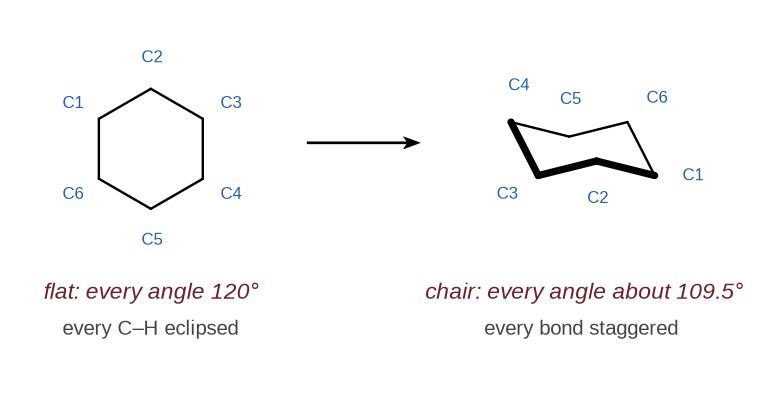
In the chair, alternate carbons sit a little above and a little below the mean plane of the ring. Now the angles are close to the ideal (in the real molecule about 111°) and every bond is staggered, exactly like the comfortable staggered form of an open chain. That is the whole reason the chair is the shape of cyclohexane, and why cyclohexane is drawn as a chair whenever its shape matters.
Axial and equatorial: two seats on every carbon
Every carbon of the chair has two positions for a substituent, and in Figure 2 all twelve hydrogens of cyclohexane are drawn so that you can see both.
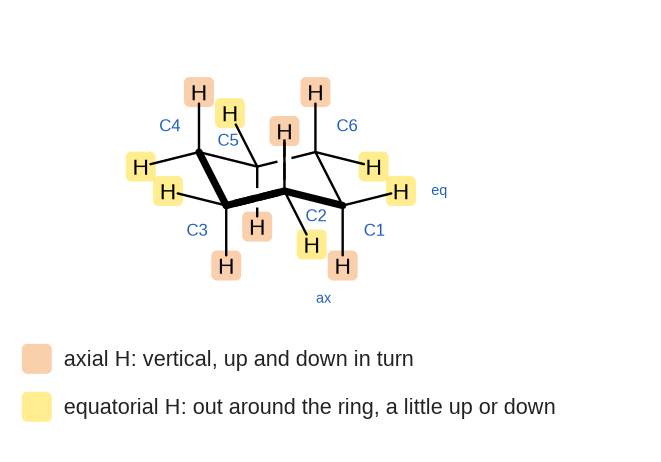
The six axial bonds are vertical, parallel to the axis through the middle of the ring. They point up and down alternately from carbon to carbon: up on C2, C4 and C6, down on C1, C3 and C5. The six equatorial bonds point out around the equator of the ring, a little up or a little down, always on the opposite side from the axial bond of the same carbon. On a carbon whose axial bond points up, the equatorial bond points slightly down, and the other way round.
How to draw the chair, and where the bonds go
Draw the ring from its parallel lines. In a chair each ring bond is parallel to the bond opposite it across the ring: C1–C2 is parallel to C4–C5, C2–C3 to C5–C6, and C3–C4 to C6–C1. The front edge C3–C2–C1 (drawn bold) goes up to a kink at C2 and down again, the back edge C4–C5–C6 does the opposite and dips at C5, and the two ends C3–C4 and C6–C1 are steep, parallel lines.
The bonds to the substituents follow two rules.
- Axial bonds are straight up or straight down, from every carbon, alternating. A carbon at the top of a kink (C2, C4, C6) has its axial bond up, a carbon at the bottom (C1, C3, C5) has it down.
- Each equatorial bond is parallel to two ring bonds, the two that are one bond removed from its carbon. Figure 3 shows it for C1 and for C2.
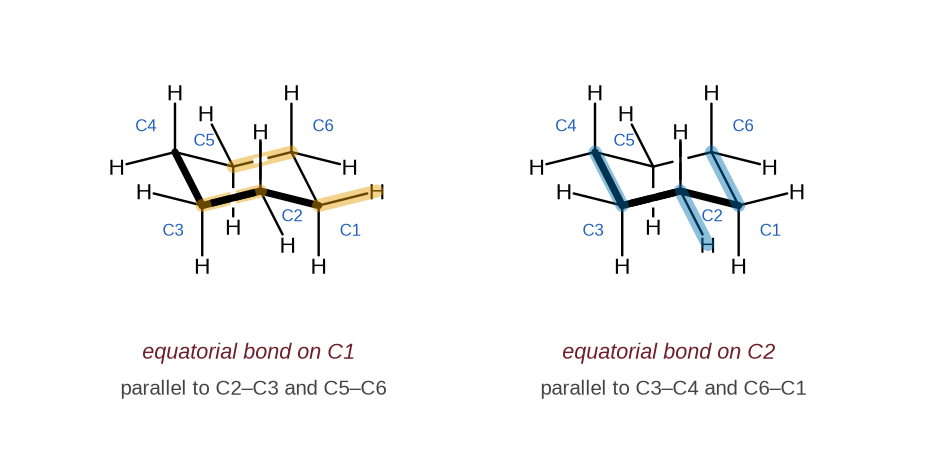
If you remember one thing from the drawing, remember this: the drawing is a perspective picture, so the three parallel directions are what make it look like a chair. Draw the lines parallel, and the ring takes care of the rest.
What the chair does when it flips
The chair can also turn itself inside out, the ring flip of Figure 4. Every axial position becomes equatorial and every equatorial position becomes axial. A group that was up stays up and a group that was down stays down; the only thing that changes is how it sits on the ring.
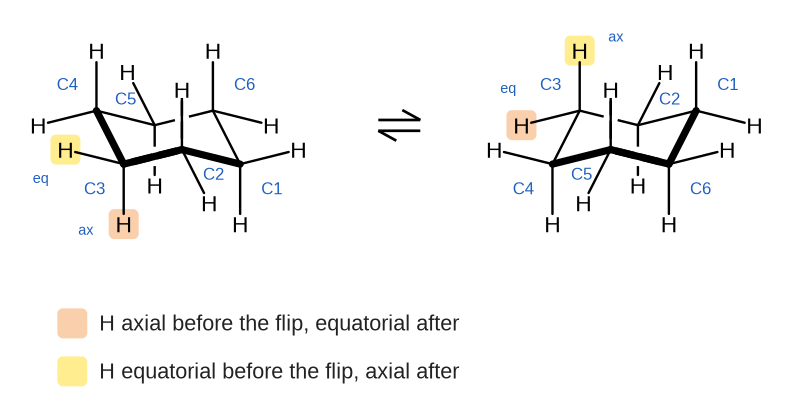
In plain cyclohexane the two chairs are identical, so the flip changes nothing you could measure. It starts to matter the moment a carbon carries something bigger than H, which is the subject of the pages on the ring flip and on disubstituted cyclohexanes.
Axial and equatorial. Axial: vertical, alternately up and down. Equatorial: out around the equator, parallel to two ring bonds, on the opposite side of the ring from the axial bond of the same carbon. The ring flip swaps the two kinds of position on every carbon.
Watch out. Up and down tell you which face of the ring a group is on. Axial and equatorial tell you how it sits on one particular chair. A group that is up is axial on one carbon and equatorial on the next, and a ring flip swaps its seat without changing its face.
More from Structure
What is the difference between configuration and conformation?
Two words that look like twins and are not. One test tells configuration and conformation apart: do you have to break a bond to get from one arrangement to the other?
How do you draw a Newman projection? Newman and sawhorse, side by side
Natta, sawhorse and Newman are three drawings of the same bond. Learn to jump between them without thinking, using 2,2-dimethylbutane and butane as the worked examples.
What are staggered, eclipsed, gauche and anti? Rotation around a single bond
Turn one single bond and the energy goes up and down like a wave. Staggered, eclipsed, gauche and anti explained with ethane, butane and 2,2-dimethylbutane.
Why is tert-butyl always equatorial? A-values explained
Cyclohexane flips between two chairs, and a tert-butyl group will spend almost all its time in one of them. Axial against equatorial, the A-value, and why size is not the whole story.