
 PossieChem
Why trans-decalin cannot ring flip and cis-decalin can
Two chairs sharing a bond. Trans-decalin is locked in one shape, cis-decalin flips; a Newman projection along the shared bond shows exactly why.
- The chair, axial and equatorial
- The ring flip
- Gauche and anti (Newman projections)
Two six-membered rings that share a bond are two chairs that share a bond. Whether they are fused with the two hydrogens on the shared carbons on opposite faces or on the same face is a question of a single wedge, and the answer changes everything about how the molecule behaves. One of the two isomers is locked in a single shape. The other flips happily.
This is the perfect test of whether you really understand what the ring flip does. If every axial bond becomes equatorial and every equatorial becomes axial, then the bonds that join the two rings must turn from one kind into the other as well. That is fine for one of the isomers and impossible for the other.
Which one is locked, and what exactly makes the flip impossible?
Decalin: two chairs that share a bond
Decalin is bicyclic: ten carbons, two rings, one bond in common. Its carbons are numbered 1 to 4 round the first ring, then 4a, 5 to 8 round the second ring, and 8a. The two shared carbons, C4a and C8a, each carry one hydrogen. If those two hydrogens are on opposite faces the isomer is called trans; on the same face, cis. The next two sections take them in turn. This is a difference of configuration: the two are different compounds, and one cannot be made into the other by turning bonds.
trans-Decalin: both rings attached equatorially
Figure 1 draws trans-decalin flat and as two fused chairs. The two fusion hydrogens (orange) are on opposite faces, and in the chairs both of them point straight up and straight down: axial.
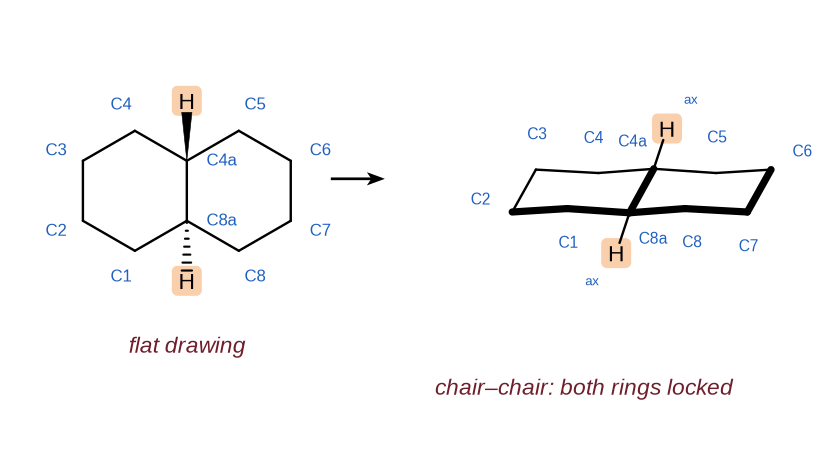
Both fusion hydrogens are axial. That means the other bonds on C4a and C8a, the ones that make up the second ring, are equatorial. So each ring is attached to the other through two equatorial bonds. There is only one chair–chair shape of this molecule.
A ring flip would turn each ring over, and those two connecting bonds would become axial on the first ring. Two axial bonds on neighbouring carbons point in opposite directions, one up and one down, exactly 180° apart. The second ring is a chain of four carbons, C5–C6–C7–C8, and it has to close across that gap. In a six-membered ring in a chair, the two ring bonds on neighbouring carbons are about 60° apart (gauche). A chain of four atoms cannot close a ring across two bonds that are 180° apart (anti). The ring would not connect. So trans-decalin cannot flip, and both rings are locked.
Figure 2 shows the same thing looking down the C4a–C8a bond: C4a is the front carbon, C8a the one behind it, and the two bonds of the second ring are drawn orange.
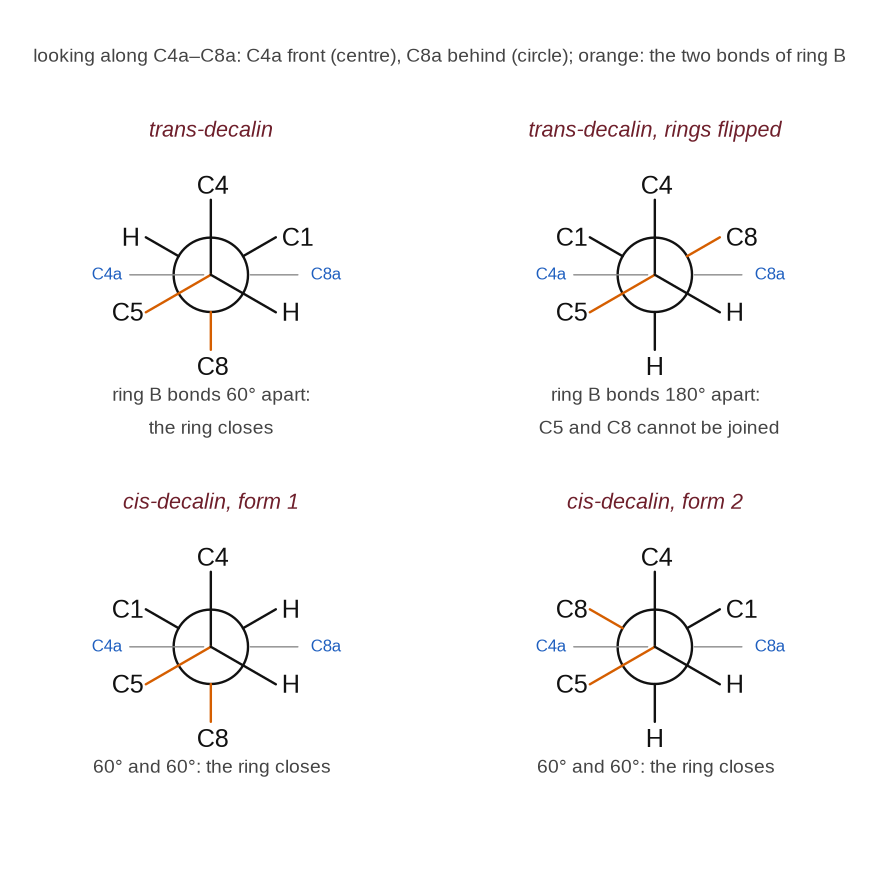
In the top left, trans-decalin as it exists, C5 and C8 are 60° apart and the ring closes. In the top right, after a hypothetical flip, they would be 180° apart, and the chain C5–C6–C7–C8 cannot reach.
The locked isomer is also the more stable one, by roughly 11 kJ/mol; the reason is in the section on cis-decalin below.
cis-Decalin: one axial, one equatorial bond
In cis-decalin (Figure 3) the two fusion hydrogens are on the same face. Now each ring is attached to the other through one axial and one equatorial bond, and the flip does not break anything.
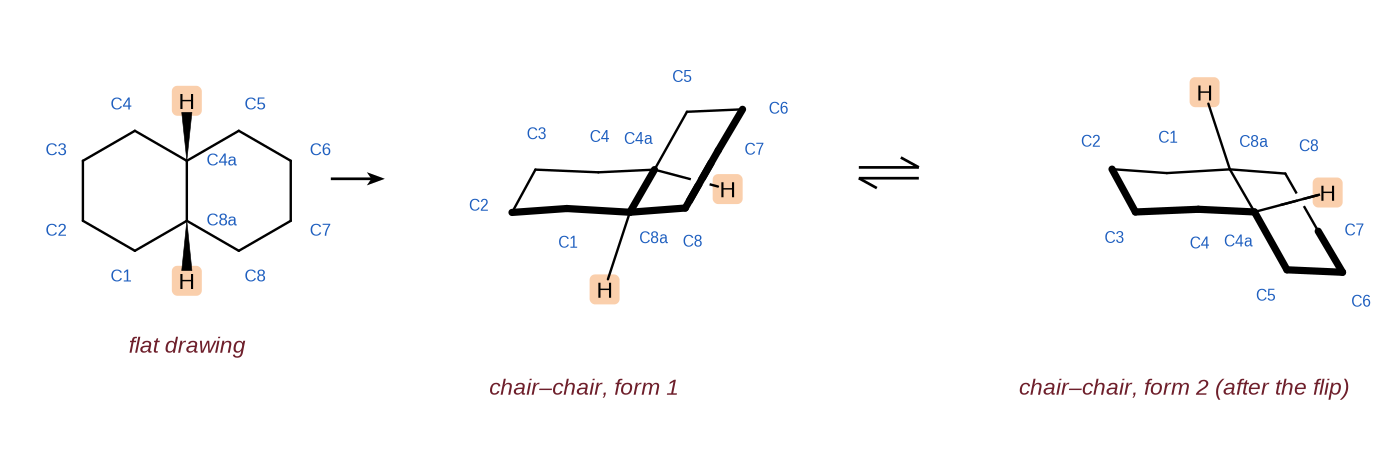
The Newman projections along C4a–C8a (Figure 2, bottom) show why: in both forms of cis-decalin each ring bond sits 60° from its partner on the next carbon, so both rings can close, before and after the flip. Both rings flip together and give the other, equally good, chair–chair shape. The barrier is roughly 50 kJ/mol, so at room temperature it is crossed thousands of times per second.
But cis-decalin is never as comfortable as trans. In either shape one bond of each ring is axial on the other ring, and that adds three gauche interactions (two groups on neighbouring carbons 60° apart, about 3.8 kJ/mol each) that trans-decalin does not have. Three times 3.8 is roughly the 11 kJ/mol by which trans is more stable.
Why this matters outside decalin
The same logic applies to every pair of fused saturated six-membered rings. Trans-fused rings are rigid and cis-fused rings can flip. It is the reason a steroid skeleton whose rings are trans-fused is a rigid, nearly flat slab: its shape is built into the skeleton and not left to a ring flip.
Locked or not? Look at the two connecting bonds on the shared carbons. Trans: both equatorial on each ring, a flip would make them both axial (180° apart, impossible for a four-carbon chain), so it cannot flip. Cis: one axial and one equatorial on each ring, both flipped forms close (60° and 60°), so it can.
Watch out. "Cannot flip" does not mean frozen solid. The molecule still vibrates and bends. What it cannot do is turn its chair–chair shape into a different chair–chair shape, because the rings would not stay joined. And cis and trans are different compounds, not two conformations of one.
More from Structure
What is the difference between configuration and conformation?
Two words that look like twins and are not. One test tells configuration and conformation apart: do you have to break a bond to get from one arrangement to the other?
How do you draw a Newman projection? Newman and sawhorse, side by side
Natta, sawhorse and Newman are three drawings of the same bond. Learn to jump between them without thinking, using 2,2-dimethylbutane and butane as the worked examples.
What are staggered, eclipsed, gauche and anti? Rotation around a single bond
Turn one single bond and the energy goes up and down like a wave. Staggered, eclipsed, gauche and anti explained with ethane, butane and 2,2-dimethylbutane.
Why is tert-butyl always equatorial? A-values explained
Cyclohexane flips between two chairs, and a tert-butyl group will spend almost all its time in one of them. Axial against equatorial, the A-value, and why size is not the whole story.