
 PossieChem
What is a cyclohexane ring flip? The energy hill and A-values
How a chair turns into the other chair, why it happens 100,000 times a second, and how the A-value of a substituent tells you which chair wins.
- The chair, axial and equatorial positions
- Gauche and anti
- The idea of an equilibrium constant, K = e^(−ΔG/RT)
A six-membered ring of sp³ carbons does not sit still. It turns itself inside out about a hundred thousand times per second at room temperature, and every position that was axial becomes equatorial while it does. In the plain ring that changes nothing you could ever measure, because both shapes are identical.
Put one substituent on the ring and the two shapes stop being the same. One of them is a little more comfortable than the other, the ring spends more of its time there, and how much more is a number you can look up: the A-value of the group. A small number means the ring hardly cares, a big one means it almost never leaves one chair.
How does the ring get from one chair to the other, why is the road so easy, and how do you turn an A-value into a percentage of molecules?
The road from chair to chair
The ring cannot flip in one move. It has to pass through shapes that are more strained than the chair. Figure 1 is the flip of cyclohexane itself, the two hydrogens on C3 coloured so that you can follow them: the orange one starts axial and ends equatorial.
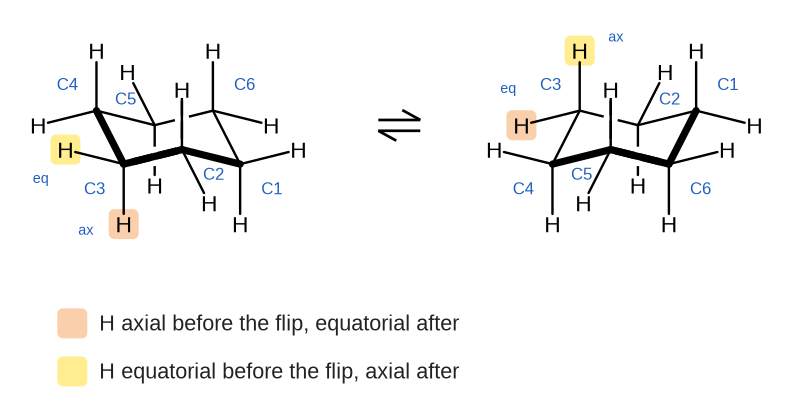
On the way, one end of the ring flattens into a half-chair, which is the top of the hill: about 45 kJ/mol above the chair. Then the ring relaxes into a twist-boat, about 23 kJ/mol above the chair, passes over a small bump (the boat, about 30 kJ/mol, with the two carbons at its ends pointing at each other) into a second twist-boat, and then goes through a second half-chair to the other chair. Figure 2 draws the whole road.
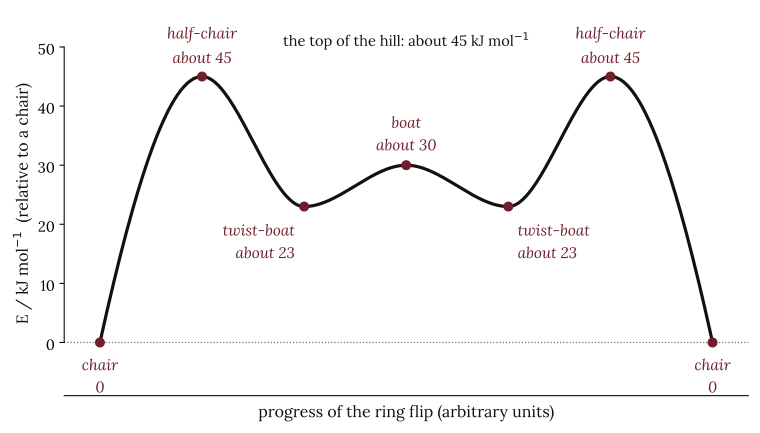
A hill of 45 kJ/mol is low enough to be climbed about 10⁵ times a second at 25 °C. It is also high enough that if you cool the sample to around −100 °C, the flip slows down so much that a spectrometer can see the axial and the equatorial hydrogens separately. The ring is not rigid; it is only quick.
What a substituent changes
Replace one hydrogen by a methyl group. Methylcyclohexane now has two chairs that are no longer equal (Figure 3): in one the CH₃ is equatorial on C1, in the other it is axial.
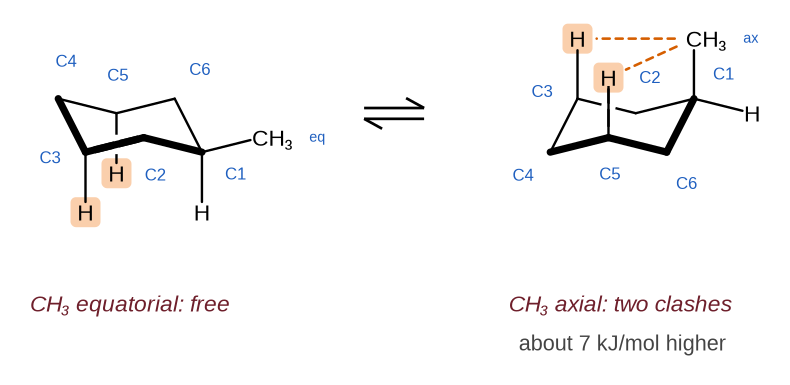
An equatorial group points away from the ring into open space. An axial group points straight up (or straight down), parallel to the other axial bonds on that face of the ring, here on C3 and C5, two carbons further round. An axial methyl sits only about 2.5 Å from the axial H on C3 and the axial H on C5: a 1,3-diaxial interaction. Each of the two costs about 3.5 to 4 kJ/mol, the same price as a gauche arrangement of two groups on neighbouring carbons (two groups 60° apart: here the CH₃ and a ring carbon), so two of them make about 7 kJ/mol.
That number has a name. The A-value of a group is how far the chair with the group axial sits above the chair with the group equatorial, for that group on cyclohexane:
For methyl, A is about 7 kJ/mol.
From an A-value to a percentage of molecules
The two chairs are in equilibrium, and the ratio follows from the energy difference:
Here is the gas constant, the temperature in kelvin and the Gibbs free energy; at 298 K, kJ/mol. For methyl, : roughly 94 % of the molecules have the methyl equatorial and 6 % axial. A bigger A-value squeezes the minority away fast, as the table shows.
| A / kJ mol⁻¹ | K at 298 K | equatorial chair |
|---|---|---|
| 2 | 2.2 | 69 % |
| 4 | 5.0 | 83 % |
| 7 | 17 | 94 % |
| 12 | 127 | 99.2 % |
| 20 | 3200 | 99.97 % |
A-values of the common groups
Figure 4 lists six groups, each drawn axial on C1 of a chair, with a bar as long as its A-value: chlorocyclohexane, bromocyclohexane, cyclohexanol, methylcyclohexane, phenylcyclohexane and tert-butylcyclohexane.
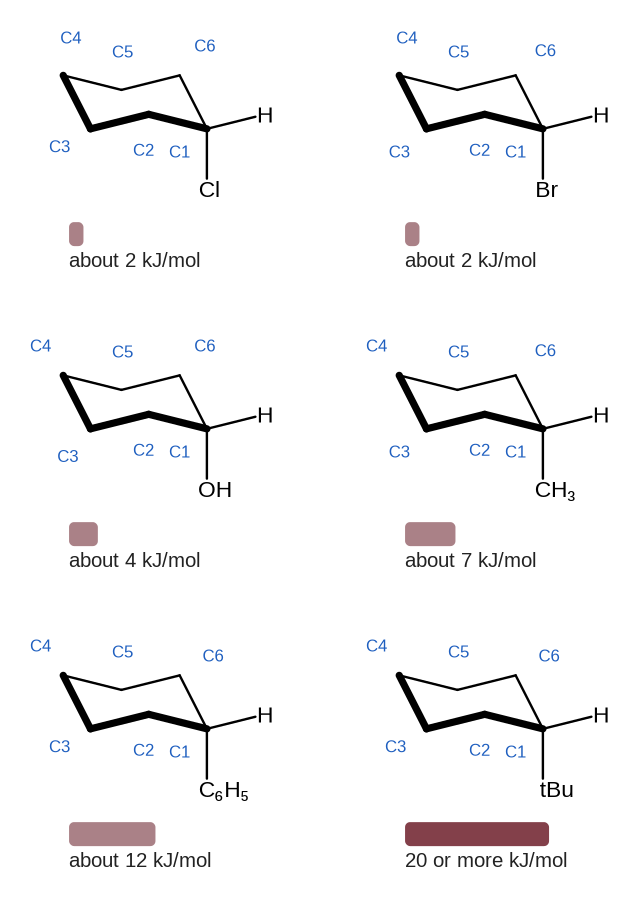
Two things are worth seeing in that ladder. The halogens are small even though the atoms are big: the long C–Cl and C–Br bond holds the halogen further from the axial hydrogens than a methyl, so size is not the whole story. And tert-butyl is off the end of the scale: with A at 20 kJ/mol or more, fewer than one molecule in 3000 has it axial, so the ring is effectively locked in the chair where it is equatorial, and a group like that is used as an anchor.
Ring flip. Chair → half-chair (45 kJ/mol) → twist-boat → boat → twist-boat → half-chair → the other chair. The A-value of a group is the energy of the axial chair minus the energy of the equatorial chair, and turns it into a ratio of chairs.
Watch out. A large A-value does not stop the ring from flipping: the half-chair still sits at about 45 kJ/mol. It only makes the axial chair so rare that you rarely meet it. The molecule keeps flipping; it just spends almost none of its time in the unfavourable chair.
More from Structure
What is the difference between configuration and conformation?
Two words that look like twins and are not. One test tells configuration and conformation apart: do you have to break a bond to get from one arrangement to the other?
How do you draw a Newman projection? Newman and sawhorse, side by side
Natta, sawhorse and Newman are three drawings of the same bond. Learn to jump between them without thinking, using 2,2-dimethylbutane and butane as the worked examples.
What are staggered, eclipsed, gauche and anti? Rotation around a single bond
Turn one single bond and the energy goes up and down like a wave. Staggered, eclipsed, gauche and anti explained with ethane, butane and 2,2-dimethylbutane.
Why is tert-butyl always equatorial? A-values explained
Cyclohexane flips between two chairs, and a tert-butyl group will spend almost all its time in one of them. Axial against equatorial, the A-value, and why size is not the whole story.