
 PossieChem
How do you assign E and Z? Naming double bonds when cis and trans run out
Cis and trans work until each carbon of a double bond has more than one interesting group. Then you rank the groups with the CIP rules: same side is Z, opposite is E.
- Cis and trans on a double bond
- The CIP priority rules (atomic number first, then go outward)
- Diastereomers
The atoms on a C=C cannot turn around it: twisting would break the π bond. So two groups can be on the same side of a double bond or on opposite sides, and that makes two different molecules with different shapes, different boiling points and often a very different smell.
You already name this with cis and trans. It works nicely as long as each carbon has one obvious group. Give each carbon several different groups and "cis to what?" has no answer, so the chemists who needed one went and borrowed the CIP (Cahn–Ingold–Prelog) priority rules from the stereocentres. The result is two letters, E and Z, and one rule you can apply to any double bond that has two different groups on each end.
What is the rule, and what do the letters stand for?
The rule in three moves
- Split the double bond into its two ends. Treat each carbon separately.
- At each end, rank the two groups as 1 and 2 with the CIP rules (higher atomic number wins; a tie is settled by going one step further out).
- Compare the two number 1 groups. If they are on the same side of the double bond, it is Z, from the German zusammen, together. If they are on opposite sides, it is E, from entgegen, opposite.
The letter goes in front of the name in brackets: (E)- or (Z)-. A helpful way to keep them apart: Z is "zame zide", the two number 1 groups on the zame zide.
Figure 1 applies the rule to the two stereoisomers of penta-1,3-diene around the C3=C4 bond.
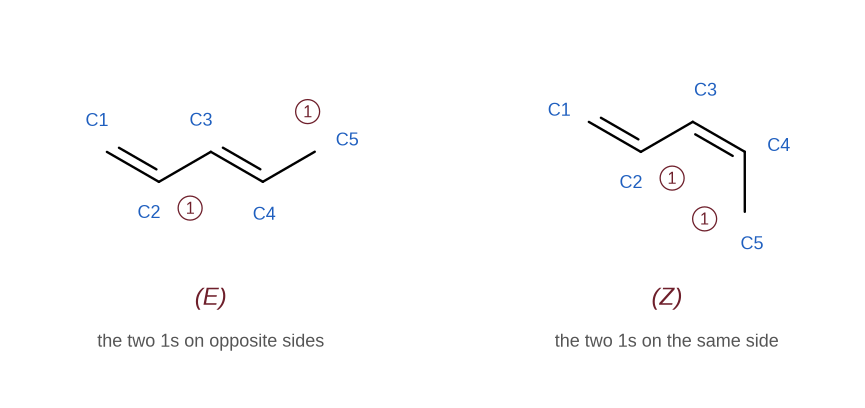
At C3 the groups are the carbon C2 and a hydrogen, so C2 is 1. At C4 they are the carbon C5 and a hydrogen, so C5 is 1. In the left isomer C2 and C5 are on opposite sides: E. In the right one they are on the same side: Z.
The terminal double bond C1=C2 has two hydrogens on C1, so it has no E and Z form at all. A double bond needs two different groups on each of its carbons before it can be labelled.
When cis and trans cannot answer
Now give each carbon two different groups and ask which isomer is "cis". Figure 2 shows 1-bromo-1-chloroprop-1-ene, which has a bromine and a chlorine on C1 and a methyl group and a hydrogen on C2.
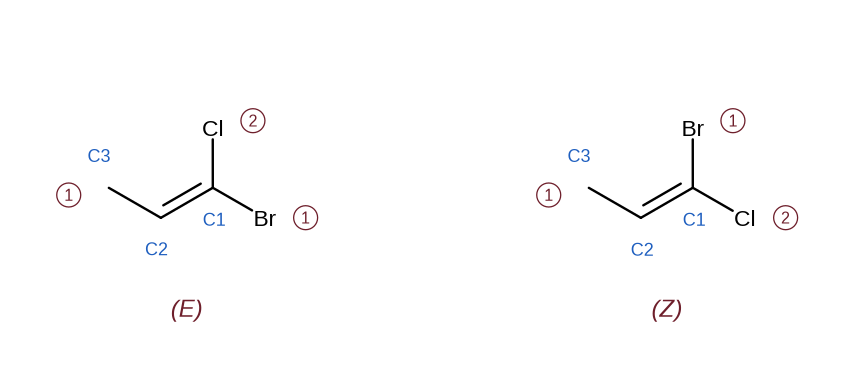
On C1, bromine (atomic number 35) beats chlorine (17), so Br is 1. On C2 the methyl carbon beats the hydrogen, so C3 is 1. The Br and the CH₃ are on opposite sides in the left-hand drawing: E. On the same side in the right-hand one: Z.
Try to say the same thing with cis and trans and you get stuck: cis to the bromine or to the chlorine? The CIP rules give an answer that depends only on the structure, with no judgement call.
Z is not always "cis", and E is not always "trans". The letters compare the two number 1 groups, which are not always the ones you would pick by eye. Swap one group for another that ranks differently and the label can change while the atoms stay where they are in space.
A longer example: geraniol and nerol
When a double bond sits in a longer chain, the ranking sometimes needs the tie-break "go one step further out". Figure 3 shows two rose-scented alcohols from essential oils, geraniol and nerol: the same constitution, 3,7-dimethylocta-2,6-dien-1-ol, with the first double bond arranged differently.
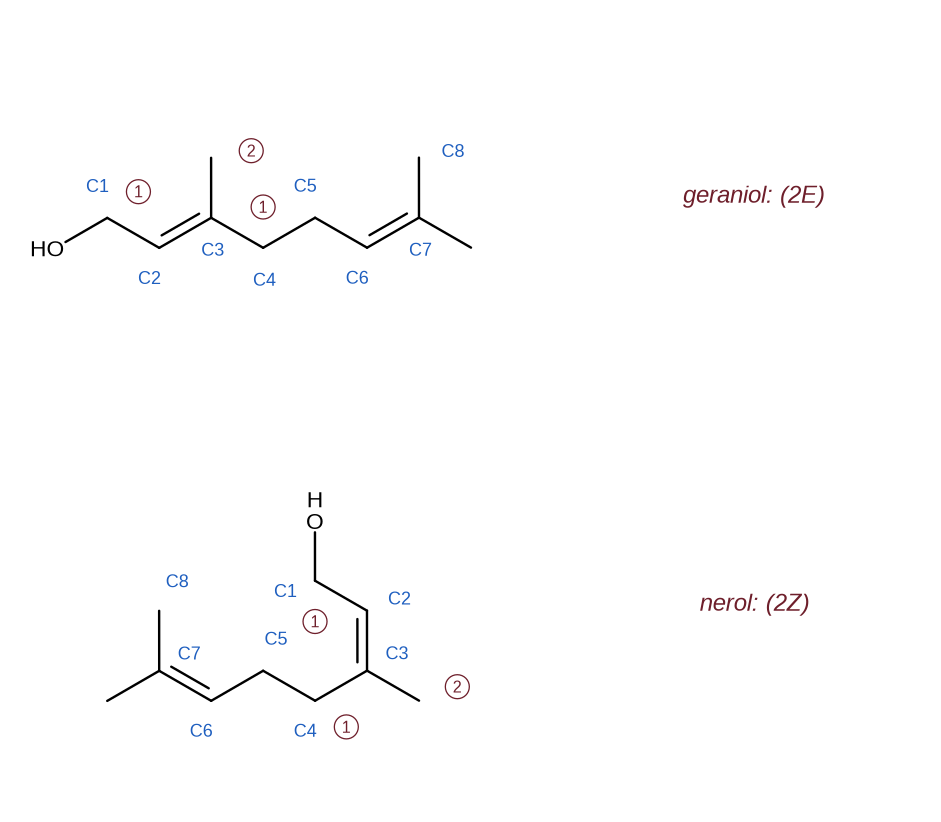
At C2 the groups are C1 and a hydrogen, so C1 is 1. At C3 they are the methyl group and C4. Both are carbons, a tie at the first step, so look one step further out: C4 carries (C, H, H) and the methyl group (H, H, H). C4 wins, so C4 is 1 and the methyl group is 2. In geraniol C1 and C4 are on opposite sides: (2E). In nerol they are on the same side: (2Z). The 2 in the label says which double bond it is about.
The other double bond, C6=C7, has two methyl groups on C7, which cannot be told apart, so it has no E or Z. Only the C2=C3 bond gets a label.
What E and Z are, in the bigger picture
E and Z isomers are not mirror images of each other, so they are diastereomers with different physical properties, and the same goes for cis and trans on a ring. The rule is not limited to C=C: the C=N bond of an imine can be E or Z in the same way, with the lone pair on nitrogen counting as the lowest priority group.
Whatever the origin of the stereoisomerism (a centre, an axis, a ring, a double bond), the question to ask first is the same: are the two molecules mirror images of each other, or not?
More from Structure
What makes a molecule chiral? Stereocentres and mirror images
Your hands are identical and still do not fit on top of each other. Molecules can do the same trick: four different groups on one carbon, and a mirror.
How do you assign R and S? The CIP rules step by step
Rank the four groups, put the lowest at the back, read 1, 2, 3. The CIP rules for R and S, worked out on three real molecules.
What is enantiomeric excess? Optical rotation and what the numbers mean
A bottle says 98 % ee, a polarimeter says −36.6 degrees. How the two are linked, how to get one from the other, and why the sign has nothing to do with R and S.
How do you read a Fischer projection? Turn it and get R or S
A cross with a rule: horizontal bonds come towards you, vertical ones go away. How to read a Fischer projection, which moves keep the molecule and which flip it, and why D and L are not R and S.