
 PossieChem
What is a meso compound? Why two stereocentres give three isomers
Two stereocentres should give four stereoisomers, and butane-2,3-diol has only three. The missing one is its own mirror image: meso, diastereomers and the 2^n rule with its exception.
- Stereocentres and enantiomers
- R and S labels
- A mirror plane (a symmetry plane that makes a molecule its own mirror image)
One stereocentre gives two stereoisomers, an enantiomer pair. Two stereocentres should give 2 × 2 = 4. Three should give 8, four 16, and so on, doubling every time you add a centre. It is the most reliable multiplication in organic chemistry, and it comes with a footnote that trips up more people than almost anything else.
Draw all four stereoisomers of a four-carbon chain with an OH on each of the two middle carbons and you will find that two of the four drawings are the same molecule. Not similar: the same. The molecule has two stereocentres and is not chiral, and it does not rotate polarised light.
How can a molecule have stereocentres and still be its own mirror image?
The count that comes out one short
Every stereocentre can be set in two ways, so a molecule with n stereocentres has at most 2ⁿ stereoisomers. The words at most are there for a reason, and Figure 1 shows it for butane-2,3-diol.
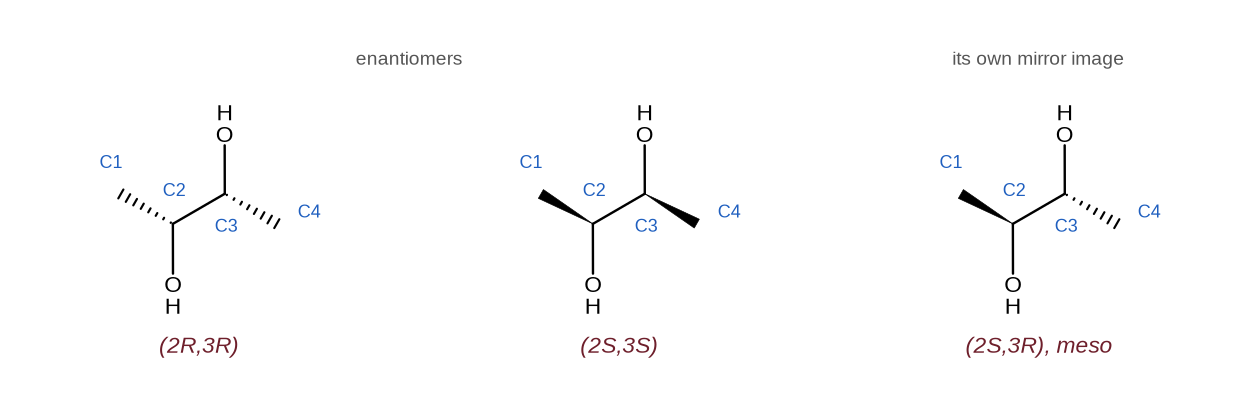
Two stereocentres should give four isomers, but this molecule has three. The left and middle drawings are mirror images of each other, a pair of enantiomers. The right-hand drawing has an R at one centre and an S at the other, and the two halves of the molecule are exact mirror images of each other, so the whole molecule is its own mirror image. A molecule like that is meso. It has two stereocentres and is not chiral. The fourth isomer, (2R,3S), would be the mirror image of (2S,3R), but they are the same molecule, which is why it is missing.
How to spot a meso compound
A meso compound is always a symmetrical molecule. Its two halves are mirror images of each other: C2 and C3 of butane-2,3-diol carry the same groups (a methyl group, an OH and a hydrogen), but with opposite handedness, so an internal mirror plane runs between them and cancels the handedness. For a molecule with two stereocentres the quickest test is therefore:
- Do the stereocentres have identical sets of groups, so that a mirror plane could swap them?
- Do they have opposite labels, R at one and S at the other?
If both answers are yes, it is meso. If the labels are the same (R,R or S,S), the mirror plane is missing and the molecule is chiral. In a Fischer projection it is even easier to see, as Figure 2 shows.
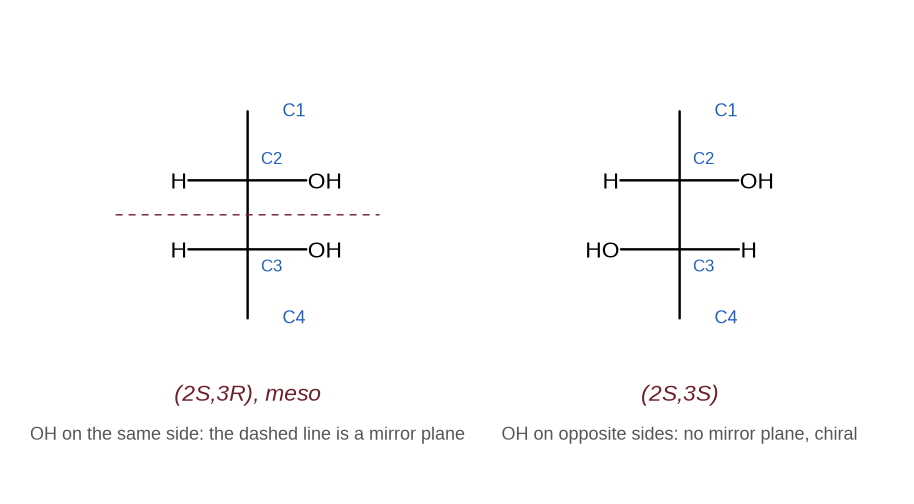
With both OH groups on the same side, the top half of the cross is the reflection of the bottom half. Put one OH on each side and the symmetry is gone.
Stereocentres do not guarantee chirality. A molecule is chiral when it cannot be laid on its mirror image. A meso compound has stereocentres and a mirror plane, so it is not. It does not rotate polarised light, and it cannot be resolved into enantiomers.
Enantiomers and diastereomers
The meso compound is related to the other two in a different way from how they are related to each other. Two stereoisomers that are mirror images of each other are enantiomers. Two stereoisomers that are not mirror images of each other are diastereomers. The meso compound is a diastereomer of both the (2R,3R) and the (2S,3S) form.
Enantiomers or diastereomers? Enantiomers: mirror images, every stereocentre inverted. Diastereomers: stereoisomers that are not mirror images, so at least one centre is the same and at least one is different. With n stereocentres there are at most 2ⁿ stereoisomers; symmetry, as in a meso compound, reduces the number.
The difference matters in the lab. Enantiomers have identical melting points, boiling points and solubilities (in an achiral solvent), but diastereomers have different ones, so they can be separated by ordinary methods such as crystallisation and chromatography. The meso diol and the (2R,3R) diol are two different substances with two different melting points.
Rings: cis, trans and four isomers
A ring behaves in the same way, with one extra twist: the groups on the ring can be on the same face (cis) or on opposite faces (trans), the cis and trans you know from rings. Figure 3 shows 2-methylcyclobutan-1-ol, with an OH on C1 and a methyl group on C2.
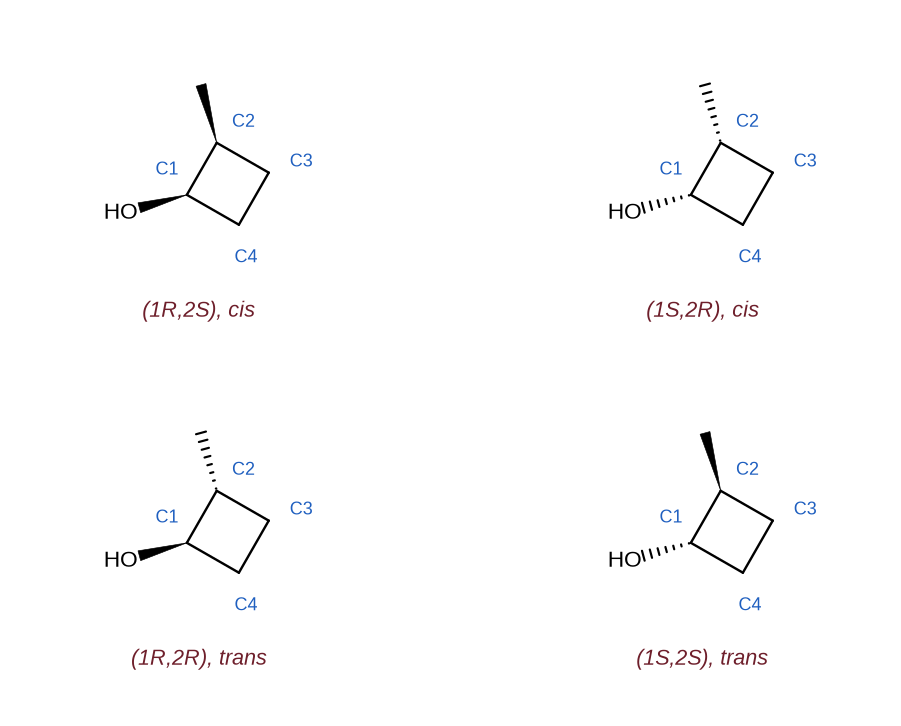
Both ring carbons C1 and C2 are stereocentres and this time there is no symmetry (the two have different groups), so all 2² = 4 isomers exist. They fall into two pairs of enantiomers: the cis pair on top, the trans pair below. Each cis isomer is a diastereomer of each trans isomer. Notice that cis and trans do not translate into R and S in a simple way. Here cis is (1R,2S) or (1S,2R) and trans is (1R,2R) or (1S,2S), but that comes from the priorities in this particular molecule; with other groups it can be the other way round. You have to work it out each time.
Counting without drawing everything
For a molecule with several stereocentres, the recipe is: start with 2ⁿ, then look for symmetry. If the molecule is symmetrical, so that the centres come in matching pairs, some of the combinations are the same molecule seen from the other end, and the ones with opposite labels on the matching centres are meso. For two matching stereocentres that gives 2² = 4 combinations, two of which are the same meso molecule: three stereoisomers. Without symmetry, as in the cyclobutanol, normally all 2ⁿ exist.
More from Structure
What makes a molecule chiral? Stereocentres and mirror images
Your hands are identical and still do not fit on top of each other. Molecules can do the same trick: four different groups on one carbon, and a mirror.
How do you assign R and S? The CIP rules step by step
Rank the four groups, put the lowest at the back, read 1, 2, 3. The CIP rules for R and S, worked out on three real molecules.
What is enantiomeric excess? Optical rotation and what the numbers mean
A bottle says 98 % ee, a polarimeter says −36.6 degrees. How the two are linked, how to get one from the other, and why the sign has nothing to do with R and S.
How do you read a Fischer projection? Turn it and get R or S
A cross with a rule: horizontal bonds come towards you, vertical ones go away. How to read a Fischer projection, which moves keep the molecule and which flip it, and why D and L are not R and S.