
 PossieChem
Why is aniline a weaker base than methylamine? Amines and heterocycles
Four nitrogens, four lone pairs, pKa values of 10.6, 7.0, 5.2 and 4.6. Why do they differ by a factor of a million?
- What a pKa means (a small pKa is a strong acid)
- Resonance and curly arrows
- Lone pairs and formal charge
- Hybridisation and s character (sp3, sp2)
All four nitrogens in Figure 1 have a lone pair, and a lone pair is what a base needs to pick up a proton. If basicity were only about having a lone pair, the four would be the same. They are not: in water they differ by a factor of about a million between the best and the worst.
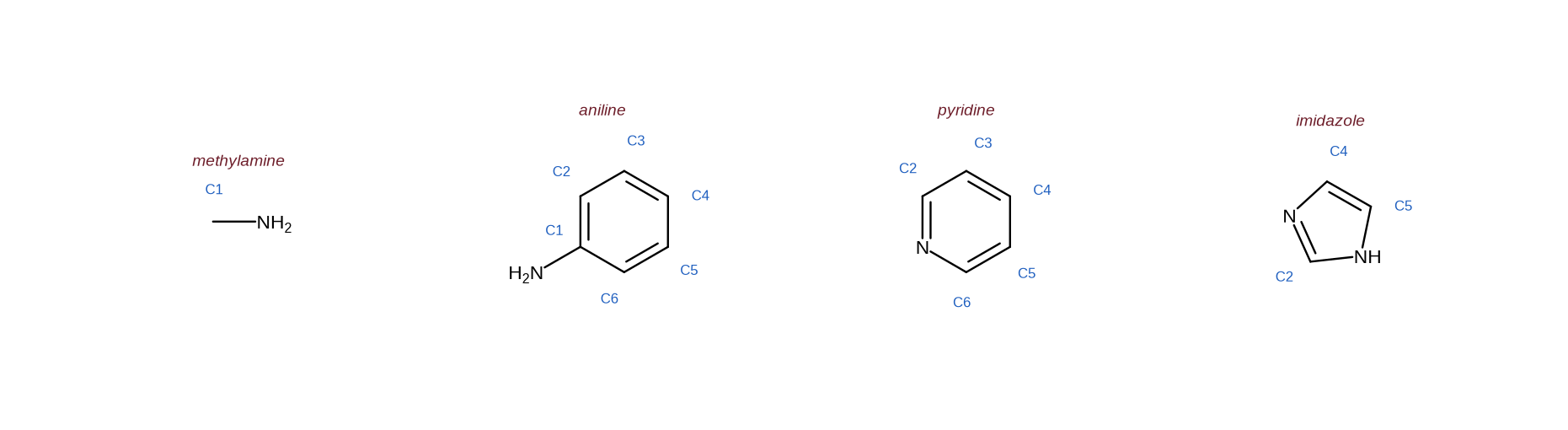
The way to measure how basic a nitrogen is: protonate it and ask how readily the ion lets go of the proton again. The pKa of the conjugate acid, the protonated amine, is the number. A high pKa means a strong base. So what makes the other three weaker than methylamine?
Step 1: how the base takes the proton
Figure 2 shows the mechanism for methylamine with the hydronium ion. Arrow 1: the nitrogen lone pair forms a bond to a hydrogen of hydronium. Arrow 2: the O–H bond becomes a lone pair on oxygen. The products are the methylammonium ion and water. Every amine and every heterocycle in this page does exactly this; what changes is how willing the lone pair is.
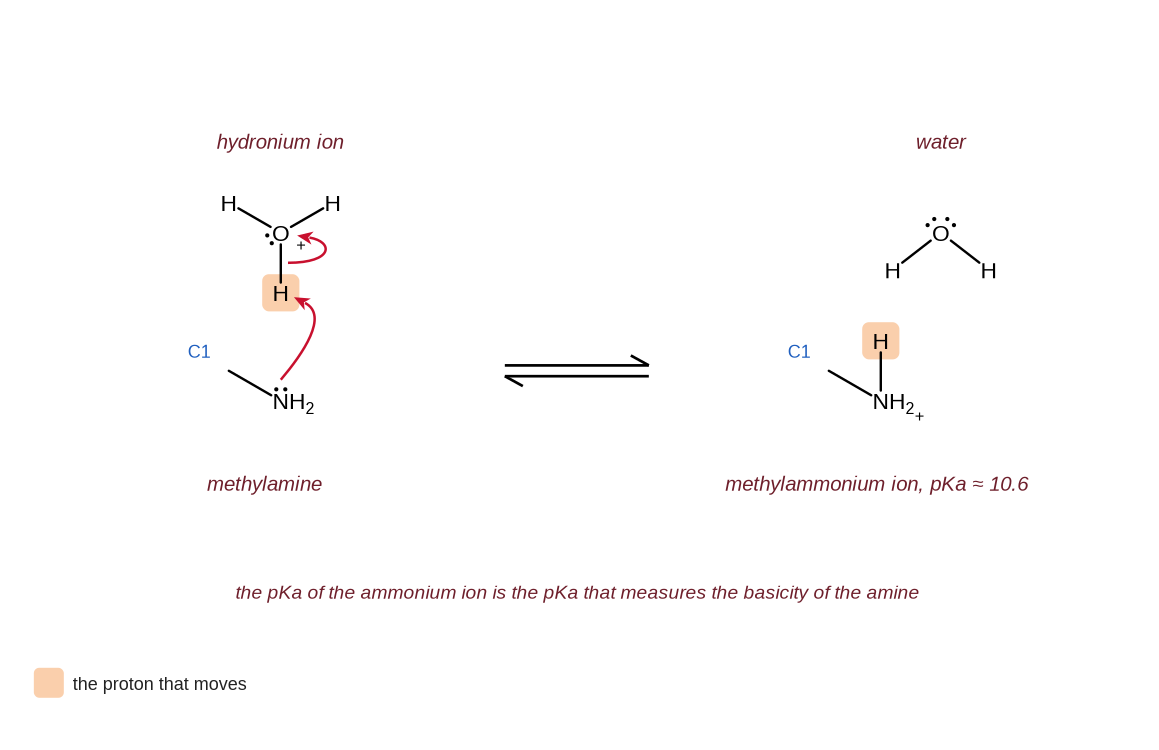
Step 2: the four conjugate acids, side by side
Figure 3 puts the four conjugate acids together. The orange N–H is the one that is lost, and the pKa is what ranks the bases: methylamine 10.6, imidazole 7.0, pyridine 5.2, aniline 4.6. For a base, use the pKa of the protonated form, and not that of the N–H of the neutral amine itself (about 35), which is a hopeless acid.
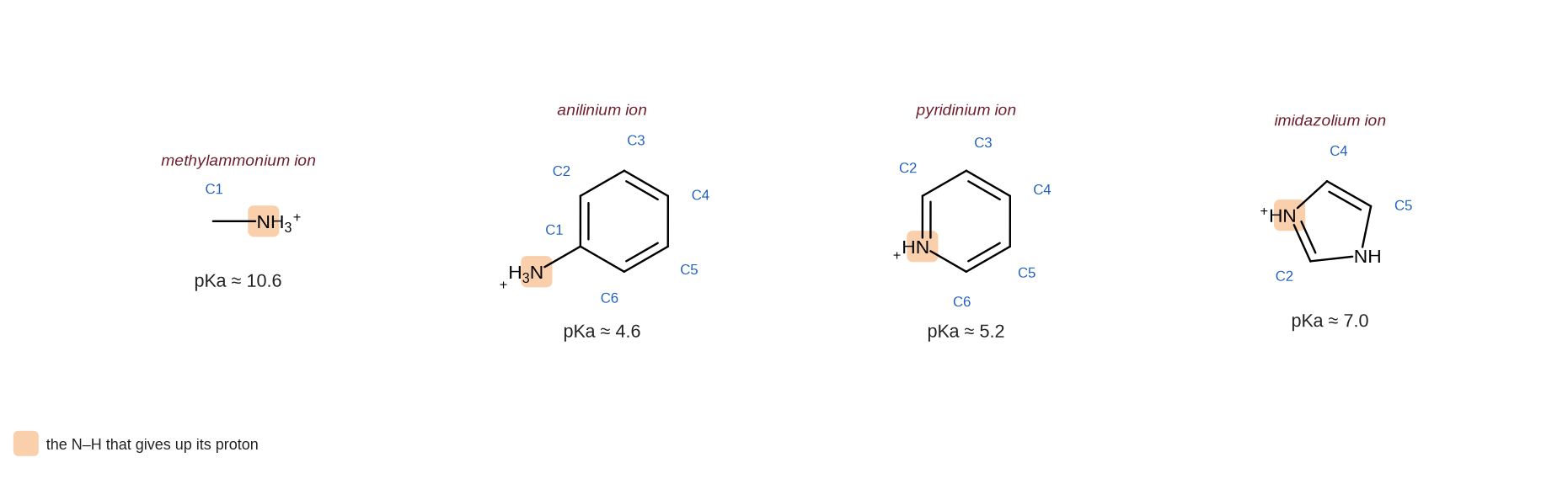
An alkylamine is the standard. The lone pair sits on the nitrogen, ready, and the alkyl group pushes electrons towards it. The other three have a reason to be weaker or, in one case, a trick to be better than expected.
Step 3: aniline, whose lone pair is busy
In aniline the nitrogen lone pair is not free. Figure 4 shows why. Arrow 1: the lone pair on nitrogen forms an N=C1 double bond. Arrow 2: the C1=C2 π bond moves onto C2 as a lone pair. The nitrogen now carries a positive charge and C2 a negative one. The real aniline is partly like this: the lone pair is spread into the ring, at C2, C4 and C6.
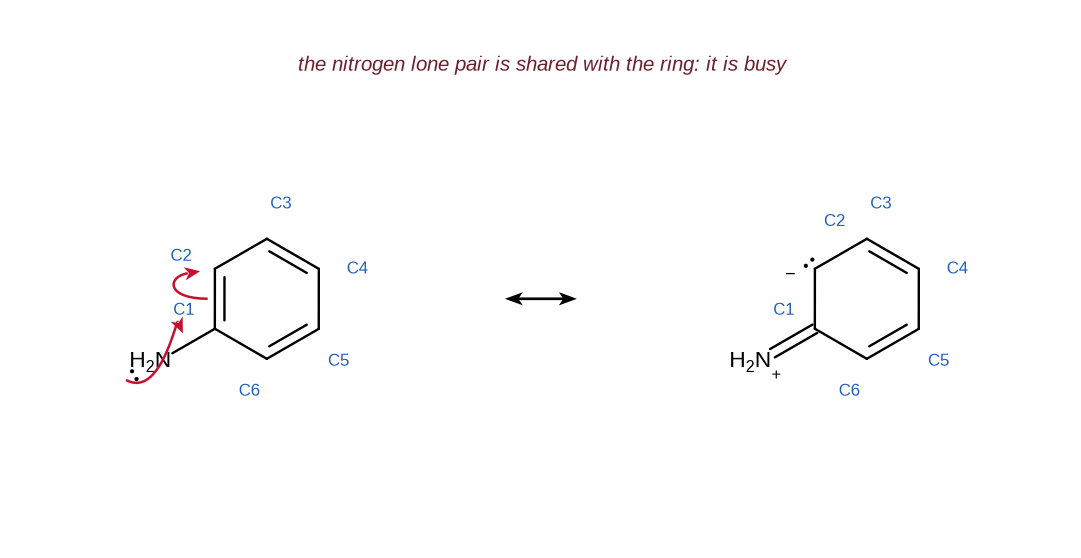
To take a proton, the nitrogen has to give that pair to the hydrogen, and it prefers to keep it in the ring. So aniline (the anilinium ion has a pKa of 4.6) is a base that is a million times weaker than methylamine.
Step 4: pyridine, and a lone pair held tight
In pyridine the nitrogen is part of an aromatic ring, but its lone pair lies in the plane of the ring, at right angles to the π system. It is not part of the aromatic sextet, so it is free to take a proton, and the ring stays aromatic afterwards. Pyridine is still a weaker base than methylamine (5.2 against 10.6) because that lone pair sits in an sp² orbital. An sp² orbital has more s character than an sp³ orbital, the same reasoning as for the C–H of an alkyne, and an s-rich lone pair is held more tightly, so it is less eager to leave.
Step 5: imidazole, a ring base that does better
Imidazole has two nitrogens. The one without a hydrogen is the pyridine-type nitrogen, with a lone pair in the plane of the ring, and that is the one that takes the proton. The ion that forms (Figure 5) is special: the positive charge is shared. Arrow 1: the lone pair on the nitrogen that does not carry the + in the first drawing forms a double bond to C2. Arrow 2: the C2=N π bond moves onto the other nitrogen as a lone pair. The result is the same ion, drawn the other way round.
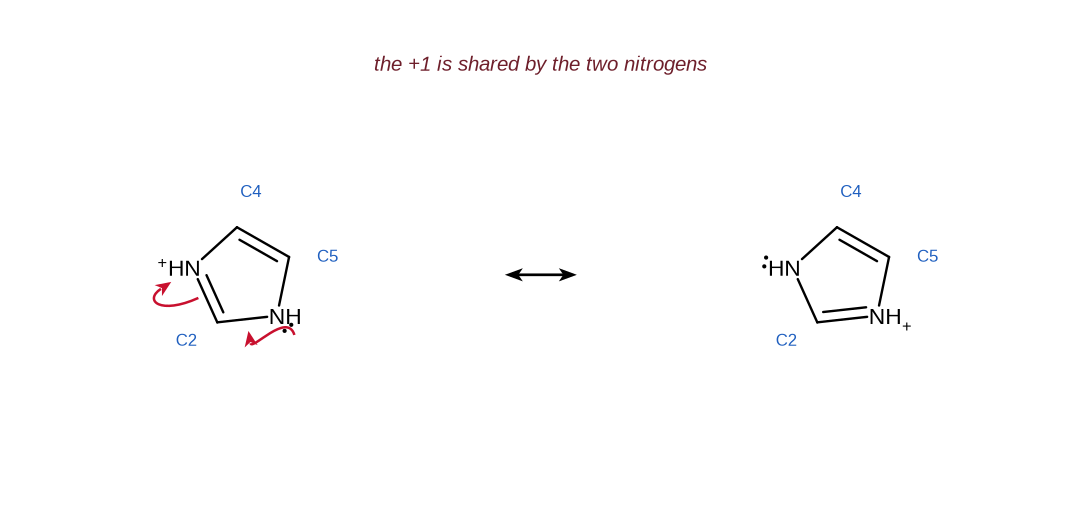
A cation whose charge is spread over two atoms is more stable than one with the charge on one, and a more stable conjugate acid means a stronger base: 7.0 for imidazole against 5.2 for pyridine. The effect is the mirror of the carboxylate story, a charge shared between two equivalent atoms.
Key idea. Basicity is the pKa of the conjugate acid: methylamine 10.6, imidazole 7.0, pyridine 5.2, aniline 4.6. A lone pair that is busy in a π system (aniline) or held in an s-rich orbital (pyridine) is a weaker base; a cation that can share its charge (imidazolium) is a better one.
Watch out. Two pKa values belong to an amine. The N–H of the amine itself (a proton leaving a neutral amine, about 35) is a hopeless acid. The N–H of its protonated form (about 11 for an alkylamine) is a decent weak acid. When you want to know how basic an amine is, use the second.
More from Structure
What does a pKa tell you? Acid strength from one number
One small number says how hard an acid pushes its proton away, and with it you can tell which hydrogen in a molecule leaves first. Here is how to read it.
Which way does an acid–base reaction go? Predict it with pKa
Put phenol and pyridine in a flask and ask which way the proton moves. One subtraction of two pKa values gives the direction and how far it goes.
Why is acetic acid so much more acidic than ethanol?
Both lose a proton from an O–H bond, yet acetic acid is about a hundred billion times more acidic than ethanol. The reason is where the leftover charge can sit.
Why is HI a stronger acid than HF, though F is more electronegative?
Fluorine pulls electrons harder than iodine, so H–F should be the strongest of the hydrogen halides. It is the weakest. The trend turns around when you go down a group.