
 PossieChem
Why is tropone stable? A ketone with a hidden aromatic ring
Tropone is a seven-membered ring with a C=O that behaves as if it had a positive ring and a negative oxygen. One curved arrow shows why, and a six-π-electron count seals it.
- Hückel's rule (4n + 2 π electrons)
- Resonance structures and curved arrows
- The C=O group is polarised
A seven-membered ring, three C=C bonds and a C=O. It looks like a ketone, it is drawn like a ketone, and for a ketone it behaves very strangely. Its dipole moment is far bigger than it should be. Something in the ring is helping the oxygen out.
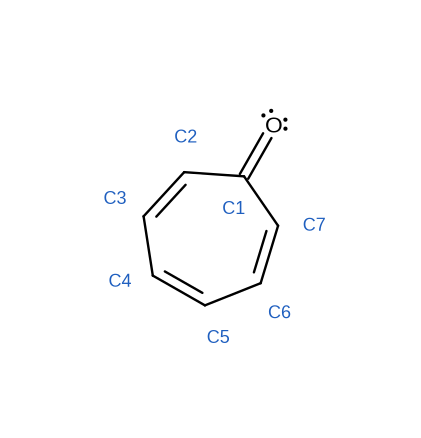
The C=O is polarised: its π electrons sit closer to the oxygen than to the carbon. A ring can take that hint, if the carbon that ends up short of electrons lands in a ring that likes a positive charge. How does tropone do that?
One arrow: push the C=O electrons onto oxygen
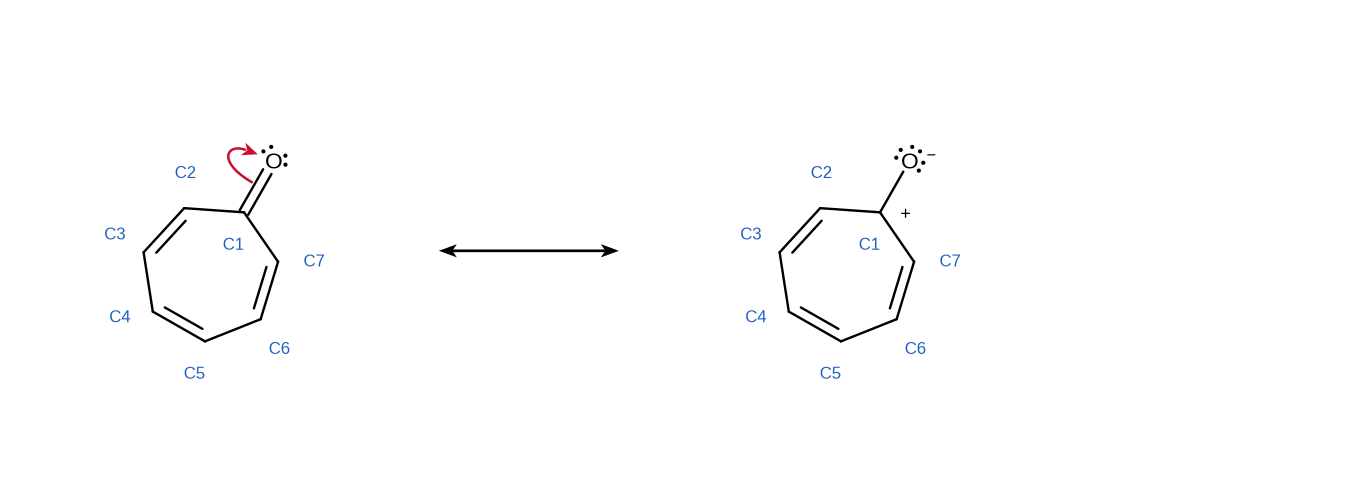
Push the π electrons of the C=O onto oxygen with one curved arrow (Figure 2). The oxygen becomes O⁻ and the carbonyl carbon C1 becomes C⁺. This is an ordinary resonance form, drawn the way you would draw any carbonyl with a positive carbon. What is unusual is what the ring looks like afterwards.
The count: six electrons over seven carbons
In the dipolar structure the ring has three C=C bonds: C2=C3, C4=C5 and C6=C7. That is six π electrons. C1 is now a carbocation with an empty p orbital, so it adds none. All seven ring carbons are sp², each has a p orbital, and the ring is planar: six electrons, with , spread over seven p orbitals. The ring in the dipolar form has exactly the π system of the cycloheptatrienyl cation (the tropylium cation), a textbook aromatic ion.
So the second form is not just another structure. It is the one that gives the ring its aromatic sextet, and for that reason it contributes a lot: tropone is stable, and the molecule has a large dipole moment (about 4 D, clearly more than the roughly 2.5 to 3 D of an ordinary ketone). Three measurements point the same way:
- a large dipole moment, with the negative end on oxygen;
- a C=O stretch at a lower wavenumber (about 1640 cm⁻¹, against about 1715 cm⁻¹ for a typical ketone), because the C=O bond has lost some double-bond character;
- a markedly higher basicity: tropone takes a proton on oxygen readily, because the product keeps the aromatic ring.
The test: the same arrow in a five-membered ring
If the aromatic sextet is what makes the dipolar form good, then a ring that would end up with the wrong number of electrons should do the opposite. Cyclopenta-2,4-dien-1-one (cyclopentadienone) is tropone's five-membered cousin, with two C=C bonds and a C=O. Push the C=O electrons onto oxygen with the same one arrow (Figure 3).
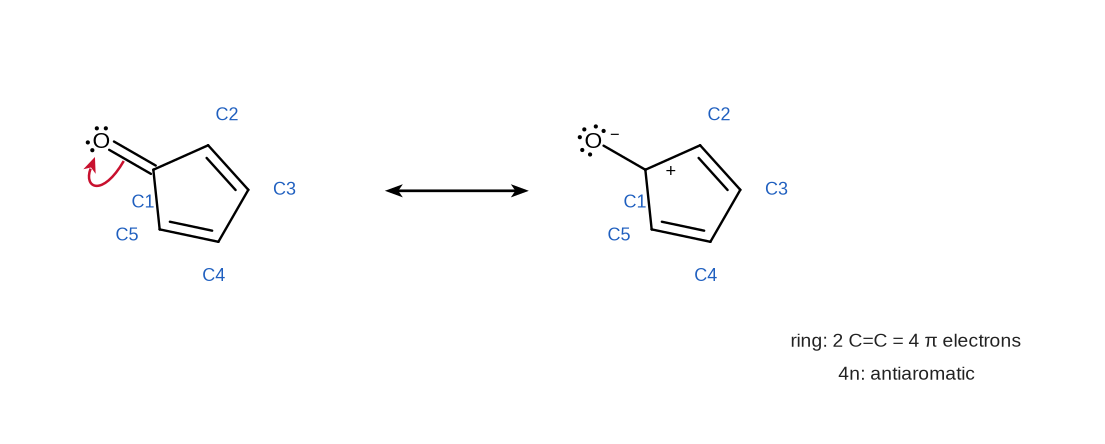
The ring now holds two C=C bonds (C2=C3 and C4=C5) and an empty p orbital on C1: four π electrons, with . A planar, fully conjugated ring with 4n electrons is antiaromatic, and unusually unstable. So here the dipolar form is a bad contributor, and cyclopentadienone gets no help from its ring. It is a highly reactive molecule, quick to dimerise, where tropone is a stable, distillable liquid.
Same arrow, opposite result. Moving the C=O electrons onto oxygen turns the ring into a 6-electron cation in tropone (aromatic, helps) and a 4-electron cation in cyclopentadienone (antiaromatic, hurts). The size of the ring and the electron count decide, not the C=O.
The dipolar form is a contributor, not a molecule. Tropone is not a zwitterion with a full charge on each end. It is one molecule, a hybrid in which the ketone form still contributes, with more weight on the dipolar form than an ordinary ketone has.
More from Structure
Why are conjugated dienes more stable than isolated ones?
Two double bonds can sit apart, side by side or share a carbon. Hydrogenation heats show which arrangement wins, and π orbitals show why.
How do you draw resonance structures? The rules and the curved arrows
When one Lewis structure is not enough: how to push electrons with curved arrows, which rules a resonance form must obey, and which form counts most.
Why is an amide flat? The C–N bond that will not turn
An amine nitrogen is a pyramid and spins freely. An amide nitrogen is flat and locked. One pair of curved arrows explains the difference.
How many π electrons does this ring have? Hückel's rule
Count the π electrons, check the ring is flat, spot the sp³ carbon. Hückel's 4n + 2 rule, tried on seven rings and counted carbon by carbon.