
 PossieChem
Why is trifluoroacetic acid 100,000 times stronger than acetic acid?
Swap the three hydrogens of acetic acid's methyl group for fluorine and the acid becomes a hundred thousand times stronger. Nothing near the O–H has changed. That is induction.
- What pKa means (a small pKa is a strong acid)
- Electronegativity and the polar bond
- Resonance in the acetate ion
Acetic acid has a pKa of 4.76. Now replace the three hydrogens of its methyl group (C2) with three fluorine atoms. You get trifluoroacetic acid, and the pKa drops to −0.25. Five units: a factor of , a hundred thousand times stronger, from three atoms that are not even bonded to the oxygen that loses the proton.
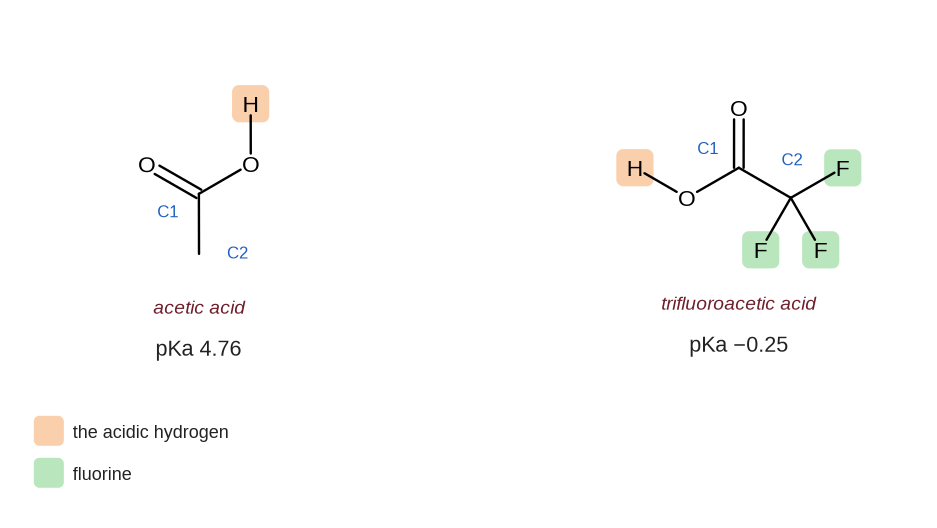
The usual explanation for a strong acid, resonance, does not help here. Both molecules are carboxylic acids, and both conjugate bases are carboxylates with the charge shared over two oxygens in exactly the same way. The fluorines are not part of any π system. Yet they matter, and they matter a lot. How does an atom reach through a carbon to change what happens at an oxygen?
Induction: electrons pulled through single bonds
Fluorine is the most electronegative element (3.98 on the Pauling scale; carbon 2.55). Each C2–F bond is polarised, with the electrons leaning towards fluorine and a slightly positive C2 left behind. That partly positive carbon pulls electrons from C1, and C1 in turn pulls them from the oxygens, as a row of people each tugging the next one's sleeve. The pull travels through the σ bonds, without any π bond or lone pair, and this is called the inductive effect.
Figure 2 shows the deprotonation of trifluoroacetic acid. The two arrows are exactly the same as for acetic acid: arrow 1, a lone pair of the oxygen of water forms a bond to the hydrogen; arrow 2, the O–H bond becomes a lone pair on the oxygen.
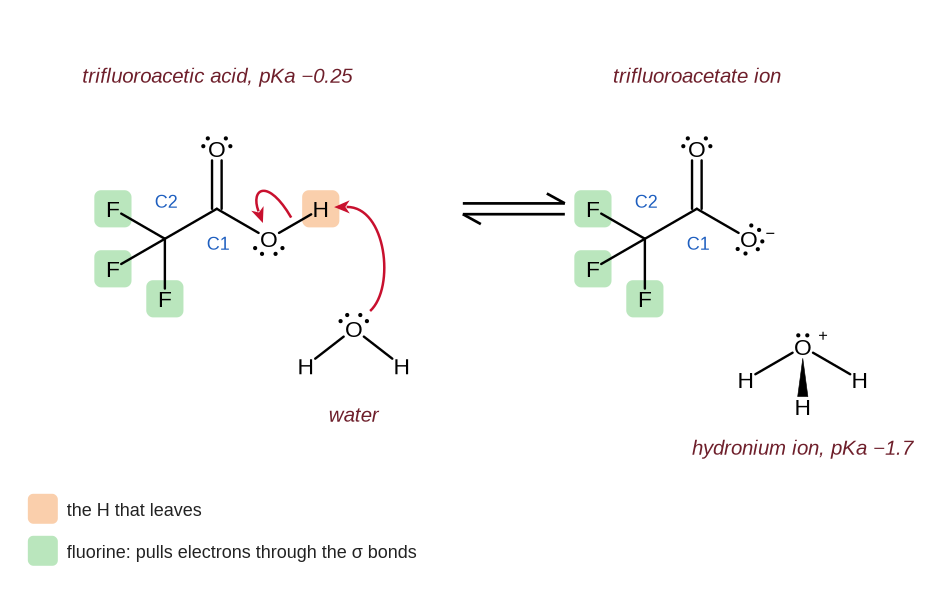
The mechanism is the same, so look at the product: the trifluoroacetate ion. Its oxygens carry a negative charge, and the three fluorines on C2 pull electron density away from that charge, through C1. A negative charge that is partly pulled away is less concentrated, so the ion is more stable, and the acid it came from is stronger. As always, a strong acid is one with a stable conjugate base.
Count the halogens: up the ladder
Figure 3 climbs the ladder one halogen at a time. Every atom of chlorine on C2 adds to the pull, and fluorine, which is more electronegative, pulls harder than chlorine.
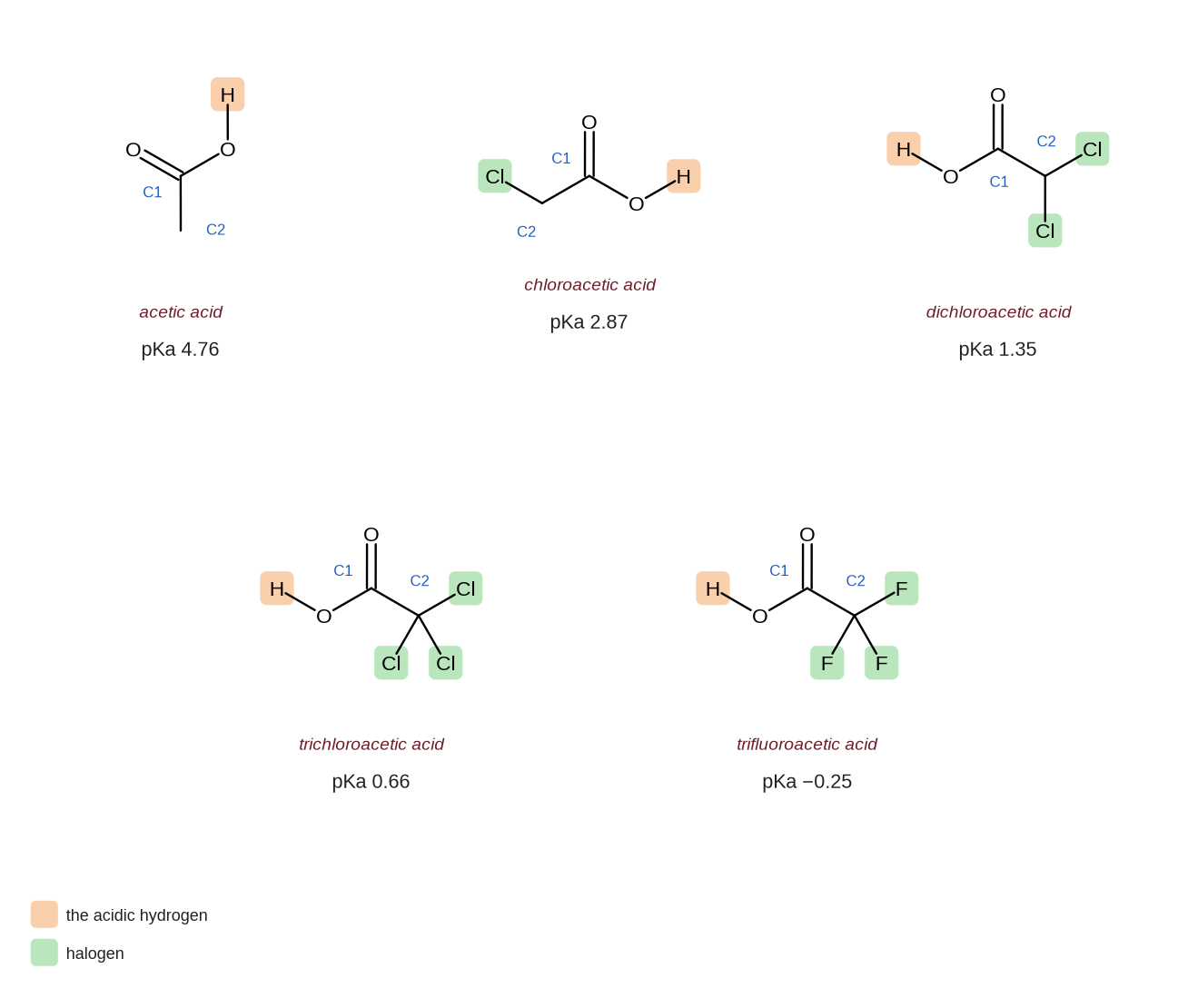
From 4.76 to 2.87 to 1.35 to 0.66: the first chlorine lowers the pKa by 1.9 units, the second by 1.5 and the third by 0.7. The effect is not exactly additive. Three fluorines (−0.25) beat three chlorines (0.66) by almost a full unit.
Move the halogen away: induction fades with distance
Does it matter where the chlorine sits? Figure 4 moves it along the chain of butanoic acid. C1 is the carboxyl carbon, so the chlorine sits on C2, C3 or C4, one, two or three carbons from it.
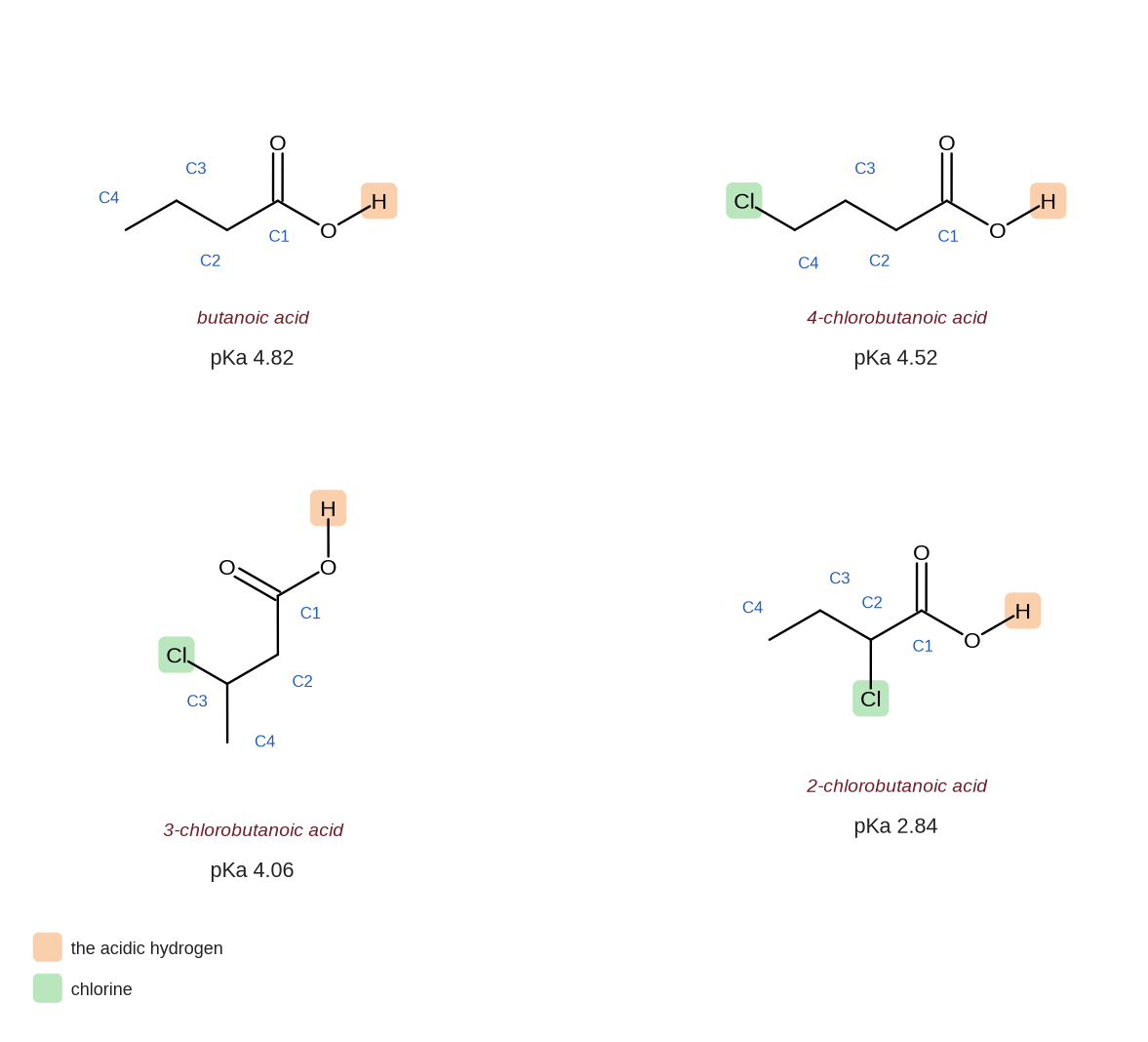
Compared with butanoic acid (4.82), a chlorine on C2 lowers the pKa by 2.0 units, on C3 by 0.8 and on C4 by only 0.3. Every extra carbon between the chlorine and the acid group cuts the effect by a factor of two to three, so after three or four bonds there is next to nothing left. Induction is a short-range effect.
Key idea. An electron-withdrawing group stabilises the negative charge of the conjugate base, and so strengthens the acid. The effect passes through σ bonds, gets weaker with every bond in between, and grows with the electronegativity and the number of the atoms doing the pulling.
The other direction, and how big it is
Groups that push electrons, like alkyl groups, work the other way and make the acid slightly weaker. Butanoic acid (4.82) has a pKa a little higher than acetic acid (4.76): a small effect, but in the direction the rule predicts.
Compare the sizes. Resonance is the main reason a carboxylic acid is about eleven pKa units, a factor of , stronger than an alcohol. Three fluorines made trifluoroacetic acid 5 units stronger, about 29 kJ/mol in free energy. Induction is real and useful, but it is the smaller of the two.
Watch out. Induction and resonance are not the same thing. Induction moves electron density through σ bonds and fades quickly. Resonance moves it through π bonds and lone pairs, and can act over a much longer stretch of molecule. When a question asks why one acid is stronger than another, ask first whether the charge can be delocalised (resonance), and then whether a nearby electronegative group can pull on it (induction).
More from Structure
What does a pKa tell you? Acid strength from one number
One small number says how hard an acid pushes its proton away, and with it you can tell which hydrogen in a molecule leaves first. Here is how to read it.
Which way does an acid–base reaction go? Predict it with pKa
Put phenol and pyridine in a flask and ask which way the proton moves. One subtraction of two pKa values gives the direction and how far it goes.
Why is acetic acid so much more acidic than ethanol?
Both lose a proton from an O–H bond, yet acetic acid is about a hundred billion times more acidic than ethanol. The reason is where the leftover charge can sit.
Why is HI a stronger acid than HF, though F is more electronegative?
Fluorine pulls electrons harder than iodine, so H–F should be the strongest of the hydrogen halides. It is the weakest. The trend turns around when you go down a group.